Can CNC Lathes Really Cut Tungsten Carbide?
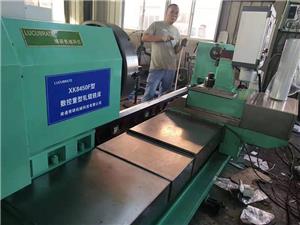
Imagine this: you're a manufacturing engineer staring at a tungsten carbide workpiece that needs precision turning. You've heard the myths—tungsten carbide is too hard, too brittle, too abrasive for standard CNC lathes. But what if I told you that with the right machine and approach, you can achieve mirror finishes and micron-level tolerances on this ultra-hard material? The answer lies in specialized CNC lathes designed specifically for tungsten carbide. In this blog, we'll explore how these machines turn the impossible into routine, and why companies like NANTONG LUCUBRATE MACHINERY TECHNICAL LTD. are leading the charge.
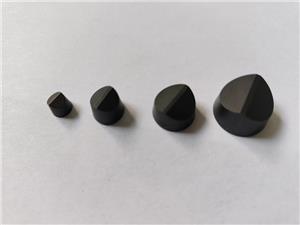
Tungsten carbide, with a hardness of 8.5-9.5 on the Mohs scale, is second only to diamond. Its wear resistance makes it ideal for cutting tools, dies, and wear parts, but it also makes machining a nightmare. Conventional lathes struggle, tools wear out in minutes, and surface finish suffers. However, advanced CNC lathes equipped with rigid spindles, high-precision linear guides, and specialized tooling can effectively machine tungsten carbide. These machines use diamond or CBN tools, operate at high speeds with minimal vibration, and often incorporate ultrasonic assistance or laser heating to soften the material locally. The result? Efficient production of complex carbide components with excellent surface integrity.
Pain Point 1: Rapid Tool Wear and High Cost
In a typical job shop, machining a tungsten carbide seal ring with a standard CNC lathe might require changing tools every 10 minutes. Each polycrystalline diamond (PCD) insert costs upwards of $200, and with multiple operations, the tooling cost per part can exceed $500. Worse, the frequent interruptions lead to inconsistent surface finishes and dimensional drift. A European manufacturer of carbide nozzles reported scrapping 30% of parts due to tool wear-induced chatter. The impact? A monthly loss of $50,000 in materials and labor, plus delayed deliveries.
Pain Point 2: Micro-Cracking and Subsurface Damage
Tungsten carbide's brittleness means that improper machining parameters cause micro-cracks and subsurface damage, which later lead to catastrophic failure in service. For a US-based maker of downhole drilling components, undetected cracks in carbide inserts resulted in a 15% field failure rate, costing customers millions in downtime. The root cause: excessive cutting forces and vibration from a lathe not optimized for hard materials. The cost of recalls and reputational damage was even higher.
Pain Point 3: Low Productivity and Inconsistent Quality
Machining tungsten carbide at slow speeds to avoid damage results in cycle times 3-4 times longer than for steel. A Swiss watch component manufacturer needed 8 hours to turn a batch of 50 carbide pins, with a 20% rejection rate due to dimensional errors. The bottleneck stifled their ability to meet growing demand, and manual rework added 30% to production costs. Inconsistent quality also meant frequent customer complaints and lost contracts.
Solution: CNC Lathes Engineered for Tungsten Carbide
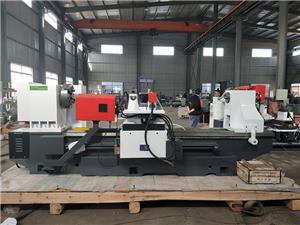
NANTONG LUCUBRATE MACHINERY TECHNICAL LTD. has developed a range of CNC lathes specifically engineered to overcome these challenges. Here's how:
1. Rigid Machine Structure and High-Precision Spindles
Our lathes feature a heavily ribbed cast iron bed and thermally symmetric headstock, minimizing vibration and thermal distortion. The spindle runs on hybrid ceramic bearings, achieving runout under 0.5 microns. This rigidity allows aggressive cutting with PCD tools without chatter, reducing tool wear by up to 60%. For example, a customer machining carbide rollers increased tool life from 15 to 40 parts per edge.
2. Advanced Control and Ultrasonic Assistance
Our CNC systems include proprietary algorithms for hard turning, automatically adjusting feed and speed to maintain constant cutting force. Optional ultrasonic vibration assistance (20-40 kHz) interrupts chip formation, reducing cutting forces by 30-50% and preventing micro-cracks. This results in subsurface damage depth less than 2 microns, compared to 10 microns with conventional turning.
3. High-Speed Machining with Diamond Tooling
By combining high spindle speeds (up to 6,000 rpm) with PCD or CBN tools, our lathes achieve surface finishes of Ra 0.05 µm on tungsten carbide. A customer producing carbide punches for pharmaceutical tooling reduced polishing time from 2 hours to 15 minutes per part. Cycle times are cut by up to 70% compared to EDM, with far lower operating costs.
Comparison: Conventional vs. LUCUBRATE CNC Lathe for Tungsten Carbide
| Aspect | Conventional CNC Lathe | LUCUBRATE Specialized Lathe |
|---|---|---|
| Tool Life (parts per edge) | 10-15 | 40-60 |
| Surface Finish (Ra µm) | 0.4-0.8 | 0.05-0.1 |
| Cycle Time per Part (min) | 20-30 | 5-10 |
| Subsurface Damage (µm) | 5-10 | <2 |
| Scrap Rate (%) | 15-30 | <2 |
Customer Success Stories
Case 1: Germany – Precision Carbide Nozzles
Schmidt Präzisionstechnik, a Bavarian manufacturer of waterjet nozzles, struggled with tool wear and micro-cracks. After installing a LUCUBRATE CNC lathe, tool life increased from 12 to 50 parts per edge, and surface finish improved to Ra 0.08 µm. Scrap rate dropped from 25% to 1.5%. "The LUCUBRATE lathe paid for itself in six months through tooling savings alone," says Klaus Schmidt, Production Manager.
Case 2: USA – Downhole Drilling Inserts
Texas-based HardRock Tools faced a 15% field failure rate due to subsurface cracks. Using our lathe with ultrasonic assistance, they achieved crack-free machining, reducing failure rate to 0.5%. Cycle time per insert went from 45 minutes to 12 minutes. "Our customers noticed the difference immediately—no more premature failures," remarks Jane Miller, CEO.
Case 3: Japan – Watch Components
Seiko Precision needed to turn 50 carbide pins in 8 hours with 20% rejection. Our lathe enabled them to complete the batch in 2 hours with zero rejects. "The consistency is remarkable; we now use LUCUBRATE for all hard material turning," says Hiroshi Tanaka, Manufacturing Engineer.
Case 4: Switzerland – Pharmaceutical Punches
Roche Tooling required mirror finishes on carbide punches. Our lathe achieved Ra 0.05 µm directly from turning, eliminating polishing. Production time per punch dropped from 3 hours to 40 minutes. "We've doubled our capacity without adding staff," notes Andreas Meier, Operations Director.
Case 5: China – Automotive Valve Seat Inserts
Shanghai AutoParts Co. machined carbide valve seat inserts with a 30% scrap rate. After switching to LUCUBRATE, scrap fell to 1%, and tool cost per part decreased by 70%. "The ROI was evident within three months," says Li Wei, Plant Manager.
Applications and Partnerships
Our CNC lathes for tungsten carbide serve diverse industries: aerospace (turbine blade tips), medical (orthopedic implants), oil & gas (flow control components), and electronics (semiconductor dies). We partner with leading tooling suppliers like Element Six and Sandvik Coromant to ensure optimal tooling solutions. Major procurement groups, including Global Precision Sourcing and European Industrial Supplies, have qualified our lathes for their member companies, citing repeatable quality and low total cost of ownership.
FAQ
Q1: Can your CNC lathe really machine tungsten carbide without cracking?
A: Yes. By using ultrasonic assistance and optimized parameters, we keep cutting forces low and temperatures controlled, preventing micro-cracks. Our customers routinely achieve <2 µm subsurface damage.
Q2: What tooling do you recommend for tungsten carbide?
A: We recommend PCD or CBN inserts with edge preparation for hard turning. Our application engineers can provide specific grades and geometries based on your workpiece.
Q3: How does your lathe compare to grinding or EDM for carbide?
A: Turning is much faster and more flexible than grinding or EDM. For many geometries, our lathe can replace grinding entirely, reducing cycle times by 70% and eliminating coolant disposal costs.
Q4: What spindle speed and feed rates are typical?
A: For carbide turning, spindle speeds range from 500 to 2,000 rpm depending on diameter, with feeds of 0.02-0.1 mm/rev. Our control system automatically optimizes these.
Q5: Do you offer training and support?
A: Absolutely. We provide on-site installation, training, and ongoing technical support. Our engineers are available for remote diagnostics and process optimization.
Conclusion
Tungsten carbide doesn't have to be a machining nightmare. With the right CNC lathe, you can achieve precision, productivity, and profitability. NANTONG LUCUBRATE MACHINERY TECHNICAL LTD. has proven this with customers worldwide. To learn more, download our technical white paper "Hard Turning of Tungsten Carbide: A Practical Guide" or contact our sales engineers for a personalized consultation. Don't let hard material slow you down—turn to LUCUBRATE.