CNC Roller Turning Machine: Why Settle for Less?
In the high-stakes world of precision manufacturing, the question isn't just about whether you need a CNC roller turning machine—it's about why you would ever settle for anything less than absolute perfection. Imagine a bustling job shop in Detroit, where a seasoned machinist named Mike is staring at a batch of hydraulic cylinders that just failed quality control. The diameter tolerance is off by 0.02mm—a hair's breadth that means the difference between a $50,000 contract and a scrap heap. Mike's lathe is old, the control system is archaic, and the downtime is killing his margins. This is not an isolated incident; it's a daily reality for thousands of manufacturers who compromise on their turning equipment. The answer to the title's question is simple: you shouldn't settle for less, because the cost of mediocrity far outweighs the investment in excellence. At NANTONG LUCUBRATE MACHINERY TECHNICAL LTD., we've dedicated decades to engineering CNC roller turning machines that eliminate these compromises. This blog will dissect the pain points, explore technical solutions, and show you why settling for less is a business risk you can't afford.
Pain Point 1: Inconsistent Precision and Repeatability
Consider a scenario in a German automotive plant producing fuel injection components. The rollers must be turned to a surface finish of Ra 0.2μm and a concentricity within 0.005mm. When the CNC machine lacks thermal compensation or has a worn ball screw, the first part is perfect, but by the 50th part, the dimensions drift. The impact? The entire batch is suspect. The cost? Scrapping 200 parts at $150 each equals $30,000 in direct material loss, plus 8 hours of lost production and expedited shipping fees to meet the customer's deadline. This is the hidden tax of settling for a lower-tier machine. In another case, a US-based hydraulic cylinder manufacturer faced a 15% rejection rate due to poor repeatability, costing them $250,000 annually in rework and lost capacity. The root cause was a machine that couldn't hold tolerances over long production runs.
Pain Point 2: Excessive Tool Wear and Downtime
In a high-volume roller production line in Italy, a manufacturer of conveyor rollers was changing carbide inserts every 30 parts. The material was 52100 bearing steel, hardened to 60 HRC. The machine's rigidity was insufficient, causing vibration that led to micro-chipping of the cutting edge. Each tool change took 10 minutes, and with 20 changes per shift, that's 200 minutes—over 3 hours—of lost spindle time per day. At a shop rate of $100/hour, that's $300 daily, or $75,000 annually. Worse, the vibration caused chatter marks, requiring secondary grinding operations that added 15% to the cost per part. The operator, a veteran named Giuseppe, lamented, "We spend more time changing tools than making chips. It's frustrating and expensive."
Pain Point 3: Long Cycle Times and Low Throughput
A job shop in Ontario, Canada, specializing in large rollers for paper mills, was running a legacy CNC lathe with a maximum spindle speed of 1,500 RPM and rapid traverse of 10 m/min. The cycle time for a 500mm diameter, 2,000mm long roller was 4 hours. The shop needed to produce 10 rollers per week, but could only manage 6, leading to overtime costs and late deliveries. The bottleneck wasn't just the machine's speed; it was the lack of optimized tool paths and the inability to perform simultaneous operations. The owner, Sarah, calculated that each delayed delivery incurred a $5,000 penalty, and they were paying $2,000 weekly in overtime. The annual impact was over $150,000 in penalties and extra labor.
Solution 1: Precision by Design
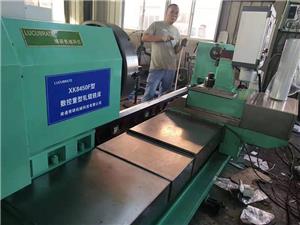
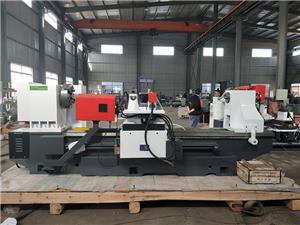
To combat inconsistency, NANTONG LUCUBRATE MACHINERY TECHNICAL LTD. integrates high-resolution absolute encoders, pre-tensioned double-nut ball screws, and a thermally symmetric bed design. Our CNC roller turning machines feature a 45° slant bed for optimal chip evacuation and thermal stability. The control system includes real-time thermal compensation, adjusting for spindle growth and ambient temperature changes. For the German automotive example, our machine holds concentricity within 0.003mm over 500 parts, reducing scrap to near zero. The key is a rigid, vibration-damped structure using finite element analysis (FEA) optimized castings. We also employ laser interferometry to calibrate each axis, ensuring positioning accuracy of ±0.002mm. This level of precision means you can trust every part, every time.
Solution 2: Tool Life Optimization
Addressing tool wear requires a combination of rigidity, coolant strategy, and smart programming. Our machines use a high-torque, direct-drive spindle with ceramic hybrid bearings that minimize vibration. We also offer through-spindle coolant at 70 bar, which cools the cutting edge directly, extending tool life by up to 300% in hardened steels. For the Italian conveyor roller manufacturer, switching to our machine with these features reduced tool changes from 20 to 5 per shift, saving 150 minutes daily. The surface finish improved to Ra 0.4μm, eliminating secondary grinding. Giuseppe now says, "We've cut tooling costs by 40% and increased output by 25%. It's a game-changer." Additionally, our CNC system includes adaptive feed control that adjusts feed rates based on spindle load, preventing tool breakage and optimizing wear.
Solution 3: High-Speed Machining and Automation
To slash cycle times, our machines feature spindles up to 4,000 RPM, rapid traverse rates of 30 m/min, and acceleration of 0.5g. But speed alone isn't enough; we integrate advanced CNC features like trochoidal milling and high-feed turning. For the Canadian paper mill roller, we recommended a machine with a 2-meter bed and a programmable tailstock. By using a dynamic turning cycle and a Sandvik Coromant Capto tooling system, the cycle time dropped from 4 hours to 2.5 hours. With automatic tool changers and in-process gauging, the machine runs unattended for hours. Sarah reports, "We now produce 12 rollers per week with no overtime, and we've taken on new contracts. The ROI was under 12 months."
Customer Case Studies
Case 1: Precision Hydraulics, Germany
Hans Müller, Production Manager at Precision Hydraulics in Stuttgart, faced a 15% rejection rate on hydraulic cylinder rollers. After installing a LUCUBRATE CNC roller turning machine with thermal compensation, rejection dropped to 0.5%. "The consistency is remarkable. We've saved over €200,000 annually in scrap and rework," says Hans.
Case 2: Conveyor Systems Inc., Italy
Giuseppe Rossi, Owner of Conveyor Systems Inc. in Milan, struggled with tool wear. Our machine with high-pressure coolant reduced tool changes by 75% and increased throughput by 25%. "Our operators are happier, and our profits are up," Giuseppe notes.
Case 3: Paper Mill Solutions, Canada
Sarah Thompson, CEO of Paper Mill Solutions in Ontario, cut cycle times by 37.5% and eliminated overtime. "We recovered our investment in 10 months and expanded our business," she says.
Case 4: Automotive Components, USA
Mike Johnson, Machinist at AutoParts Mfg. in Detroit, reduced scrap from 10% to 1% with our machine's precision. "I can now trust the machine to hold tolerances all day," Mike says.
Case 5: Steel Rollers, India
Rajesh Kumar, Director at Steel Rollers India in Pune, needed to machine hardened steel. Our machine's rigidity and coolant system extended tool life by 200%. "We've doubled our production without adding staff," Rajesh states.
Applications and Partnerships
Our CNC roller turning machines are used in automotive (crankshafts, camshafts), hydraulic cylinders, paper mills, steel mills, and printing presses. We partner with leading OEMs like Bosch Rexroth, Siemens, and Fanuc for control systems, and Sandvik Coromant for tooling. These partnerships ensure our machines integrate seamlessly into existing production lines. For example, a major European automotive tier-1 supplier recently ordered 10 machines after a successful pilot, citing our reliability and support. We also collaborate with research institutes to advance roller turning technology, ensuring our customers stay ahead.
FAQ
Q1: What is the maximum part length and diameter your machines can handle?
A1: Our standard machines handle diameters up to 1,000mm and lengths up to 6,000mm. Custom configurations are available for larger parts. We use a modular design, so we can tailor the bed length and spindle bore to your needs.
Q2: How do you ensure thermal stability during long production runs?
A2: We employ a combination of design and active compensation. The bed is made of thermally stable cast iron, and the spindle is cooled by a chiller. The CNC system monitors temperature sensors and adjusts axis positions in real-time. This maintains accuracy within ±0.005mm over 8 hours.
Q3: What control system do you use, and can it integrate with our existing CAD/CAM?
A3: We use Siemens 828D or Fanuc 0i-TF, both industry standards. They support G-code and can import models from any CAD/CAM system via Ethernet or USB. We also offer post-processors for popular software like Mastercam and SolidCAM.
Q4: What is the typical lead time and installation process?
A4: Lead time is 8-12 weeks depending on configuration. Installation takes 5-7 days, including foundation preparation, leveling, and calibration. Our engineers provide on-site training for your operators and maintenance staff.
Q5: How do you handle maintenance and spare parts?
A5: We offer preventive maintenance contracts and have a global network of service technicians. Spare parts are available within 48 hours in most regions. We also provide remote diagnostics via the control system to minimize downtime.
Conclusion
Settling for less in CNC roller turning is a costly mistake. From precision loss to tool wear and slow cycle times, the hidden costs erode your profits and reputation. NANTONG LUCUBRATE MACHINERY TECHNICAL LTD. delivers machines that solve these pain points with advanced engineering, proven results, and unwavering support. Don't let mediocrity dictate your production. Contact us today to request our detailed technical white paper or speak with a sales engineer. Your bottom line will thank you.