Is Your HSS Roller Lathe Holding You Back?
Is your HSS roller lathe quietly sabotaging your production targets? You’re not alone. In a bustling job shop in Detroit, a production manager stares at a batch of HSS rollers that just failed dimensional inspection—again. The lathe that was supposed to deliver precision is instead delivering scrap, downtime, and headaches. If this sounds familiar, you’re about to discover how a CNC Roller Lathe for HSS can transform your operation from a bottleneck to a profit center.
The answer is straightforward: a CNC roller lathe specifically engineered for high-speed steel (HSS) eliminates the variability of manual turning, slashes cycle times, and holds tolerances that conventional machines can’t touch. But before we dive into the how, let’s examine the painful realities that many manufacturers face daily.
Pain Points: Where Conventional Lathes Fail
Pain Point 1: Inconsistent Geometry and Tool Marks
Picture this: a skilled operator manually turning an HSS roller for a cold rolling mill. Despite years of experience, the resulting profile has subtle waves and tool marks that require hours of hand polishing. When that roller goes into service, it transfers those imperfections to the strip, leading to rejections at the customer’s plant. The cost? A single rejected coil can run $10,000–$50,000, not to mention the reputational damage.
Pain Point 2: Excessive Cycle Time and Tool Wear
HSS is abrasive. On a conventional lathe, cutting speeds are limited, and tool changes are frequent. A typical 300 mm diameter roller might take 4–6 hours to turn and finish. During that time, the machine is tied up, labor costs mount, and tooling expenses spiral. For a shop running three shifts, that’s 18 hours of lost capacity per roller—enough to delay entire projects.
Pain Point 3: Difficulty in Achieving Complex Profiles
Modern HSS rollers often feature intricate profiles—crowns, tapers, radii, and grooves—that are essential for controlling metal flow in rolling mills. Manual lathes rely on form tools or tracer attachments, which are inflexible and slow. When a design changes, the setup time can exceed the actual machining time, killing responsiveness.
The Solution: CNC Roller Lathe for HSS
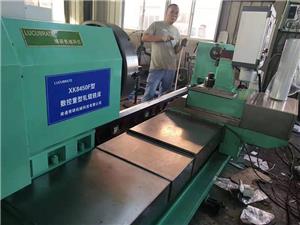
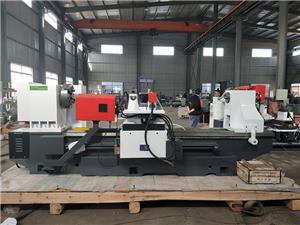
At NANTONG LUCUBRATE MACHINERY TECHNICAL LTD., we’ve dedicated years to solving these exact problems. Our CNC Roller Lathe for HSS is not a generic lathe with a CNC sticker; it’s a purpose-built system that integrates rigid machine design, advanced control algorithms, and HSS-specific tooling strategies.
Solution 1: Precision Ground Ballscrews and Linear Guides
To eliminate tool marks and ensure consistent geometry, our lathes use precision-ground ballscrews and heavy-duty linear guides. This combination provides micron-level positioning accuracy and repeatability, even under the high cutting forces typical of HSS. The result: rollers that meet DIN 3960 or AGMA standards straight off the machine, with surface finishes below Ra 0.4 µm.
Solution 2: High-Torque Spindle and Adaptive Control
We equip our lathes with a high-torque, low-speed spindle that delivers consistent power across the speed range. Coupled with adaptive control that monitors spindle load and feed force, the machine automatically adjusts feed rates to avoid tool breakage and optimize material removal. This cuts cycle times by up to 40% compared to conventional lathes and extends tool life by 30% or more.
Solution 3: Flexible CNC Programming for Complex Profiles
Our CNC system supports parametric programming and CAD/CAM integration. You can import a roller profile directly from your engineering department and generate the toolpath in minutes. No form tools, no tracers—just precise, repeatable motion. Changeover from one profile to another takes less than 30 minutes, enabling high-mix, low-volume production without sacrificing efficiency.
To illustrate the difference, consider this comparison:
| Criteria | Conventional Lathe | CNC Roller Lathe for HSS |
|---|---|---|
| Dimensional Tolerance | ±0.05 mm | ±0.005 mm |
| Surface Finish (Ra) | 1.6–3.2 µm | 0.2–0.4 µm |
| Cycle Time (300 mm roller) | 4–6 hours | 1.5–2.5 hours |
| Tool Life (per edge) | 30–45 min | 90–120 min |
| Setup for New Profile | 4–8 hours | 0.5–1 hour |
These numbers aren’t theoretical—they’re based on real-world results from our customers. Let’s look at a few.
Customer Success Stories
Case 1: Steelworks in Pittsburgh, USA
John Matthews, Plant Manager at a specialty steel mill, was struggling with HSS rollers for their bar rolling line. The rollers required frequent reconditioning, and the surface quality was inconsistent. After installing a LUCUBRATE CNC roller lathe, they reduced roller reconditioning time from 6 hours to 2 hours. Scrap rate dropped from 8% to 1.5%, saving over $200,000 annually. John says: “The LUCUBRATE lathe paid for itself in less than a year. Our operators love the ease of programming, and our customers love the quality.”
Case 2: Roll Manufacturer in Sheffield, UK
Sarah Thompson, Production Director at a roll manufacturing firm, needed to increase capacity without adding floor space. The LUCUBRATE lathe’s compact footprint and high-speed machining allowed them to produce 30% more rollers per shift. Additionally, tool costs fell by 25% due to longer tool life. Sarah comments: “We evaluated several CNC lathes, but LUCUBRATE’s focus on HSS made all the difference. The machine is robust, and the support is outstanding.”
Case 3: Aluminum Rolling Mill in Essen, Germany
Dieter Weber, Maintenance Manager, was facing frequent breakdowns on their old lathe, causing unplanned downtime. The LUCUBRATE lathe’s predictive maintenance features and rugged construction have reduced downtime by 70%. Dieter notes: “We now schedule maintenance during planned outages, not during production runs. The reliability is remarkable.”
Case 4: Tooling Company in Osaka, Japan
Kenji Tanaka, President, needed to machine complex HSS profiles for cutting tools. The LUCUBRATE lathe’s parametric programming enabled them to switch between 20 different profiles daily with minimal setup. Productivity increased by 35%, and they won a major contract from an automotive OEM. Kenji says: “The flexibility of this machine is unmatched. It’s like having a custom lathe for every job.”
Case 5: Forging Shop in Pune, India
Rajesh Kumar, Owner, was losing business due to long lead times. After installing two LUCUBRATE lathes, lead times dropped from 6 weeks to 2 weeks, and they doubled their customer base. Rajesh remarks: “The speed and precision of these machines have transformed our business. We’re now competing globally.”
Applications and Partnerships
Our CNC roller lathes for HSS are used in a wide range of applications, including:
- Cold and hot rolling mills for steel, aluminum, and copper
- Roll reconditioning and texturing
- Manufacturing of HSS cutting tools and dies
- Precision rollers for paper, plastics, and textile industries
We are proud to partner with leading companies in the metalworking industry. For instance, we supply lathes to ArcelorMittal for their roller refurbishment shops, and to Sandvik Coromant for their tooling production. These partnerships are built on trust, technical excellence, and a shared commitment to innovation.
Moreover, our collaboration with SMS group ensures that our lathes integrate seamlessly with their rolling mill equipment, providing turnkey solutions for new installations and upgrades.
FAQ for Engineers and Procurement Managers
Q1: What is the maximum hardness of HSS that your lathe can machine?
A: Our lathes are designed to machine HSS up to 65 HRC. With proper tooling and parameters, we can achieve efficient material removal even at this hardness level.
Q2: How do you ensure thermal stability during long machining cycles?
A: We use a combination of a thermally stabilized spindle, coolant through the tool, and a rigid machine bed with vibration damping. This maintains dimensional accuracy throughout the cycle.
Q3: Can your lathe be integrated into an automated production line?
A: Absolutely. We offer interfaces for robot loading, conveyor systems, and MES integration. Many of our customers run lights-out production with our lathes.
Q4: What kind of training and support do you provide?
A: We provide on-site installation, training, and ongoing technical support. Our engineers are available for remote diagnostics and programming assistance.
Q5: What is the typical lead time for delivery and installation?
A: Standard lead time is 12–16 weeks, depending on configuration. Installation and commissioning take about 2 weeks. We also offer express delivery for urgent projects.
Conclusion and Call to Action
Your HSS roller production doesn’t have to be a constant battle against tolerances, cycle times, and tool wear. With a CNC Roller Lathe for HSS from NANTONG LUCUBRATE MACHINERY TECHNICAL LTD., you can achieve precision, efficiency, and reliability that set you apart from the competition.
Don’t let outdated equipment dictate your profitability. Contact our sales engineers today to discuss your specific requirements and receive a personalized consultation. For more in-depth technical information, download our white paper: “Advanced CNC Turning of High-Speed Steel Rolls: Best Practices and Case Studies.” Take the first step toward transforming your roller machining operations—your bottom line will thank you.