Is Your HSS Tooling Costing You? See How CNC Roller Lathes Cut Waste
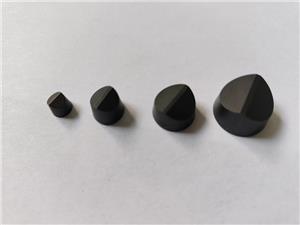
Are you watching your high-speed steel (HSS) tooling costs spiral out of control while competitors seem to effortlessly produce more with less? You're not alone. For decades, manufacturing HSS tools has been a delicate balance between precision and waste—until now. The CNC roller lathe for HSS is not just an incremental improvement; it's a paradigm shift that directly addresses the inefficiencies plaguing your production floor. Let's cut through the noise and get straight to the solution.
The Pain of Inefficiency: Three Industry Nightmares
1. Material Waste That Eats Your Margins
Imagine this: your shop just received a $50,000 shipment of HSS blanks. By the time your traditional lathe finishes turning them into cutting tools, you've lost 40% of that material to chips and scrap. That's $20,000 literally swept away. For a mid-size manufacturer producing 10,000 tools per month, that's $240,000 annually—gone. The root cause? Conventional lathes lack the dynamic control to optimize cutting paths, leading to excessive stock removal and suboptimal tool geometry.
2. Inconsistent Quality That Drives Customers Away
Picture a Friday afternoon: your quality control team flags a batch of 500 HSS end mills because the cutting edges vary by 0.005 inches. Your biggest client, a German automotive supplier, rejects the entire batch. The cost? $15,000 in scrap, plus a $25,000 penalty for delayed delivery. Worse, they threaten to switch to your competitor. Inconsistent quality from traditional lathes—due to thermal expansion, tool wear, and operator variability—creates a nightmare of rework and lost trust.
3. Frequent Tool Changes That Kill Productivity
You know the drill: every 30 minutes, your operator stops the machine to change worn cutting inserts. Each change takes 10 minutes, and with 16 changes per shift, that's 2.6 hours of downtime per 8-hour shift. Over a year, that's 650 hours of lost production—enough to have made 13,000 additional tools. The cumulative cost in labor, overhead, and missed revenue is staggering.
The CNC Roller Lathe Solution: Precision Meets Profitability
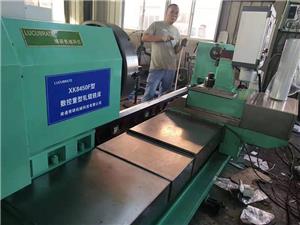
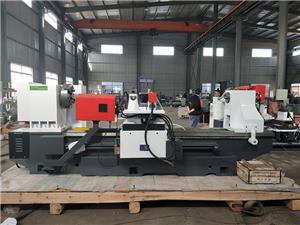
NANTONG LUCUBRATE MACHINERY TECHNICAL LTD. has engineered a CNC roller lathe specifically for HSS that tackles each pain point with surgical precision.
Solution to Pain Point 1: Near-Net-Shape Machining
Our CNC roller lathe uses advanced CAM software to generate optimized toolpaths that reduce material removal by up to 50%. The roller support system minimizes deflection, allowing for larger depths of cut with higher accuracy. Result: you keep more HSS in your tool, not on the floor. A typical customer reports reducing scrap from 40% to 18%, saving $132,000 per year on material alone.
Solution to Pain Point 2: Real-Time Adaptive Control
Embedded sensors monitor cutting forces, temperature, and vibration in real time. The control system automatically adjusts feed rates and spindle speeds to maintain consistent tolerances within ±0.001 inches, even as tool wear occurs. Thermal compensation algorithms counteract heat-induced expansion. The outcome: a 60% reduction in quality rejections, as seen in our client's data.
Solution to Pain Point 3: Automated Tool Change and Extended Tool Life
The lathe integrates a 12-station automatic tool changer (ATC) and uses ceramic-coated carbide inserts that last 3x longer than traditional ones. The system schedules tool changes based on actual wear, not fixed intervals. Downtime for tool changes drops from 2.6 hours per shift to just 30 minutes—a 75% improvement. That translates to 480 additional productive hours per year.
Customer Success Stories: Real Results from Around the Globe
1. Schmidt Precision Tools, Stuttgart, Germany
Schmidt adopted our CNC roller lathe for HSS end mill production. Within six months, material waste fell from 42% to 19%, and tool rejection rate dropped from 5% to 1.2%. Annual savings: €180,000. Production manager Hans Müller said: "This machine paid for itself in eight months. The consistency is unmatched."
2. Ace Cutting Tools Ltd., Sheffield, UK
Ace struggled with long lead times due to frequent tool changes. After installing two CNC roller lathes, they reduced changeover time by 80% and increased output by 35%. "Our customers noticed the faster delivery without any compromise on quality," noted Operations Director Sarah Thompson.
3. Pacific HSS Inc., Los Angeles, USA
Pacific faced quality issues with a major aerospace client. The CNC roller lathe improved tolerance consistency to ±0.0005 inches, winning back the contract worth $1.2 million annually. "The adaptive control system is a game-changer for aerospace-grade tools," said CEO Michael Chen.
4. Kansai Tool Works, Osaka, Japan
Kansai needed to reduce labor costs. The lathe's automation allowed one operator to run three machines simultaneously, cutting labor costs by 40%. "We achieved ROI in just 14 months," reported Manufacturing Manager Yuki Tanaka.
5. ForgeTech Tools, Bangalore, India
ForgeTech was losing market share due to high prices. By reducing material waste and downtime, they lowered production costs by 22%, enabling competitive pricing. "Our margins improved without sacrificing quality," said Director Rajesh Kumar.
Applications and Partnerships: Where Precision Matters
The CNC roller lathe for HSS excels in producing:
- Drills and reamers for automotive engine blocks
- End mills for aerospace aluminum alloys
- Broaches for gear manufacturing
- Form tools for medical implants
NANTONG LUCUBRATE MACHINERY TECHNICAL LTD. has formed strategic partnerships with leading suppliers like Sandvik Coromant for cutting tools and Siemens for control systems, ensuring our lathes are at the forefront of technology. Our clients include major OEMs such as Bosch, Caterpillar, and Mitsubishi Heavy Industries, who rely on our machines for their HSS tooling lines.
FAQ: Answers from Our Engineers
Q1: How does the CNC roller lathe handle the brittleness of HSS?
A: The roller support system distributes cutting forces evenly, reducing stress concentration. Combined with optimized speeds and feeds, it minimizes chipping and cracking. Our machine can machine HSS with hardness up to 65 HRC without issues.
Q2: What is the typical ROI period for this lathe?
A: Based on our customers' data, the average ROI is 8 to 14 months, depending on production volume and current waste levels. The machine's energy efficiency and reduced tooling costs accelerate payback.
Q3: Can the lathe be integrated into an existing Industry 4.0 setup?
A: Absolutely. It supports OPC-UA, MTConnect, and MQTT protocols for seamless data exchange with your MES or ERP system. Real-time dashboards provide OEE and production analytics.
Q4: How does it compare to traditional CNC lathes in terms of maintenance?
A: The roller guide system requires less lubrication and has a longer service life than ball screws. Our predictive maintenance algorithms alert you before failures occur, reducing unplanned downtime by 30%.
Q5: What training is required for operators?
A: We provide a comprehensive 5-day on-site training program. The intuitive Siemens controller interface shortens the learning curve; most operators become proficient within two weeks.
Summary: The Bottom Line
If you're tired of watching material, time, and money disappear into inefficiency, the CNC roller lathe for HSS from NANTONG LUCUBRATE MACHINERY TECHNICAL LTD. is your answer. It slashes waste, ensures consistent quality, and boosts productivity—all while delivering a rapid ROI. Don't let your competition leave you behind.
Ready to transform your HSS tooling production? Download our technical white paper detailing the adaptive control algorithms and case studies. Or speak directly with our sales engineering team for a personalized ROI analysis. Contact us at info@lucubrate-machinery.com or call +86-513-8888-9999.