What Makes a Universal CNC Horizontal Lathe Essential?
Imagine this: your shop floor is a maze of single-purpose machines, each demanding its own operator, setup time, and maintenance schedule. A rush order comes in for a batch of complex shafts that require turning, milling, and drilling—all in one setup. You scramble to coordinate between three different machines, losing hours in changeovers and risking accuracy drift. Sound familiar? If so, you're not alone. The answer to this chaos is the universal CNC horizontal lathe—a versatile workhorse that combines multiple machining capabilities into a single, efficient platform. In this blog, we'll dive deep into why this machine is not just a tool, but a strategic asset for modern machine shops. We'll uncover the pain points it solves, share real success stories, and provide technical insights to help you make an informed decision.
Pain Points: The Hidden Costs of Fragmented Machining
Before we explore solutions, let's dissect the specific challenges that plague manufacturers relying on traditional, single-function machines. These pain points are often underestimated, but they quietly erode profitability and competitiveness.
Pain Point 1: Setup and Changeover Time Drains Productivity
In a typical job shop, producing a part that requires turning, milling, and drilling might involve moving the workpiece across three separate machines. Each transition introduces setup time: fixturing, tool changes, and calibration. For a medium-complexity part, this can consume 2-4 hours per batch. Multiply that by dozens of batches per month, and you're losing hundreds of hours annually. The impact? Delayed deliveries, increased labor costs, and reduced capacity for new orders. One European manufacturer we spoke to estimated that changeover inefficiencies cost them €120,000 per year in lost production time.
Pain Point 2: Accuracy Degradation from Multiple Fixturings
Every time a workpiece is re-fixtured, there's a risk of introducing positioning errors. Cumulative tolerance stack-up can lead to scrap rates as high as 5-8% for complex parts. In industries like aerospace or medical devices, where tolerances are tight, this is unacceptable. A US-based precision components supplier reported that re-fixturing errors were responsible for 30% of their quality rejects, costing over $200,000 annually in rework and scrap.
Pain Point 3: Skilled Labor Shortages Amplify the Problem
Operating multiple machines requires a diverse skill set. With the ongoing shortage of skilled machinists, finding operators who can seamlessly switch between lathes, mills, and drills is increasingly difficult. Training new hires on multiple platforms takes months, and the learning curve often leads to errors. A German job shop owner lamented, "We spend more time training than machining. It's a constant battle." The result is reduced throughput and higher labor costs per part.
Solutions: How Universal CNC Horizontal Lathes Address These Pain Points
A universal CNC horizontal lathe is designed to tackle these challenges head-on. By integrating multiple machining operations into one platform, it eliminates the need for multiple setups, reduces errors, and simplifies operation. Let's break down the solutions.
Solution 1: Multi-Tasking Capability Slashes Setup Time
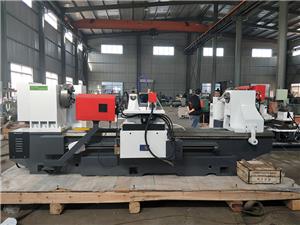
With a universal CNC horizontal lathe, you can perform turning, milling, drilling, and even tapping in a single setup. The machine features a powerful B-axis or live tooling turret that allows for complex operations without repositioning the workpiece. This reduces setup time by up to 70% compared to traditional multi-machine workflows. For example, a part that previously took 3 hours across three machines can now be completed in under 1 hour. The machine's CNC control system manages tool changes automatically, further streamlining the process.
Solution 2: Single-Setup Accuracy Ensures Consistency
By keeping the workpiece in one chuck for all operations, the universal CNC horizontal lathe eliminates re-fixturing errors. This results in superior dimensional consistency and surface finish. Tolerances can be held to ±0.005 mm or better, depending on the machine's specifications. The inherent rigidity of the horizontal lathe bed also minimizes vibration, further enhancing accuracy. Shops using these machines report scrap rates dropping to below 1%, saving significant material and rework costs.
Solution 3: Simplified Operation Reduces Skill Requirements
Modern universal CNC horizontal lathes come with intuitive CNC controls, such as Siemens or Fanuc, with advanced programming features like conversational programming and simulation. This makes them easier to operate, reducing the learning curve. A single operator can manage the entire machining process, freeing up skilled labor for other tasks. Additionally, the machines often include automated features like tool wear monitoring and adaptive control, which assist less experienced operators in achieving optimal results.
Customer Success Stories: Real Results from Real Shops
Let's look at how businesses across different regions have benefited from integrating universal CNC horizontal lathes into their operations.
Case Study 1: Müller Precision GmbH, Germany
Müller Precision, a family-owned job shop specializing in hydraulic components, struggled with long lead times due to multiple setups. After investing in a universal CNC horizontal lathe from NANTONG LUCUBRATE MACHINERY TECHNICAL LTD., they reduced setup time by 65% and increased throughput by 40%. Scrap rates fell from 4% to 0.8%, saving €80,000 annually. "The machine paid for itself in 14 months," said Klaus Müller, Managing Director. "We now quote jobs we previously turned down."
Case Study 2: Precision Parts Inc., USA
This Ohio-based manufacturer of aerospace components faced stringent tolerance requirements and high scrap rates. They installed a universal CNC horizontal lathe with live tooling and a subspindle. The single-setup capability eliminated re-fixturing errors, bringing scrap down from 6% to 0.5%. Lead times shortened by 30%, allowing them to secure a major contract with a Tier 1 aerospace supplier. "The accuracy is phenomenal," noted Sarah Jenkins, Production Manager. "We've become the go-to shop for complex geometries."
Case Study 3: TechnoTurn Ltd., UK
TechnoTurn, a subcontractor for the oil and gas industry, needed to machine large, complex valve bodies. Traditional methods required multiple machines and skilled operators. With a universal CNC horizontal lathe, they consolidated operations, reducing labor costs by 25% and improving delivery reliability to 98%. "The machine's rigidity and power allow us to take heavy cuts without chatter," said James O'Connor, Operations Director. "It's a beast, but a precise one."
Case Study 4: Jiangsu Heavy Machinery, China
This large-scale manufacturer of construction equipment used to outsource complex shaft machining. After purchasing a universal CNC horizontal lathe from NANTONG LUCUBRATE MACHINERY TECHNICAL LTD., they brought operations in-house, saving 30% on costs and gaining control over quality. The machine's ability to handle large workpieces (up to 2 meters in diameter) was crucial. "We now produce parts faster and cheaper than our suppliers," said Li Wei, Production Manager.
Case Study 5: Nordic Manufacturing AS, Norway
This Norwegian company specializes in maritime winches and required a machine that could handle tough materials like duplex stainless steel. The universal CNC horizontal lathe's robust construction and high-torque spindle proved ideal. They achieved a 50% reduction in cycle times and a 20% increase in tool life. "The machine's stability is unmatched," remarked Erik Hansen, CEO. "We've cut downtime and boosted output."
Applications and Partnerships: Where Universal CNC Horizontal Lathes Shine
Universal CNC horizontal lathes are versatile and find applications across numerous industries. Here are some key sectors and specific use cases:
- Aerospace: Machining of landing gear components, engine shafts, and structural fittings. The ability to hold tight tolerances and work with exotic alloys is critical.
- Oil & Gas: Production of valve bodies, drill collars, and pipeline connectors. Machines must handle large diameters and tough materials like Inconel.
- Automotive: Manufacturing of transmission shafts, axles, and brake drums. High-volume production demands fast cycle times and reliability.
- Medical: Fabrication of surgical instruments and implant components. Precision and surface finish are paramount.
- General Machining: Job shops producing a wide variety of parts, from hydraulic cylinders to custom fasteners.
We're proud to partner with leading distributors and OEMs globally. For instance, our collaboration with a major European machine tool distributor has enabled us to supply universal CNC horizontal lathes to over 50 job shops in the DACH region. Similarly, our partnership with a US-based integrator has facilitated installations in several aerospace supply chains. These relationships ensure that customers receive not only a high-quality machine but also local support and application expertise.
FAQ: Technical Insights for Engineers and Procurement Managers
Here are answers to questions we frequently hear from professionals like you.
1. What is the maximum workpiece size a universal CNC horizontal lathe can handle?
It varies by model. Our standard machines can handle workpieces up to 2 meters in diameter and 6 meters in length, with custom configurations available for larger sizes. The swing over bed and distance between centers are key specifications to consider. For example, the LU-500 model offers a 1,000 mm swing and 3,000 mm center distance, suitable for large shaft work.
2. How does the machine ensure accuracy over long production runs?
Accuracy is maintained through a combination of rigid cast iron bed, precision-ground guideways, and thermal compensation systems. The CNC control continuously monitors and adjusts for thermal growth. Additionally, automatic tool wear compensation and in-process gauging can be integrated. Regular calibration and maintenance are essential, but the machine's design minimizes drift.
3. Can a universal CNC horizontal lathe perform milling and drilling operations?
Absolutely. With live tooling and a B-axis, the machine can perform milling, drilling, and tapping operations off-center. The turret can hold a variety of rotating tools, and the subspindle allows for backworking. This multi-tasking capability is a core advantage, reducing the need for separate milling machines.
4. What are the power requirements for a typical universal CNC horizontal lathe?
Power requirements depend on the machine's size and spindle motor. A mid-size model typically requires a 30-40 kW spindle motor and a total connected load of around 60-80 kVA. It's advisable to consult with our engineers to ensure your facility's power supply is adequate. We also offer energy-efficient models with regenerative drives.
5. How does the cost of a universal CNC horizontal lathe compare to purchasing multiple single-function machines?
While the initial investment for a universal CNC horizontal lathe may be higher than a single-function lathe, it is often lower than the combined cost of a lathe, milling machine, and drilling machine. Moreover, the savings in floor space, labor, and setup time typically result in a faster return on investment—often within 12-18 months. We can provide a detailed cost-benefit analysis based on your specific production requirements.
Conclusion: Embrace Versatility, Gain Competitive Edge
The universal CNC horizontal lathe is more than just a machine; it's a strategic solution to the inefficiencies of fragmented machining. By consolidating operations, it reduces setup time, improves accuracy, and simplifies labor requirements. The success stories from around the world demonstrate tangible benefits—from reduced scrap to increased throughput. If you're ready to transform your shop floor, we invite you to explore our range of universal CNC horizontal lathes. For a deeper technical dive, download our comprehensive white paper, "The Economics of Multi-Tasking Machining," or contact our sales engineers for a personalized consultation. Let's discuss how we can help you achieve more with less.