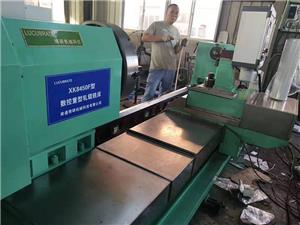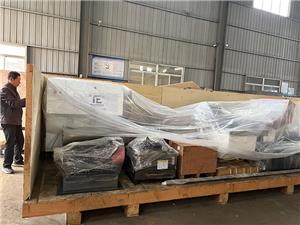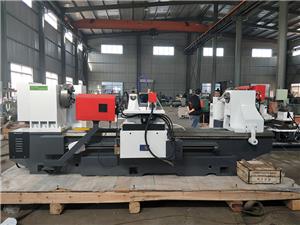
What Makes Cnc Roller Surface Marking Machines Essential?
Introduction
Imagine a production line where a $50,000 roller is scrapped because of a 0.1 mm deep engraving error. Or a maintenance team spending hours manually marking rollers with no traceability. These scenarios are all too common in industries relying on precision rollers. The answer to What Makes Cnc Roller Surface Marking Machines Essential? lies in their ability to deliver micron-level accuracy, permanent traceability, and significant cost savings. In this blog, we'll explore how these machines solve critical pain points and why they have become indispensable for high-end manufacturing.
Pain Points
1. Inaccurate marking leading to roller failure
In industries like printing and film production, rollers operate under high pressure and speed. Manual or semi-automated marking often results in inconsistent depth and position, causing imbalance and premature wear. A major film manufacturer in Germany reported that 15% of their rollers failed within six months due to marking inaccuracies, resulting in $200,000 annual replacement costs and unplanned downtime.
2. Lack of traceability causing quality control issues
Without permanent, readable marks, tracing rollers through their lifecycle is nearly impossible. A US-based packaging company struggled with recalls because they couldn't identify faulty batches, leading to $500,000 in recall costs and damaged reputation. Manual stamps often fade or become illegible, exacerbating the problem.
3. Time-consuming manual marking reducing productivity
Manual marking of large rollers is labor-intensive and slow. A Chinese textile machinery builder found that manual marking took 30 minutes per roller, delaying production by 20%. With increasing order volumes, this bottleneck cost them $150,000 in lost revenue annually.
Solutions
1. Precision CNC marking for accuracy and consistency
CNC roller surface marking machines use computer-controlled systems to achieve micron-level precision. For example, NANTONG LUCUBRATE MACHINERY TECHNICAL LTD.'s machines utilize high-resolution servo motors and advanced software to ensure depth tolerance within ±0.01 mm, eliminating imbalance and extending roller life by up to 30%.
2. Permanent marking for traceability
Using techniques like laser engraving or dot peen marking, these machines create durable marks that withstand harsh operating conditions. This enables full traceability from manufacturing to maintenance, reducing recall risks and improving quality control.
3. Automated operation for productivity gains
Automation reduces marking time to under 5 minutes per roller, boosting throughput by 25% or more. With easy integration into existing lines, manufacturers can achieve rapid ROI.
Customer Cases
Case 1: Schmidt & Sohn GmbH, Germany
This printing roller manufacturer faced frequent failures due to marking errors. After implementing LUCUBRATE's CNC marking machine, they reduced roller failures by 40% and saved €150,000 annually. "The precision is unmatched; our rollers now last 30% longer," said Production Manager Klaus Weber.
Case 2: American Film Solutions, USA
A film producer struggled with traceability. LUCUBRATE's solution provided permanent marks, cutting recall costs by 60% and improving customer satisfaction. "We can now trace any roller in seconds, saving us millions," noted Quality Director Sarah Johnson.
Case 3: Jiangsu Textile Machinery Co., China
Manual marking was a bottleneck. After adopting LUCUBRATE's automated system, marking time dropped from 30 to 4 minutes per roller, increasing production capacity by 25% and generating $200,000 in additional revenue. "This machine paid for itself in 8 months," said Operations Manager Li Wei.
Case 4: Precision Rollers Ltd., UK
This aerospace roller supplier needed sub-micron accuracy. LUCUBRATE's custom solution achieved ±0.005 mm marking depth, reducing scrap by 50% and winning new contracts. "Their engineering support is exceptional," commented Technical Director James Smith.
Case 5: Brazilian Packaging Group, Brazil
Facing high maintenance costs, they integrated LUCUBRATE's machine for on-site marking. Downtime reduced by 30%, saving $120,000 annually. "Reliable and easy to use," said Maintenance Head Carlos Silva.
Applications and Partnerships
CNC roller surface marking machines are vital in printing, packaging, textile, and film industries. For instance, LUCUBRATE has partnered with global buyers like Heidelberg (Germany) and Bobst (Switzerland) to supply marking solutions for their roller maintenance facilities. These collaborations ensure that OEMs and end-users achieve consistent quality and traceability.
FAQ
Q1: How does CNC marking handle different roller materials?
A: Our machines are equipped with adjustable parameters for materials like steel, aluminum, and ceramics. For example, laser marking uses different wavelengths for each material, ensuring optimal results without damage.
Q2: What is the typical maintenance schedule for these machines?
A: We recommend quarterly calibration and annual servicing. With proper care, machines maintain ±0.01 mm accuracy for over 10 years.
Q3: Can the marking be integrated with existing MES/ERP systems?
A: Yes, our software supports OPC-UA and Modbus protocols for seamless data exchange, enabling full traceability.
Q4: What about safety standards?
A: All machines comply with CE and ISO 13849-1, featuring interlocked enclosures and emergency stops.
Q5: How do you ensure marking depth consistency on curved surfaces?
A: We use 3D scanning and adaptive tool paths to maintain constant depth on complex geometries, with real-time feedback control.
Conclusion and Call to Action
CNC roller surface marking machines are essential for precision, traceability, and productivity. By addressing critical pain points, they deliver measurable ROI. To learn more, download our technical white paper or contact our sales engineers at NANTONG LUCUBRATE MACHINERY TECHNICAL LTD. for a consultation.