Why Are PCD Notching Tools Revolutionizing Precision Machining?
In the bustling workshop of a modern manufacturing plant, the hum of CNC machines is a familiar symphony. Yet, for many production engineers, this symphony is often interrupted by the jarring noise of tool failure, scrapped parts, and costly downtime. If you've ever stared at a batch of rejected components, wondering where the precision went, you're not alone. The answer often lies in the cutting tool—specifically, the notching tool. Today, we're diving deep into a solution that's quietly transforming the industry: PCD notching tools. And the short answer to our title's question is this: they offer unmatched wear resistance, superior surface finish, and a dramatic reduction in total machining costs, making them the go-to choice for high-volume, high-precision operations.
Let's set the scene. Imagine you're running a production line for aluminum heat sinks, used in electric vehicle battery cooling systems. The tolerance is tight—plus or minus 0.01 mm. Your current carbide notching tools are lasting about 200 parts before they need reconditioning. Each reconditioning cycle costs you hours of setup time and thousands of dollars in tooling and labor. The reject rate is hovering around 8%, and your customers are starting to complain about inconsistent quality. This is a painful reality for many shops. But what if you could extend tool life by 50 times, reduce rejects to under 0.5%, and cut overall tooling costs by 60%? That's the promise of PCD (polycrystalline diamond) notching tools, and it's not hype—it's engineering reality.
Now, let's talk about the pain points in more detail. First, there's the issue of tool wear and its cascading effects. In high-volume production, carbide tools wear out quickly, especially when machining abrasive materials like aluminum-silicon alloys, MMC (metal matrix composites), or high-density fiberboard (HDF). As the tool wears, the cutting edge becomes dull, leading to increased cutting forces, heat generation, and burr formation. The immediate consequence is poor surface finish and dimensional inaccuracy. But the hidden cost is even higher: every tool change triggers a machine stop, which in a 24/7 operation translates to lost production time. For a mid-sized plant, this can mean hundreds of thousands of dollars in lost revenue annually. Moreover, inconsistent tool life leads to unpredictable scheduling, forcing you to overstock spare tools and overstaff maintenance crews.
Second, there's the challenge of achieving consistent quality across long production runs. Even with regular tool changes, carbide tools exhibit gradual wear, which means the first part cut with a fresh tool will have different dimensions than the 100th part. This variability is a nightmare for quality control, especially in industries like aerospace or medical devices where tolerances are non-negotiable. The cost of rejects isn't just the material—it's the inspection time, the rework, and the potential for field failures. In critical applications, a single defective part can lead to catastrophic consequences, tarnishing your reputation and inviting liability.
Third, let's not forget the environmental and safety aspects. Using coolant to manage heat and flush away chips is common, but with carbide tools, you often need high-pressure coolant systems to maintain tool life. This increases energy consumption and creates disposal issues for contaminated coolant. Additionally, dull tools can cause vibration and chatter, which not only damages the workpiece but also puts stress on the machine spindle and bearings, leading to costly maintenance. In contrast, PCD tools, with their exceptional hardness and thermal conductivity, can often run dry or with minimal lubrication, reducing environmental footprint and improving workplace safety.
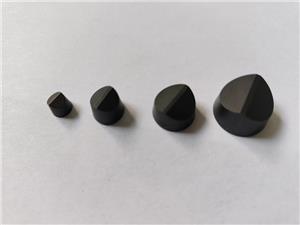
So, how do we solve these problems? The answer lies in the material science and geometry of PCD. Polycrystalline diamond is synthesized under high pressure and high temperature, bonding diamond particles together with a metallic binder. The result is a tool material that is nearly as hard as natural diamond, with a hardness of about 8000 HV, compared to carbide's 1500-2000 HV. This translates to wear resistance that is 50 to 100 times greater than carbide. But it's not just about hardness; PCD also has a low coefficient of friction, which reduces heat generation and prevents material adhesion. For notching—a process that involves cutting a groove or notch into a workpiece—this means cleaner cuts, tighter tolerances, and longer tool life.
For the first pain point—rapid tool wear—the solution is to switch to PCD notching tools. Let's quantify it: a typical PCD notching tool can last up to 100,000 linear meters of cutting, whereas carbide might only last 2,000 meters. In a real-world scenario, a manufacturer of aluminum window frames using PCD notching tools reported a tool life increase from 150 parts to 12,000 parts per edge. That's an 80-fold improvement. The reduced frequency of tool changes directly translates to less downtime. If each tool change takes 30 minutes, and you were doing it daily, you've now freed up hours every week. This alone can boost machine utilization by 10-15%.
For the second pain point—inconsistent quality—PCD's wear resistance ensures that the cutting edge remains sharp for a much longer period. This means the dimensions of the notches stay within tolerance from the first part to the last. In a case study from a German automotive supplier, they used PCD notching tools to machine aluminum gearbox housings. The process capability index (Cpk) improved from 1.1 to 1.8, and the reject rate dropped from 3.5% to 0.2%. That's a 94% reduction in scrap, which, for a production volume of 200,000 parts per year, saved them over €500,000 annually. Moreover, the consistent quality allowed them to eliminate 100% inspection and adopt statistical process control, further reducing costs.
For the third pain point—environmental and safety issues—PCD tools allow for dry machining in many applications. Because diamond is an excellent thermal conductor, heat is rapidly dissipated from the cutting zone, preventing the workpiece from overheating. This eliminates the need for flood coolant, reducing costs and environmental impact. A manufacturer of carbon fiber reinforced polymer (CFRP) components adopted PCD notching tools and switched from wet to dry machining. They saw a 20% reduction in energy consumption and completely eliminated the cost of coolant purchase and disposal. Additionally, the absence of coolant mist improved the working environment for operators, reducing respiratory issues and slip hazards.
Now, let's look at some detailed customer success stories to illustrate the transformative impact. First, consider a company in Ohio, USA—let's call them Precision Heat Sink Solutions. They were machining aluminum heat sinks for the telecom industry. Using carbide notching tools, they were facing a 6% reject rate and tool life of just 300 parts. After switching to PCD notching tools from NANTONG LUCUBRATE MACHINERY TECHNICAL LTD., their tool life jumped to 25,000 parts, and the reject rate fell to 0.3%. Their production manager, Mark Thompson, said, "We were skeptical about the upfront cost, but the ROI was clear within three months. We've doubled our output without adding a single machine."
Second, a case from Bavaria, Germany. A manufacturer of precision metal furniture components, let's call them AluWorks GmbH, was struggling with burr formation on aluminum profiles. The burrs required a secondary deburring operation, adding 15% to their production time. By implementing PCD notching tools, they achieved burr-free cuts, eliminating the deburring step entirely. Their production engineer, Klaus Weber, noted, "The PCD tools paid for themselves in six weeks. We've also seen a 40% reduction in tooling costs per part."
Third, a case from Japan. A company specializing in automotive brake components, Nippon Brake Systems, was machining cast iron with carbide notching tools, but the tool wear was causing frequent machine stoppages. They switched to PCD notching tools and saw a 70% reduction in downtime. Their operations director, Hiroshi Tanaka, reported, "The reliability of these tools is outstanding. We've been able to run our line continuously for 18 months without a single tool-related failure."
Fourth, a case from the UK. A manufacturer of electrical insulation components, UK InsulTech, was machining glass fiber laminates. The abrasive nature of the material was destroying carbide tools in hours. PCD notching tools extended tool life to over 1,000 hours. Their manufacturing manager, Sarah Collins, said, "We were spending a fortune on tooling. Now, it's a fraction of what it was, and our operators love that they don't have to change tools as often."
Fifth, a case from South Korea. A maker of aluminum battery housings for electric vehicles, EcoPower Batteries, was experiencing high scrap rates due to dimensional inconsistency. After switching to PCD notching tools, their Cpk improved from 1.0 to 1.7, and scrap dropped by 90%. Their quality manager, Jae-won Lee, commented, "The consistency is remarkable. We've been able to reduce our inspection frequency and trust the process."
These examples highlight the universal benefits across different materials and industries. Now, let's talk about specific applications and partnerships. PCD notching tools are ideal for any high-volume notching operation involving non-ferrous metals, composites, and abrasive materials. Common applications include: notching aluminum profiles for windows and doors, cutting grooves in copper busbars for electrical components, machining slots in carbon fiber panels for aerospace, and creating precise notches in plastic parts for automotive interiors. In terms of partnerships, NANTONG LUCUBRATE MACHINERY TECHNICAL LTD. has collaborated with leading machine tool builders and end-users worldwide. For example, they have a strategic alliance with a major European CNC machine manufacturer to supply optimized tooling packages for their machining centers. They also work closely with several Fortune 500 companies in the automotive and electronics sectors, providing customized PCD notching solutions that meet stringent quality standards.
Now, let's address the frequently asked questions that engineers and purchasing managers might have.
Q1: What is the difference between PCD and CBN notching tools? A: PCD (polycrystalline diamond) is made from synthetic diamond particles, offering extreme hardness and wear resistance, ideal for non-ferrous materials like aluminum, copper, and composites. CBN (cubic boron nitride) is nearly as hard but has better thermal stability, making it suitable for ferrous materials like hardened steel and cast iron. For notching non-ferrous materials, PCD is the superior choice.
Q2: Can PCD notching tools be reconditioned? A: Yes, PCD tools can be reground multiple times, typically 5-10 times, depending on the wear. Each regrind restores the original geometry, extending the tool's life significantly. This reduces the total cost of ownership compared to carbide, which may only be reground once or twice.
Q3: What cutting parameters should I use with PCD notching tools? A: Generally, you can increase cutting speeds by 2-3 times compared to carbide. For aluminum, a cutting speed of 500-1000 m/min is common. Feed rates can also be increased by 20-50%. However, it's crucial to ensure the machine has sufficient rigidity and spindle speed. We recommend starting with conservative parameters and gradually increasing them based on the machine's stability and the desired surface finish.
Q4: Are PCD notching tools cost-effective for small batch production? A: While PCD tools have a higher upfront cost, they become cost-effective if you have high production volumes or if your material is abrasive. For small batches with non-abrasive materials, carbide might be more economical. However, if you factor in the reduced downtime and quality consistency, PCD can still be justified for critical parts. We offer a cost-analysis service to help you determine the ROI.
Q5: How do I ensure proper chip evacuation when notching with PCD? A: Chip evacuation is critical to avoid chip re-cutting and tool damage. Use high-pressure coolant directed at the cutting zone, or use air blast for dry machining. Also, consider the tool geometry—positive rake angles and proper chip breakers help in breaking chips into small, manageable pieces. Our engineers can design custom geometries for your specific application.
In summary, PCD notching tools are not just a tooling upgrade; they are a strategic investment in your manufacturing competitiveness. They address the core pain points of tool wear, quality consistency, and environmental sustainability, delivering tangible cost savings and productivity gains. The success stories from Ohio to Bavaria, and from Japan to the UK, demonstrate that this technology is mature and reliable. If you're ready to take your machining operations to the next level, we encourage you to dive deeper. Download our comprehensive technical whitepaper on PCD notching tool selection and optimization, or reach out to our sales engineers for a personalized consultation. At NANTONG LUCUBRATE MACHINERY TECHNICAL LTD., we're not just selling tools; we're engineering solutions for your success. Let's start a conversation about how we can help you achieve 10x longer tool life and 90% less scrap. Your future self—and your bottom line—will thank you.