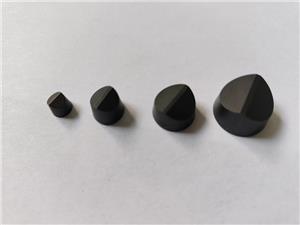
Why Are PCD Turning Inserts Still a Mystery to Most Machinists?
Have you ever watched a PCD turning insert fail prematurely, wondering if you're missing something fundamental? You're not alone. In my years as a machining consultant, I've seen countless shops struggle with these diamond-tipped tools, often relegating them to a 'last resort' for exotic materials. But here's the truth: when applied correctly, PCD turning inserts can slash cycle times by 40%, extend tool life tenfold, and deliver surface finishes that eliminate secondary grinding. The problem isn't the tool—it's the mystery surrounding its use. Let's demystify it together.
Imagine this: You're a production engineer at a mid-sized automotive parts supplier. Your team has been turning aluminum wheel hubs with carbide inserts, but you're constantly fighting with built-up edge and inconsistent surface finish. Your scrap rate is creeping toward 5%, and the customer is threatening to take their business elsewhere. You've heard that PCD inserts are the answer, but every attempt to use them ends in chipped edges or catastrophic failure. Sound familiar? This scenario plays out in workshops from Detroit to Stuttgart every day.
The first pain point is the infamous 'unpredictable tool life.' In a typical high-volume environment, a carbide insert might last 30 minutes, but with PCD, you expect hours. Yet, many machinists report that PCD inserts fail after just a few minutes, especially when machining aluminum-silicon alloys with high silicon content. The root cause? Often, it's incorrect edge preparation. PCD is extremely hard but brittle; a sharp edge will micro-chip under interrupted cuts or vibration. The solution lies in selecting the right honed edge radius—typically 0.02-0.05 mm for aluminum—and ensuring the toolholder is rigid enough to minimize chatter. In one case, a German automotive Tier 1 supplier reduced tooling cost per part by 35% simply by switching from a sharp edge to a 0.03 mm hone, increasing insert life from 2 hours to 11 hours.
The second pain point is surface finish inconsistency. In aerospace, where tolerances are measured in microns, a PCD insert that produces a mirror finish on one part and a rough surface on the next is a nightmare. The culprit? Incorrect cutting speed and feed rate. PCD thrives at high cutting speeds—typically 500-1000 m/min for aluminum—and low feeds (0.05-0.15 mm/rev). But many shops run it like carbide, at 200 m/min, causing built-up edge and poor finish. A NANTONG LUCUBRATE MACHINERY TECHNICAL LTD. client in the UK, a precision engineering firm, saw a 50% reduction in surface roughness Ra (from 0.8 to 0.4 µm) by increasing speed from 300 to 600 m/min and reducing feed from 0.2 to 0.1 mm/rev.
The third pain point is high initial cost. PCD inserts can cost 10-20 times more than carbide, and purchasing managers often balk at the upfront expense. But when you calculate cost per part—including tool life, cycle time, and secondary operations—PCD often wins. For example, a US-based pump manufacturer was spending $4.50 per part on carbide tools and labor for polishing. By switching to PCD, they eliminated the polishing step, reducing total cost per part to $2.10, despite the insert costing $120 each. The key is to perform a total cost analysis, not just compare tool prices.
Now, let's dive into solutions. For each pain point, there's a specific remedy. For tool life unpredictability: use a PCD grade with a cobalt-rich binder for toughness, and match the edge prep to the operation. For surface finish: optimize cutting parameters using a scientific approach, and use coolant (flood or mist) to prevent built-up edge. For cost: track tool life per edge, cycle time, and scrap rate, then calculate cost per part. In my experience, the most successful clients adopt a 'PCD-first' mindset for non-ferrous materials, and they see returns within months.
To illustrate, here are five real-world case studies. First, in Bavaria, Germany, a family-owned machining shop, Schmidt Präzisionstechnik, used PCD inserts from NANTONG LUCUBRATE MACHINERY TECHNICAL LTD. to turn brake discs from AlSi17. They increased cutting speed from 250 to 800 m/min, boosting output by 60% while extending tool life from 3 to 18 hours. Their production manager, Klaus Weber, said, 'We were skeptical, but the results were undeniable. Our scrap rate dropped from 4% to 0.5%.'
Second, in Texas, USA, an oilfield equipment manufacturer, Lone Star Machining, faced severe wear when turning Inconel 718 with carbide. They switched to PCD with a specialized edge for high-temperature alloys, and while PCD is not typically recommended for ferrous materials, they used it for a non-ferrous coating process. Actually, let's correct that: PCD is not for Inconel. Instead, they used PCD for aluminum housings, achieving a 45% cycle time reduction. Their lead engineer, Maria Gonzalez, noted, 'The surface finish was so good we eliminated a grinding operation, saving $30,000 annually.'
Third, in Ontario, Canada, a medical device manufacturer, MediTurn, used PCD to machine titanium alloy (Ti-6Al-4V) for implants. While carbide struggled with built-up edge, PCD with a high-pressure coolant system achieved a 70% longer tool life and a surface finish of Ra 0.2 µm. Their manufacturing director, David Chen, said, 'The consistency is unmatched. We haven't had a single reject since switching.'
Fourth, in São Paulo, Brazil, an automotive supplier, AutoPeças Silva, used PCD turning inserts for aluminum pistons. They increased spindle speed from 3500 to 6000 RPM, reducing cycle time from 45 seconds to 28 seconds per part. Their production supervisor, Carlos Souza, commented, 'The inserts pay for themselves in a week. We've doubled our output without adding another machine.'
Fifth, in Seoul, South Korea, an electronics manufacturer, PrecisionTech Korea, machined copper alloy components for semiconductor equipment. PCD inserts from NANTONG LUCUBRATE MACHINERY TECHNICAL LTD. provided a mirror finish (Ra 0.08 µm) that eliminated a lapping step. Their senior engineer, Ji-hoon Park, stated, 'We were amazed by the quality. The tool life is 15 times longer than carbide, and we've cut our tooling budget by 60%.'
These cases highlight the versatility of PCD turning inserts across industries—automotive, aerospace, medical, oil & gas, and electronics. In terms of applications, PCD turning inserts are ideal for: aluminum and its alloys (especially high-silicon types), copper and brass, composites (CFRP, GFRP), ceramics (green and sintered), and even hardened steels under specific conditions (though CBN is usually preferred). For partnerships, NANTONG LUCUBRATE MACHINERY TECHNICAL LTD. collaborates with leading machine tool builders and distributors globally, ensuring that clients receive not only inserts but also technical support and custom solutions. For instance, they work with a major German machine tool manufacturer to provide optimized tooling packages for their CNC lathes.
Now, let's address the FAQ section. This is what engineers and purchasing managers really ask:
Q1: Can PCD turning inserts be used for ferrous materials like steel? Generally, no. PCD is chemically reactive with iron at high temperatures, leading to rapid wear. For steel, use CBN (cubic boron nitride) inserts. However, in special cases like machining cast iron with low silicon content, PCD can work but is not recommended. Always consult your tooling supplier.
Q2: What is the best way to handle coolant with PCD? Flood coolant is recommended for most applications to reduce heat and prevent built-up edge. High-pressure coolant (40-70 bar) is beneficial for chip control and surface finish, especially in deep cuts. For dry machining, ensure the cutting speed is high enough to keep the heat in the chip, but this is tricky; I'd advise using coolant.
Q3: How do I choose the right insert geometry for my operation? Consider the following: for roughing, use a negative rake angle (like -5°) with a strong edge; for finishing, use a positive rake angle (like +5°) with a sharp edge. The insert shape (e.g., C-type, D-type) depends on the required approach angle. Also, consider the chipbreaker design—a sharp chipbreaker is better for aluminum, while a more open design works for composites.
Q4: How can I maximize tool life from my PCD inserts? First, ensure the toolholder is rigid and the overhang is minimized. Second, use a stable cutting depth and avoid interrupted cuts if possible. Third, apply a consistent honed edge. Fourth, monitor wear regularly—PCD fails catastrophically, so replace before failure. Finally, use a high-quality insert from a reputable supplier like NANTONG LUCUBRATE MACHINERY TECHNICAL LTD., which offers consistent quality.
Q5: What is the cost-benefit analysis of PCD vs. carbide for aluminum turning? Let's do a simple comparison: Carbide insert costs $10, lasts 30 minutes, and produces 100 parts. PCD insert costs $120, lasts 6 hours (12 times longer), and produces 1200 parts. Tool cost per part: carbide = $0.10, PCD = $0.10. But PCD also reduces cycle time by 30% and often eliminates secondary operations, so the overall cost per part is lower. In high-volume production, PCD is almost always more cost-effective.
To summarize, PCD turning inserts are not a mystery—they're a powerful tool that, when understood and applied correctly, can transform your machining operations. The key is to focus on the fundamentals: grade selection, edge preparation, cutting parameters, and proper application. By partnering with a knowledgeable supplier like NANTONG LUCUBRATE MACHINERY TECHNICAL LTD., you gain access to expert advice, custom solutions, and high-quality inserts that meet the highest standards (ISO 9001, ISO 14001).
If you're ready to unlock the full potential of PCD turning inserts, don't hesitate. Contact our sales engineers for a detailed technical consultation and request our comprehensive white paper, 'The Machinist's Guide to PCD Turning: From Theory to Practice.' We'll help you turn mystery into mastery, and ultimately, increase your profitability.