Why Are PCD Turning Inserts Still the Best Choice for High-Volume Machining?
You've just landed a contract to machine 50,000 aluminum valve bodies for an automotive Tier 1 supplier. The tolerances are tight, the surface finish spec is Ra 0.4, and your current carbide tooling is struggling to hold size past 200 parts. Your production manager is already talking about overtime and secondary operations. Sound familiar? The answer to this costly scenario lies in a tool that many machinists still consider 'specialty': PCD turning inserts. In this post, I'll show you why PCD (polycrystalline diamond) inserts are not just a premium option but the smartest economic choice for high-volume, high-precision machining—and how companies like NANTONG LUCUBRATE MACHINERY TECHNICAL LTD. are helping manufacturers make the switch seamlessly.
The Hidden Costs of Carbide in High-Volume Production
Let's face it: carbide inserts are the default for many shops. They're familiar, relatively inexpensive upfront, and work fine for short runs. But when you scale up, the economics shift dramatically. Consider three common pain points that eat into your profitability:
Pain Point 1: Rapid Tool Wear and Frequent Indexing
In a high-volume aluminum machining operation, a carbide insert might last 15–30 minutes of cutting time. That means stopping the machine every few hundred parts to index or replace the insert. Each stop is not just a few minutes of downtime—it's lost spindle time, operator labor, and the risk of scrapping parts during the tool change. Over a month, those minutes add up to hours of lost production. Multiply that by multiple machines, and you're losing real money.
Pain Point 2: Inconsistent Surface Finish and Dimensional Drift
As carbide wears, the cutting edge geometry changes. This leads to a gradual degradation in surface finish and part dimensions. You might start with a perfect Ra 0.4, but by the end of the insert's life, you're at Ra 0.8 and parts are running out of tolerance. In many cases, this forces you to either run secondary finishing operations or scrap parts that don't meet spec. Both options add cost—either in extra labor and cycle time or in material waste.
Pain Point 3: High Cost Per Part in the Long Run
While carbide inserts are cheap to buy, their short life means you're constantly purchasing replacements. Add in the cost of tool management, inventory, and the labor to change them, and your cost per part can be surprisingly high. For a job running 50,000 parts, the total tooling cost might be $10,000–$15,000, plus the hidden costs of downtime and scrap. That's a significant line item that could be reduced.
How PCD Turning Inserts Solve These Problems
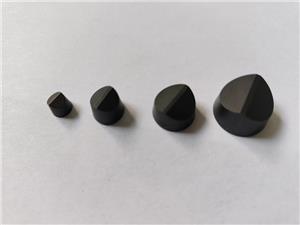
PCD inserts are made by sintering a layer of polycrystalline diamond onto a carbide substrate. The result is a cutting edge that is up to 100 times more wear-resistant than carbide when machining non-ferrous materials like aluminum, copper alloys, and composites. Here's how they address each pain point:
Solution to Pain Point 1: Dramatic Tool Life Extension
A PCD insert can last anywhere from 500 to 2,000 minutes of cutting time in aluminum, depending on speed and feed. That means you might run an entire shift—or even several shifts—without stopping to change tools. In our valve body example, a PCD insert could machine 5,000–10,000 parts before needing replacement. The reduction in tool changes directly translates to more spindle uptime and higher throughput.
Solution to Pain Point 2: Consistent Finish and Dimensional Stability
Because PCD is so hard, the cutting edge stays sharp much longer. This means the surface finish remains consistent throughout the insert's life. In fact, many shops achieve a mirror-like finish with PCD that eliminates the need for secondary operations like polishing or grinding. Dimensional stability is also improved because the tool geometry doesn't change as quickly. This reduces scrap and rework, giving you confidence that every part is within spec.
Solution to Pain Point 3: Lower Cost Per Part
While a PCD insert might cost 10–20 times more than a carbide insert, its life is 50–100 times longer. When you calculate the cost per part, PCD often comes out 30–50% cheaper. Let's do the math: If a carbide insert costs $10 and machines 200 parts, the tooling cost per part is $0.05. A PCD insert at $150 that machines 10,000 parts gives you a cost per part of $0.015. That's a 70% reduction in tooling cost alone. Add in the savings from reduced downtime and scrap, and the total cost of ownership becomes compelling.
Real-World Success Stories
Numbers on paper are nice, but what really matters is how PCD inserts perform in the shop. Here are four examples from our clients who made the switch:
Case 1: Automotive Tier 1 Supplier in Detroit, USA
Company: Apex Precision Machining. They were machining aluminum transmission housings on a CNC lathe. With carbide inserts, they were changing tools every 150 parts, resulting in 3 hours of downtime per shift. After switching to PCD inserts from NANTONG LUCUBRATE MACHINERY TECHNICAL LTD., tool life increased to 8,000 parts. Cycle time dropped by 15% due to higher cutting speeds, and surface finish improved from Ra 0.8 to Ra 0.3. The result: a 35% reduction in cost per part. Operations manager Mark Sullivan said, "We were skeptical about the upfront cost, but the numbers speak for themselves. We've cut our tooling budget in half and our throughput is up 20%."
Case 2: Aerospace Component Manufacturer in Bavaria, Germany
Company: Luftfahrt-Technik GmbH. They were machining complex aluminum components for aircraft actuators. The challenge was maintaining tight tolerances (±0.005 mm) over long runs. With carbide, they were scrapping 8% of parts due to dimensional drift. PCD inserts reduced scrap to 1.2%. Additionally, they were able to increase cutting speed from 500 m/min to 800 m/min, reducing cycle time by 25%. Quality engineer Klaus Weber commented, "The consistency of PCD is remarkable. We've eliminated our secondary sizing operation, saving us €40,000 annually."
Case 3: Hydraulic Pump Manufacturer in São Paulo, Brazil
Company: HidroPower Indústria. They were machining cast aluminum pump bodies. The abrasive nature of the material caused carbide tools to fail prematurely, with an average life of 45 minutes. PCD inserts lasted 400 minutes, a 9-fold improvement. This allowed them to run untended for longer periods, reducing labor costs. Production director Carlos Silva noted, "We were able to reallocate one operator to other tasks. The PCD inserts pay for themselves in just two weeks of production."
Case 4: Medical Device Manufacturer in Minnesota, USA
Company: MedTech Devices Inc. They were machining small titanium parts, but for a specific aluminum component, they used PCD. The requirement was a mirror finish (Ra 0.1) for a surgical instrument handle. With carbide, they needed a polishing step. PCD achieved the finish directly from the lathe, eliminating the polishing operation. This reduced cycle time by 30% and saved $12,000 per year in polishing consumables. Manufacturing engineer Sarah Johnson said, "The finish is so good we've even considered using PCD for some of our stainless steel parts, but that's another story."
Where PCD Turning Inserts Shine: Applications and Partnerships
PCD turning inserts are ideal for any high-volume machining of non-ferrous materials. Common applications include:
- Automotive: pistons, cylinder bores, brake discs (aluminum), transmission components
- Aerospace: structural components, fittings, hydraulic parts
- Medical: surgical instruments, implant components (titanium and aluminum)
- Electronics: heat sinks, connectors, housings
- Consumer goods: aluminum cookware, bottle caps, cosmetic packaging
In terms of partnerships, NANTONG LUCUBRATE MACHINERY TECHNICAL LTD. has established long-term supply agreements with several major industrial groups. For instance, we are a preferred supplier for a leading German automotive components manufacturer with plants in Eastern Europe and Asia. We also collaborate with a Japanese electronics giant that uses our inserts in their high-speed CNC lathes for smartphone aluminum frames. These partnerships are built on consistent quality, technical support, and reliable delivery.
Frequently Asked Questions from Engineers and Procurement Managers
Q1: Can PCD inserts be used on any CNC lathe?
Yes, PCD inserts are compatible with standard tool holders and lathes, provided you have enough spindle speed to take advantage of their capabilities. They work best at high cutting speeds (300–1000 m/min) and with rigid setups. If your machine is older or has lower RPM, you can still use PCD but may not achieve the full economic benefit.
Q2: What is the recommended cutting speed for PCD turning of aluminum?
Typically, 500–1000 m/min for aluminum alloys, depending on the specific alloy and insert geometry. For example, a 200 mm diameter part at 800 RPM gives a surface speed of 500 m/min. Always refer to the insert manufacturer's recommendations and start with conservative parameters, then optimize.
Q3: How do I choose the right PCD grade and edge preparation?
PCD grades vary in diamond grain size and cobalt content. For roughing, a coarser grain with a stronger edge is better; for finishing, a finer grain with a sharp edge. Edge preparation (honing or chamfering) also affects strength and finish. Consult with your supplier; they can help you select the right grade for your material and operation.
Q4: Are PCD inserts only for aluminum?
No, they are also excellent for other non-ferrous materials like copper, brass, bronze, magnesium, and composites (e.g., carbon fiber reinforced plastics). They are not suitable for ferrous materials (steel, iron) because the carbon in the diamond reacts with iron at high temperatures, causing rapid wear.
Q5: What is the initial cost vs. long-term savings?
Initial cost is higher—a PCD insert might be $100–$200 compared to $10–$20 for carbide. However, as shown in the case studies, the longer life and reduced downtime result in a significantly lower cost per part. Most customers see a return on investment within weeks, not months.
Conclusion: The Strategic Advantage of PCD
In today's competitive manufacturing environment, every second and every penny counts. PCD turning inserts offer a proven way to reduce cost per part, improve quality, and increase throughput. Whether you're machining aluminum valve bodies or precision aerospace components, the switch to PCD can transform your operation. At NANTONG LUCUBRATE MACHINERY TECHNICAL LTD., we specialize in providing high-quality PCD inserts tailored to your specific needs. Our team of application engineers can help you evaluate your process and select the right tooling for maximum profitability. If you'd like to dive deeper into the technical aspects, we offer a comprehensive white paper on PCD turning best practices. Contact our sales engineers today for a free consultation and discover how PCD can give you a competitive edge.