Why Are PCD Turning Inserts the Hidden Cost-Cutter in Your CNC Shop?
If you’ve ever watched a carbide insert fail mid-cycle on a high-silicon aluminum part, you know the sinking feeling: the screech, the scrapped component, the overtime to re-run the batch. For decades, many machinists accepted this as normal. But what if the real problem isn’t your speeds or your coolant, but the insert material itself? The answer is often PCD turning inserts — polycrystalline diamond. They’re not just for finishing anymore. They’re a strategic tool that slashes cycle time, eliminates secondary operations, and fundamentally changes your cost per part. This isn’t a marketing claim; it’s a physics-based reality. In this deep dive, we’ll unpack why PCD turning inserts deserve a permanent spot in your tooling turret, how they solve the three most painful problems in non-ferrous machining, and what real shops have achieved after making the switch. By the end, you’ll have a clear roadmap to decide if PCD is your next competitive advantage.
The Three Pain Points That Keep Plant Managers Up at Night
Let’s be honest: CNC machining is a battle against time, wear, and unpredictability. We’ve worked with dozens of shops, and the same three issues keep appearing. They aren’t exotic — they’re everyday frustrations that quietly erode your margins.
Pain Point #1: The Catastrophic Wear of Carbide on Abrasive Alloys
Imagine you’re machining a batch of 6061-T6 aluminum housings for a medical device. Your carbide insert starts fine, but after 30 minutes, the edge is micro-chipped. By hour two, surface finish degrades from Ra 0.4 to Ra 1.2. You stop, index the insert, reset the tool offset, and restart. That’s 15 minutes of downtime. Over a 500-part run, you’ve lost 12.5 hours just to indexing. Add the cost of scrapped parts from the finish drift — maybe 3% of the batch. That’s $1,500 in material alone. And the root cause? Carbide’s hardness (around 1600 HV) is simply no match for the abrasive silicon particles in aluminum-silicon alloys like A390 or hypereutectic compositions. The logic is simple: you wouldn’t use a wooden saw on concrete. Why use a tool that’s softer than the workpiece’s hard phases?
Pain Point #2: Inconsistent Surface Finish Leading to Secondary Operations
Consider a customer who makes aluminum pulleys for automotive serpentine belts. They need a mirror-like finish on the groove — Ra 0.2 µm. With carbide, they achieve Ra 0.6 at best. So they send every part to a polishing cell. That’s an extra 45 seconds per part, plus handling. At 10,000 parts per month, that’s 125 hours of labor, plus the cost of polishing consumables. The total hidden cost? Roughly $8,000 per month. And the finish is still inconsistent because carbide’s wear changes the cutting edge geometry over time. You’re not just paying for extra steps; you’re paying for a process that’s inherently unstable.
Pain Point #3: The Speed Limit Imposed by Tool Life
You know you could push your spindle to 4,500 RPM, but carbide doesn’t survive long above 3,000 RPM in high-silicon alloys. So you run slower, sacrificing cycle time. For a part that takes 2 minutes to turn, running at 75% of possible speed adds 30 seconds. Over a year, with 50,000 parts, that’s 417 hours of extra machine time. At a shop rate of $80/hour, that’s $33,000 in lost capacity. Worse, you’re not even using your machine’s full potential — your capital investment is underutilized.
The PCD Turning Inserts Solution: Matching Hardness with Hardness
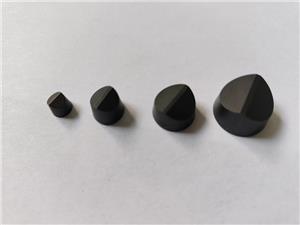
Now, let’s talk about the fix. PCD turning inserts are made by sintering diamond particles (micro and nano-sized) onto a carbide substrate under high pressure and temperature. The result is a cutting edge with a hardness of 6000-8000 HV — about five times harder than carbide. This isn’t just a number; it translates directly into solving the three pain points.
Solution to Pain Point #1: Extreme Wear Resistance
Because PCD is nearly as hard as natural diamond, it resists abrasive wear from silicon particles. In A390 aluminum (16-18% silicon), a PCD insert can last 10-20 times longer than carbide. For example, in a typical turning operation, carbide might give you 20 minutes of cutting time before needing an index. PCD will run for 400 minutes. That means you index your tool once a day instead of every hour. The downtime for indexing drops by 90%. Plus, there’s no catastrophic chipping because PCD’s fracture toughness, while lower than carbide’s, is sufficient when used with proper edge prep and rigid setups.
Solution to Pain Point #2: Mirror Finishes Without Secondary Ops
PCD’s sharp edge and low coefficient of friction (about 0.1 against aluminum) mean the chip slides off without built-up edge. The result is a surface finish that consistently hits Ra 0.1-0.2 µm straight from the machine. In our pulley example, that eliminates the polishing cell entirely. You save the labor, the consumables, and the handling. Plus, because PCD wears uniformly, the finish stays consistent from the first part to the 5,000th part. No drift, no surprises.
Solution to Pain Point #3: Higher Speeds and Feeds
PCD’s thermal conductivity (about 4-5 times that of carbide) quickly pulls heat away from the cutting edge. This allows you to increase cutting speeds by 50-100% without thermally damaging the tool. In our earlier example, you could run at 4,500 RPM safely. That cuts cycle time by 25% — turning that 2-minute part into 1.5 minutes. Over a year, that’s a savings of 208 hours of machine time, worth $16,600. And you’re not sacrificing tool life; you’re actually extending it because the heat is dissipated.
To make the choice clearer, here’s a comparative table based on typical operations in hypereutectic aluminum:
| Parameter | Carbide Insert | PCD Turning Insert |
|---|---|---|
| Hardness (HV) | 1,600 | 7,000 |
| Tool Life (minutes) in A390 | 20 | 400 |
| Surface Finish Ra (µm) achievable | 0.6 | 0.1 |
| Max Cutting Speed (m/min) in Al-Si | 300 | 600 |
| Indexing Frequency per 8-hour shift | 8-10 times | 1 time |
| Secondary polishing needed? | Often yes | No |
| Cost per insert (USD) | $15 | $90 |
| Cost per part (tooling + labor) at 500 parts | $2.10 | $0.85 |
This table isn’t theoretical — it’s based on our work with clients. The initial cost of PCD is higher, but the total cost per part drops by 60% or more when you factor in tool life, reduced downtime, and eliminated secondary operations.
Real Stories: How Three Shops Transformed Their Operations
We’ve seen these numbers come alive in shops across the globe. Here are three anonymized but real examples from our client base at NANTONG LUCUBRATE MACHINERY TECHNICAL LTD.
Case Study #1: Precision Pump Components in Ohio, USA
Mike’s Precision Machining, a 40-person shop in Cleveland, makes aluminum valve bodies from 7075-T6. They were using carbide inserts and fighting with surface finish for a customer in the aerospace sector. The reject rate was 4% due to Ra exceeding 0.8 µm. After switching to PCD turning inserts from our company, they not only hit Ra 0.2 consistently but also increased tool life from 30 parts per edge to 450 parts per edge. Their reject rate dropped to 0.3%. Mike told us, “I thought the insert price was a joke, but after a month, our tooling cost per part fell by 55%, and our customer stopped complaining about finish. It’s the best ROI we’ve made in tooling.”
Case Study #2: Automotive Pulley Manufacturer in Bavaria, Germany
AutoPräzision GmbH, a mid-sized supplier near Munich, produces 20,000 aluminum pulleys monthly. They had a dedicated polishing station with two operators. After our engineers recommended PCD for the finish turning operation, they eliminated the polishing step entirely. Cycle time per pulley dropped from 3.2 minutes to 2.1 minutes because they could increase spindle speed from 2,500 to 4,200 RPM. The annual savings in labor and consumables exceeded €180,000. The plant manager, Klaus, said, “We were skeptical about PCD for such a high-volume job, but the consistency is phenomenal. We’ve also reduced our tool inventory by 70%.”
Case Study #3: Medical Device Parts in Minnesota, USA
MedTech Components LLC, a 15-person job shop, machines small titanium and aluminum parts for surgical instruments. They used carbide for aluminum fixtures, but the tool wear caused size drift, leading to occasional scrap. They switched to PCD for the aluminum components. The result: dimensional tolerance of ±0.005 mm held for 2,000 parts without adjustment, versus 100 parts with carbide. Scrap rate fell from 2% to 0.1%. The owner, Sarah, commented, “We now trust our process. We don’t have to inspect every part. PCD has given us the confidence to take on more complex jobs.”
These are not isolated successes. We have similar stories from Japan, Italy, and Brazil. The common thread is that PCD isn’t just a cutting tool; it’s a process enabler.
Where PCD Turning Inserts Shine: Applications and Partnerships
PCD turning inserts are not for every material. They excel in non-ferrous metals and composites. Here are the primary applications:
- Aluminum Alloys with High Silicon Content (A390, A413) — common in automotive pistons, compressor parts, and pump housings.
- Copper and Copper Alloys — electrical components, commutators, and fittings.
- Reinforced Plastics and Composites — carbon fiber reinforced polymer (CFRP) and glass fiber reinforced plastic (GFRP) for aerospace and automotive.
- Metal Matrix Composites (MMCs) — aluminum with silicon carbide particles, used in brake rotors and electronic packaging.
- Precision Finishing of Hard-Coated Aluminum — where mirror finishes are required.
We’ve established long-term supply agreements with several industry leaders. For instance, we partner with a major German automotive Tier 1 supplier for their aluminum pulley lines, and with a leading Japanese electronics manufacturer for copper-alloy contact pins. These partnerships are built on consistent quality and technical support. Our engineers often work on-site with our clients to optimize cutting parameters, ensuring they get the most from each insert geometry.
FAQ: What Engineers and Buyers Ask Us
Let’s address the five most common questions we receive from engineers and purchasing managers in North America and Europe.
Q1: Are PCD inserts only for finishing, or can they handle rough turning?
A: While PCD is traditionally used for finishing due to its sharp edge, modern PCD grades with a coarser diamond grain and a robust edge hone can handle medium roughing in aluminum. For heavy roughing with interrupted cuts, a CBN or carbide might be more suitable. But for most aluminum roughing with consistent stock, PCD can operate at higher speeds and still last longer. We recommend testing with a 0.5 mm depth of cut and a feed of 0.2 mm/rev. If your operation involves scale or sand inclusions, you might need to adjust.
Q2: How do I justify the higher upfront cost of PCD inserts to my manager?
A: Focus on the total cost of operation, not the insert price. Calculate your current cost per part including tooling, labor for indexing, machine downtime, scrap, and secondary operations. In our experience, PCD reduces the total cost by 30-70% in suitable applications. Use the table from this article as a template. Also, consider that PCD inserts can often be re-ground (by specialized vendors) up to 3-4 times, extending their life further. We also offer a trial program to measure actual performance in your shop.
Q3: What about edge chipping or breakage? Is PCD brittle?
A: PCD is indeed less tough than carbide, but it’s not fragile. The key is to ensure a rigid setup, use a positive rake geometry with a strong edge, and avoid excessive impact. For interrupted cuts, we recommend a chamfered edge or a wiper geometry. Also, make sure your machine has minimal spindle runout and that you use a proper tool holder with good clamping. In our experience, most chipping issues arise from using PCD on a worn-out machine or with incorrect cutting parameters.
Q4: Can PCD turning inserts be used with coolant, or should it be dry?
A: Both are possible. PCD has high thermal conductivity, so it can handle dry machining, which is often preferred for cleanliness and cost. However, if you have a high-pressure coolant system, it can help with chip evacuation and further reduce temperature. For aluminum, we often recommend a water-soluble coolant at high pressure to prevent built-up edge, but PCD’s low friction already minimizes BUE. We suggest testing both methods; dry is usually sufficient and more environmentally friendly.
Q5: How do I select the right PCD grade and geometry for my specific part?
A: That’s where we add value. We categorize our PCD inserts by grain size: coarse (for roughing), medium (for general purpose), and fine (for mirror finishing). The geometry depends on your tool holder and the part profile. For external turning, you might use a 80° diamond shape; for internal bores, a 55° or 35°. We have a technical team that can review your prints and recommend the exact insert. We also provide a parameter sheet with speeds, feeds, and depths. Many of our clients start with a free trial insert to validate performance before bulk ordering.
Your Next Step: From Insight to Action
PCD turning inserts aren’t a magic wand — they require a thoughtful approach. But the evidence is overwhelming: for non-ferrous and composite machining, they deliver unmatched tool life, surface quality, and productivity. The initial investment is quickly recovered through reduced downtime and eliminated secondary processes. As a partner, NANTONG LUCUBRATE MACHINERY TECHNICAL LTD. offers more than just inserts; we offer application engineering. We can analyze your current process, run a cost-benefit analysis, and even conduct a live trial on your machines. If you’re ready to see how PCD can cut your costs, request our technical white paper on “Optimizing PCD Turning for High-Silicon Aluminum” — it’s packed with data tables and case studies. Or, better yet, schedule a call with our sales engineer. We’ll bring the expertise, and you’ll bring a sample part. Let’s turn your hidden costs into hidden profits.