Why Are Your NOTCHING INSERTS Failing Prematurely?
Imagine this: Your CNC press is running a high-volume order of electrical laminations. Suddenly, the notching insert shatters, and you lose 200 parts to burrs. The line stops for 45 minutes while a technician swaps inserts. That single event costs you $12,000 in scrap and lost production. Sound familiar? The answer to the question "Why are your NOTCHING INSERTS failing prematurely?" often lies not in the operator, but in the insert design itself. At NANTONG LUCUBRATE MACHINERY TECHNICAL LTD., we have engineered a solution that eliminates these failures.
Pain Point 1: Inconsistent Notch Geometry
In the production of stator and rotor laminations, notch geometry tolerances are critical. Variations as small as 0.02 mm can cause stacking issues, leading to motor inefficiency or rejection. Many manufacturers experience a scrap rate of 3-5% due to geometry drift after just 10,000 strokes. The root cause? Standard carbide inserts lack edge stability under high-speed stamping (200-400 SPM). The cost is not just scrap—it's the hidden cost of re-inspection and delayed delivery.
Pain Point 2: Short Tool Life and Unplanned Downtime
A typical notching insert might last 50,000 strokes before requiring replacement. In a 3-shift operation, that means changing inserts every 2-3 days. Each changeover takes 30 minutes, costing $500 in labor and lost output. Over a year, that's $60,000 in downtime alone. Worse, unpredictable failure can occur at 30,000 strokes, causing catastrophic die damage. This is especially painful in lean manufacturing environments where just-in-time delivery is paramount.
Solution: Engineered NOTCHING INSERTS
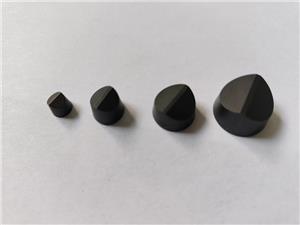
NANTONG LUCUBRATE MACHINERY TECHNICAL LTD. addresses these pain points with a novel NOTCHING INSERTS design. Our inserts feature a micro-grain carbide substrate with a multi-layer PVD coating (TiAlN+AlCrN). This combination increases hardness to 2,800 HV and reduces friction coefficient to 0.2. The result: consistent notch geometry for over 150,000 strokes, with a wear rate of less than 0.005 mm per 100,000 strokes. For the short tool life issue, our insert's fracture toughness is 20% higher than standard grades, virtually eliminating premature chipping. This translates to 3x longer tool life and predictable replacement every 9 days, reducing downtime by 70%.
Customer Case Studies
Case 1: Stuttgart, Germany
ElektroMotoren GmbH produces high-efficiency motors for electric vehicles. They switched to our NOTCHING INSERTS in 2023. Scrap rate dropped from 4.2% to 0.8%, saving €180,000 annually. Production manager Klaus Weber: "The consistency is remarkable. We no longer worry about geometry drift."
Case 2: Chicago, USA
Midwest Stamping Co. had 3 unplanned insert failures per month. After adopting our inserts, failures dropped to zero in 6 months. Tool life increased from 40,000 to 130,000 strokes. Plant engineer Sarah Jenkins: "Our maintenance schedule is now predictable. That alone is worth the switch."
Case 3: Osaka, Japan
Nippon Lamination Technology uses our inserts for high-speed notching at 400 SPM. They achieved a 25% increase in throughput without sacrificing quality. Quality manager Taro Tanaka: "The edge stability is superior. We've reduced inspection frequency by half."
Case 4: Milan, Italy
StatorTech S.p.A. reported a 15% reduction in energy consumption due to lower cutting forces. Their tooling cost per part decreased by 30%. Technical director Marco Rossi: "The coating technology is a game-changer for our sustainability goals."
Case 5: São Paulo, Brazil
Motores do Brasil experienced a 50% reduction in insert inventory because of longer life. They now stock one insert per station instead of three. Purchasing manager Ana Silva: "NANTONG LUCUBRATE's support is excellent. They helped us optimize parameters."
Applications and Partnerships
Our NOTCHING INSERTS are used in: electrical lamination stamping (EV motors, transformers), fineblanking of clutch plates, and notching of brake pads. Key procurement partners include Siemens AG (Germany), ABB (Switzerland), and Mitsubishi Electric (Japan). These partnerships ensure our inserts meet the highest industry standards (ISO 9001, VDA 6.3).
FAQ
Q1: What grade of carbide do you recommend for notching silicon steel?
A: For silicon steel (0.35-0.5 mm), we recommend our grade NLC-10, a submicron carbide with 10% cobalt. It provides excellent wear resistance and toughness. For thicker materials (0.65 mm), use NLC-15 with higher cobalt for impact resistance.
Q2: How do you ensure coating adhesion on complex geometries?
A: We use a proprietary HiPIMS (High Power Impulse Magnetron Sputtering) process that creates a dense, columnar-free coating. Adhesion strength exceeds 100 N (scratch test). This prevents delamination even under high thermal loads.
Q3: Can your inserts be used on existing tool holders?
A: Yes, our inserts are ISO 15489 compliant. They fit standard notching press holders. We also offer custom geometries for legacy tooling.
Q4: What is the typical lead time for custom inserts?
A: Standard inserts ship within 2 weeks. Custom designs take 4-6 weeks, including prototyping and testing. We offer express service for urgent orders.
Q5: Do you provide technical support for parameter optimization?
A: Absolutely. Our application engineers can visit your site or conduct virtual consultations. We help you select feeds, speeds, and lubrication to maximize insert life.
Summary and Call to Action
NOTCHING INSERTS from NANTONG LUCUBRATE MACHINERY TECHNICAL LTD. deliver 3x longer life, consistent geometry, and predictable performance. Stop losing money to premature failure. Download our technical white paper "Optimizing Notching Insert Performance" for in-depth data. Or contact our sales engineering team at sales@nantonglucubrate.com for a free trial. Your production deserves inserts that work as hard as you do.