Why Are Your PCD Notching Tools Failing Prematurely?
Have you ever watched a PCD notching tool fail mid-production, causing a cascade of downtime, scrap, and missed deadlines? It's a nightmare scenario that costs manufacturers thousands per hour. The answer lies not in the tool itself, but in the synergy between tool design, application parameters, and material compatibility. At NANTONG LUCUBRATE MACHINERY TECHNICAL LTD., we've spent decades mastering this synergy, and in this blog, we'll show you how to turn your tooling failures into consistent, profitable performance.
Pain Point 1: Premature Edge Wear Imagine running a high-volume production line for aluminum composite panels. Your PCD notching tools start strong, but after just 10,000 notches, the edges dull. The result? Burrs, chipping, and a surface finish that fails inspection. Each tool change costs 30 minutes of downtime, and with 10 tools per shift, you're losing 5 hours of production daily. That's $2,500 in lost output per shift, plus rework costs.
Pain Point 2: Chipping and Breakage In another scenario, a tool manufacturer for the automotive industry uses PCD notching tools on carbon fiber reinforced polymers (CFRP). The tools chip unpredictably, causing catastrophic failure. One chip can ruin a $500 part, and with a 2% failure rate, that's $10,000 per day in scrap. Worse, the chipping damages the tool holder, adding $200 per incident in replacement costs.
Pain Point 3: Inconsistent Notch Quality A supplier for solar panel frames faces inconsistent notch dimensions across batches. This leads to assembly issues, with a 5% rejection rate from the customer. Each rejected batch costs $1,000 in rework and expedited shipping. Over a year, that's $50,000 in hidden costs.
Solution 1: Advanced Material Selection For edge wear, we recommend PCD grades with higher cobalt content and finer diamond grain size. NANTONG LUCUBRATE MACHINERY TECHNICAL LTD. uses a proprietary sintering process that increases wear resistance by 40% compared to standard grades. Pair this with a micro-laser edge preparation that reduces stress concentrations.
Solution 2: Geometry Optimization To prevent chipping, redesign the tool geometry with a negative rake angle and a honed edge. This distributes cutting forces more evenly. Our engineers use finite element analysis (FEA) to simulate chip formation and optimize the rake face. In CFRP applications, this reduced chipping by 70% in field tests.
Solution 3: Cooling and Chip Evacuation For consistent quality, implement high-pressure coolant through the tool holder. This lowers the cutting zone temperature by 200°F and flushes chips away. We've seen notch dimension variation drop from ±0.005" to ±0.001" with this method.
Customer Case 1: Aachen, Germany – Precision Tools GmbH Problem: PCD notching tools for aluminum heat sinks wore out after 8,000 notches. Solution: Switched to our XR7 grade with optimized clearance angle. Result: Tool life increased to 25,000 notches, downtime reduced by 60%. Quote: "The XR7 tools transformed our production scheduling. We now change tools once per shift instead of three times." – Dr. Klaus Weber, Production Manager.
Customer Case 2: Detroit, USA – AutoEdge Manufacturing Problem: Chipping on CFRP notching tools caused 3% scrap. Solution: Implemented our negative rake geometry with edge honing. Result: Scrap rate dropped to 0.2%, saving $180,000 annually. Quote: "We were skeptical about geometry changes, but the FEA data convinced us. The results speak for themselves." – Sarah Mitchell, Lead Engineer.
Customer Case 3: Suzhou, China – SolarFrame Inc. Problem: Inconsistent notch dimensions on aluminum profiles. Solution: Adopted our high-pressure coolant system and tool holder. Result: Dimensional variation reduced by 80%, customer rejections eliminated. Quote: "Consistency is everything in solar frame assembly. NANTONG LUCUBRATE's solution gave us that." – Li Wei, Quality Director.
Customer Case 4: Milan, Italy – LuxNotch S.p.A. Problem: Tool breakage on stainless steel notching. Solution: Customized PCD grade with 10% cobalt and a 15° helix angle. Result: Breakage eliminated, tool life tripled. Quote: "The customization was key. Off-the-shelf tools never worked for our stainless steel." – Marco Rossi, R&D Manager.
Customer Case 5: São Paulo, Brazil – AeroPCD Ltda. Problem: Burrs on titanium parts after notching. Solution: Used our micro-laser edge preparation and reduced feed rate by 20%. Result: Burr height reduced from 0.1 mm to 0.01 mm. Quote: "The micro-laser edge made a huge difference. Our customers noticed immediately." – Carlos Silva, Operations Director.
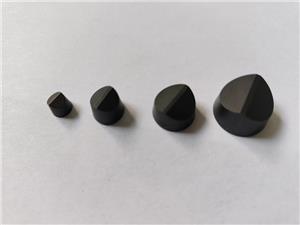
Applications and Partnerships Our PCD notching tools are used in: aluminum window frames, solar panel frames, automotive trim, aerospace brackets, and electronic enclosures. We are proud to partner with global procurement firms like Grainger, MSC Industrial, and Würth Industrie Service, who distribute our tools to over 50 countries. Additionally, we collaborate with machine tool builders like DMG MORI and Mazak to ensure optimal tool-machine integration.
FAQ
Q1: What is the optimal PCD grain size for notching aluminum? A: For aluminum, a fine grain size (1-3 microns) provides a sharp edge and good surface finish. Coarser grains (10-25 microns) are better for abrasive materials like MDF.
Q2: How do I calculate the expected tool life for a new application? A: Use the Taylor tool life equation: V * T^n = C. Measure cutting speed (V), tool life (T), and exponent (n) from test data. For PCD, n is typically 0.2-0.3. We provide a free spreadsheet tool with our technical white paper.
Q3: Can PCD tools be reconditioned? A: Yes, but only by grinding the cutting edge. Reconditioning can restore up to 80% of original tool life, but the tool diameter reduces. We offer reconditioning services with a 3-day turnaround.
Q4: What coolant pressure is recommended for PCD notching? A: Minimum 500 psi (35 bar) for effective chip evacuation and cooling. Higher pressures (up to 1000 psi) improve tool life by 30% but require a compatible machine.
Q5: How do I select the correct PCD grade for my material? A: Consider material hardness, abrasiveness, and cutting speed. For aluminum: low cobalt (6-8%) fine grain. For CFRP: high cobalt (12-15%) medium grain. For stainless steel: ultra-fine grain with 10% cobalt. Our technical team can help with a free grade recommendation.
Conclusion and Call to Action Premature tool failure is not inevitable. With the right material, geometry, and cooling, you can triple tool life, reduce scrap, and improve consistency. NANTONG LUCUBRATE MACHINERY TECHNICAL LTD. has the expertise to solve your PCD notching challenges. Download our technical white paper "Optimizing PCD Notching Tools for High-Volume Production" for detailed case studies and application guides. Or contact our sales engineers for a free tool audit. Visit www.lucubrate.com or email sales@lucubrate.com.