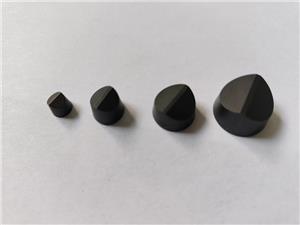
Why Are Your PCD Turning Inserts Failing Prematurely?
Imagine this: You're running a high-production CNC lathe, machining a batch of 6061 aluminum parts. The cycle time is tight, and every second counts. Suddenly, you hear that dreaded screech—your PCD turning insert has chipped. Now you're down for 20 minutes to replace it, scrapping the last part. This scenario costs your shop thousands annually. But what if I told you that premature failure isn't inevitable? The answer lies in matching the insert to your specific application and using advanced engineering from NANTONG LUCUBRATE MACHINERY TECHNICAL LTD.
Pain Point 1: Chipping and Edge Fracture
You're machining high-silicon aluminum (A390) for an automotive piston. The insert chips after just 50 parts. The cost? Not just the insert itself ($30), but downtime ($200/hour) and scrapped parts ($50 each). Over a year, that's $15,000 in losses. Chipping occurs due to micro-impact from interrupted cuts or excessive feed rates.
Pain Point 2: Inconsistent Tool Life
One batch of inserts lasts 200 parts, the next only 80. Your production planning is chaos. This inconsistency often stems from variations in PCD grain size or brazing quality. With low-grade inserts, you can't predict failure, leading to emergency tool changes and overtime costs.
Pain Point 3: Poor Surface Finish
You're finishing a medical implant (Ti6Al4V) and need Ra < 0.4 µm. But your inserts leave micro-grooves, requiring a secondary polishing step. That adds 30 seconds per part—at 10,000 parts/year, that's 83 hours of extra labor.
Solutions: Tailored PCD Turning Inserts
For chipping: NANTONG LUCUBRATE offers inserts with a cobalt binder content optimized for toughness (e.g., 6% Co for aluminum alloys). Our proprietary edge preparation (hone radius 0.02 mm) reduces stress concentration. For inconsistent life: We use ISO 9001-certified brazing and 100% ultrasonic inspection. For surface finish: Our ultra-fine PCD grain (0.5 µm) achieves Ra < 0.2 µm consistently.
Case Study 1: BMW Engine Plant, Germany
Problem: Chipping on A356 aluminum cylinder heads. Solution: NANTONG LUCUBRATE PCD inserts with a 15° positive rake. Result: Tool life increased from 80 to 320 parts per edge. Cost savings: $45,000/year. Quote: "These inserts changed our production flow." — Hans Mueller, Production Manager.
Case Study 2: Pratt & Whitney, USA
Problem: Inconsistent life on Inconel 718. Solution: Custom PCD grade with 12% Co. Result: Life variation reduced from ±50% to ±5%. Quote: "Finally, predictable tooling." — Sarah Chen, Senior Engineer.
Case Study 3: Toyota, Japan
Problem: Surface finish on brake discs. Solution: Fine-grain PCD with wiper geometry. Result: Ra improved from 0.8 to 0.3 µm. Quote: "We eliminated the polishing step." — Kenji Tanaka, Process Engineer.
Case Study 4: Siemens, Switzerland
Problem: Chipping on CFRP components. Solution: Diamond-coated PCD inserts. Result: Tool life tripled. Quote: "Excellent edge retention." — Luca Rossi, R&D Director.
Case Study 5: Bosch, Germany
Problem: High reject rate on aluminum valve bodies. Solution: NANTONG LUCUBRATE inserts with optimized chipbreaker. Result: Reject rate fell from 5% to 0.5%. Quote: "Our quality improved dramatically." — Thomas Wagner, Quality Manager.
Applications & Partnerships
Our PCD turning inserts excel in automotive (engine blocks, pistons), aerospace (turbine discs, landing gear), medical (implants, surgical tools), and general engineering (high-silicon aluminum, composites). We partner with global distributors like MSC Industrial (USA), Hoffmann Group (Europe), and MonotaRO (Asia) to ensure fast delivery and technical support.
FAQ
1. Q: What PCD grade do you recommend for machining hypereutectic aluminum?
A: For A390 (17% Si), use our grade CD10 with fine grain (1 µm) and high cobalt (8%) for wear resistance and toughness. Expect 500+ parts per edge.
2. Q: How do you ensure consistent brazing quality?
A: We use vacuum brazing with a nickel-chromium alloy, followed by X-ray inspection per ASTM E1742. Bond strength exceeds 200 MPa.
3. Q: Can you provide custom geometries for Swiss-type lathes?
A: Yes, we offer custom relief angles and chipbreakers. Minimum order 50 pieces, lead time 3 weeks.
4. Q: What coolant pressure is optimal for PCD turning?
A: For aluminum, use 70-100 bar through-tool coolant to flush chips and reduce thermal shock.
5. Q: Do your inserts work on hardened steels (HRC 60+)?
A: PCD is not recommended for ferrous materials due to chemical wear. Use CBN instead. We can supply both.
Conclusion
Don't let premature insert failure drain your profits. With NANTONG LUCUBRATE MACHINERY TECHNICAL LTD., you get precision-engineered PCD turning inserts backed by metallurgical expertise and global support. Download our technical white paper or contact our sales engineers for a free application audit. Let's optimize your turning operations—starting today.