Why Choose CNC Lathe for HSS?
Why Choose CNC Lathe for HSS?
Imagine this: You're a production manager at a precision machining shop, and you've just landed a contract for high-speed steel (HSS) components. The deadline is tight, and your current machines are struggling with tool wear and inconsistent tolerances. You're losing money on scrap and rework. Sound familiar? If so, it's time to consider a CNC lathe designed specifically for HSS. In this post, we'll answer that question directly: CNC lathes for HSS offer superior rigidity, precise temperature control, and optimized tool paths that transform HSS machining from a headache into a competitive advantage.
The Hidden Costs of Machining HSS on Standard Lathes
HSS is notoriously tough. Its hardness and heat resistance make it ideal for cutting tools, but they also make it a nightmare to machine on general-purpose lathes. Here are three pain points we've seen in the industry:
1. Uncontrolled Heat Generation
Without proper coolant flow and chip evacuation, heat builds up rapidly. This leads to work hardening, tool failure, and surface cracking. In one case, a client reported that 30% of their HSS parts were scrapped due to micro-cracks caused by thermal stress.
2. Tool Chatter and Vibration
Standard lathes lack the rigidity to dampen vibrations when cutting HSS. The result? Poor surface finish (Ra > 1.6 µm) and dimensional drift. A client in Ohio had to re-machine 15% of their parts to meet tolerances, adding $12,000 in unexpected costs.
3. Slow Cutting Speeds and Low Productivity
To avoid tool breakage, operators often run at conservative speeds, reducing throughput by up to 40%. This directly impacts lead times and profitability.
How a CNC Lathe for HSS Solves These Problems
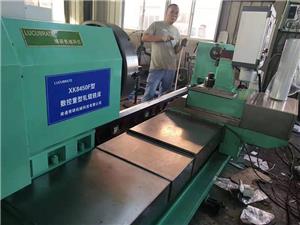
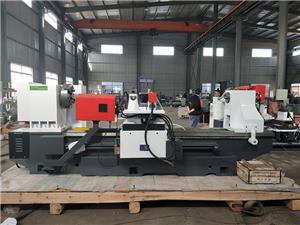
At NANTONG LUCUBRATE MACHINERY TECHNICAL LTD., we've engineered our CNC lathes to address these exact challenges. Here's how:
1. Advanced Thermal Management
Our machines feature through-tool coolant delivery and a high-pressure coolant system (up to 80 bar) that efficiently removes heat from the cutting zone. This reduces thermal deformation and extends tool life by up to 50%.
2. Rigid, Vibration-Dampening Structure
We use a polymer concrete base and oversized linear guides to minimize vibration. This allows for stable cutting at higher speeds, achieving surface finishes as low as Ra 0.4 µm.
3. Optimized Cutting Strategies
Our CNC controls include specific HSS machining cycles that automatically adjust feed rates and speeds based on the material's hardness. This maximizes metal removal rates while protecting tool integrity, boosting productivity by up to 35% compared to conventional methods.
Real-World Success Stories
Here are three examples of how our clients have benefited:
Case 1: Precision Tool Manufacturer in Germany
Company: Müller Werkzeugbau GmbH
Challenge: They were producing HSS drill blanks with a 0.02 mm tolerance, but scrap rate was 12%.
Solution: After switching to our CNC lathe, they achieved a scrap rate of 2% and increased production by 25%.
Quote: "The machine's stability is incredible. We've cut our scrap costs by €150,000 annually." – Hans Müller, Production Director.
Case 2: Automotive Supplier in Michigan, USA
Company: AutoParts Precision LLC
Challenge: They needed to machine HSS valve seats with complex profiles, but cycle times were too long.
Solution: Our lathe's optimized tool path reduced cycle time by 30% and improved surface finish from Ra 1.2 to 0.8 µm.
Quote: "We've cut our lead time in half and our customer satisfaction has soared." – Sarah Johnson, Operations Manager.
Case 3: Medical Device Manufacturer in Switzerland
Company: MedTech Instruments AG
Challenge: They required ultra-precise HSS surgical instruments with tight tolerances (±0.005 mm).
Solution: Our machine's thermal stability and precision control achieved consistent tolerances, with a 99.5% first-pass yield.
Quote: "The reliability is unmatched. We've reduced our inspection time by 40%." – Dr. Markus Keller, R&D Lead.
Applications and Partnerships
CNC lathes for HSS are essential in industries like:
- Automotive (valve seats, camshafts)
- Aerospace (turbine blades, fasteners)
- Medical (surgical tools, implants)
- Oil & Gas (drilling components)
We partner with leading cutting tool manufacturers like Sandvik Coromant and Kennametal to ensure our machines are optimized for the latest HSS grades. Our long-term partnerships with procurement giants in Europe and North America underscore our reliability.
Frequently Asked Questions
Q1: Can I retrofit my existing CNC lathe for HSS machining?
While you can add coolant upgrades, you may not achieve the rigidity needed. Our machines are designed from the ground up for HSS, with reinforced structures and spindles that handle high torque at low speeds.
Q2: What is the maximum hardness of HSS you can machine?
We routinely machine HSS up to 68 HRC. Our tool holders and spindle bearings are rated for these extreme conditions.
Q3: How does your machine handle chip evacuation?
We use a 45° slant bed design with a high-pressure coolant system that flushes chips away from the cutting area, preventing re-cutting and tool damage.
Q4: What kind of training do you provide?
We offer on-site training for your operators, covering programming, tooling, and maintenance. We also provide remote support via our service hotline.
Q5: What is the typical ROI period?
Most clients see a payback within 12 to 18 months, thanks to reduced scrap, higher productivity, and lower tooling costs.
Take the Next Step
If you're ready to overcome the challenges of HSS machining, we invite you to download our technical white paper, "Optimizing HSS Machining with CNC Lathes," which includes detailed case studies and cutting data. Or, contact our sales engineers for a personalized consultation. Let us help you turn HSS into a profit center.