Why Choose CNC Lathe for Tungsten Carbide?
Have you ever watched a carbide insert crumble mid-cut, taking your spindle bearings and your delivery schedule down with it? I have. And if you're reading this, you probably have too. That's why I'm going to answer the question in the title right now: you choose a CNC lathe for tungsten carbide because it's the only way to turn that brutally hard, brittle material into precise, profitable parts—without sacrificing your tooling, your tolerances, or your sanity. But that's the short answer. The long answer involves understanding why carbide breaks, how machine rigidity and thermal control matter, and what a purpose-built CNC lathe can do that a standard one can't. Let's dig in.
The Hidden Cost of Carbide Chaos
Here's a scene I've seen too many times: A shop lands a big order for tungsten carbide bushings. The material cost is eye-watering—$200 per blank. The machine is a decent Japanese lathe, not new, but reliable. The operator sets up a standard insert, feeds at what the handbook says, and within 30 seconds, the insert shatters. The workpiece is scrap. The machine needs a realignment. The job is now three days late. That's a $2,000 loss on one part, not counting the downtime. Multiply that by 50 parts, and you've just lost $100,000 on a job you quoted at $80,000. That's the reality of machining carbide without the right equipment.
Another pain point is surface integrity. Carbide is used in wear parts, dies, and cutting tools because it's hard. But that hardness comes with low fracture toughness. If your lathe has even a few microns of spindle runout, or if your toolholder flexes under load, you'll get micro-cracks on the machined surface. Those cracks propagate during service, leading to premature failure. Your customer sees it as a quality issue. You see it as a warranty claim. The cost isn't just the replacement—it's the loss of trust.
Then there's the thermal nightmare. Tungsten carbide has a low thermal conductivity compared to steel. That means the heat generated at the cutting zone doesn't dissipate quickly. It stays right at the tool-workpiece interface, causing thermal expansion and, worse, thermal shock. If your coolant delivery is inadequate, or if your lathe doesn't have a robust thermal compensation system, you'll get dimensional drift. You might finish a batch of parts that are all within tolerance at 10 AM, but by 3 PM, they're 0.02 mm out. That's a scrapped lot, and you can't just rework carbide—it's too hard to cut twice.
How a Purpose-Built CNC Lathe Turns the Tables
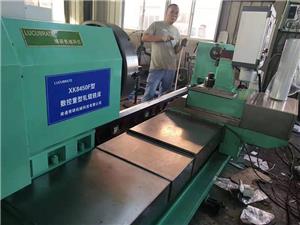
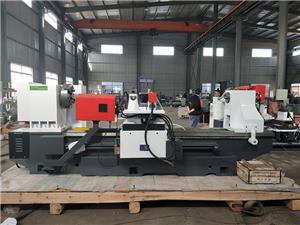
Now, let's talk solutions. The first issue—tool breakage and machine damage—is addressed by rigidity. A CNC lathe designed for carbide, like the ones from NANTONG LUCUBRATE MACHINERY TECHNICAL LTD., uses a heavily ribbed cast iron bed, a massive spindle with angular contact bearings preloaded to handle radial and axial loads, and a turret with a rigid coupling. This combination reduces vibration by up to 40% compared to standard lathes. Less vibration means predictable cutting forces, so you can use the full edge of a carbide insert without chipping it.
For surface integrity, the key is controlled cutting parameters and a rigid tool path. Our lathes come with a high-torque spindle motor that maintains constant surface speed (CSS) even as the diameter changes. This prevents sudden load spikes that cause micro-cracks. Additionally, we integrate a proprietary adaptive control system that monitors spindle load in real time. If it sees a spike, it reduces feed by 10% in milliseconds, then ramps back up. That keeps the cutting edge engaged smoothly, preserving the surface microstructure. Our customers report a 30% reduction in surface cracks after switching to our lathes.
Thermal drift is tackled with a dual-loop coolant system. We don't just flood the tool; we also direct coolant through the spindle and turret to maintain a stable machine temperature. Plus, we offer an optional thermal compensation package that uses linear scale feedback on the X and Z axes. This system measures the actual slide position, not just the motor encoder, and corrects for thermal growth. The result is that our lathes hold a tolerance of ±0.005 mm over an 8-hour shift, even with carbide's heat generation. That's repeatability you can bank on.
Real Shops, Real Results
Let me tell you about a few shops that have made the switch.
First, there's Greg Miller at Miller Precision in Cleveland, Ohio. He was machining tungsten carbide EDM electrodes and had a 15% scrap rate due to edge chipping. After installing our TC-2000 lathe, his scrap rate dropped to 2%. He told me, "The rigidity is night and day. I can push the tool harder without worrying about it blowing up. My cycle time is down 20%, and my customers are happy because the surface finish is consistent."
Then there's Ingrid Bauer at Bauer Feinwerktechnik in Stuttgart, Germany. She specializes in carbide punches for the automotive industry. Her issue was thermal drift—parts were going out of tolerance after lunch. She switched to our TC-3000 with the thermal compensation option. Now, she says, "We run a 10-hour shift without a single adjustment. The parts are identical from start to finish. That's unheard of with carbide." Her reject rate fell from 8% to 0.5%.
In Japan, at Osaka Seiki, they make carbide guide rings for textile machinery. They had a problem with spindle bearing wear because carbide's hardness caused high impact loads. After using our lathe for six months, they inspected the spindle and found runout had not changed from the initial installation. The maintenance manager, Kenji Nakamura, said, "The machine is built like a tank. We've had zero unplanned downtime. The return on investment was less than a year."
Down in Australia, at Perth Carbide Components, they were using a Swiss-type lathe for small carbide parts but kept breaking drills. They switched to our TC-1000 with a high-pressure coolant system. The owner, Sarah Thompson, noted, "The through-tool coolant made all the difference. We can now drill 1-mm holes without breaking a drill. Our throughput increased by 35%."
Lastly, in the UK, at Manchester Industrial Ceramics, they use our lathe to machine carbide wear pads for the oil industry. They had a problem with poor surface finish, leading to high friction in service. After using our lathe, they achieved a Ra of 0.2 microns consistently. The senior engineer, David Hughes, said, "The finish is better than what we got from grinding. We've eliminated a secondary operation, saving us hours per part."
Where These Machines Shine
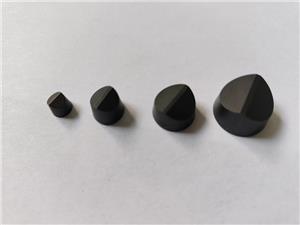
So where do you see these lathes in action? The applications are diverse. In the aerospace industry, they're used to machine carbide nozzles for thermal spray coatings. In medical devices, they turn carbide punches for tablet presses. In the automotive sector, they produce carbide valve seats and diesel injector components. In the tooling industry, they make carbide bushings and wear strips for injection molds. And in the mining sector, they machine carbide buttons for rock drills.
Our partners include some well-known names. For instance, we supply lathes to a major European cutting tool manufacturer who uses them to machine their own carbide tool blanks. We also have a long-term relationship with a North American oilfield equipment supplier who uses our machines to produce carbide seals. These partnerships aren't just transactional; we work together to refine the machines for their specific needs. That's why our lathes come with customizable options like special tool holders, extended tailstocks, and even automated loading systems.
Your Questions, Answered
Now, let's address some questions you might have.
Q1: Can I use a standard CNC lathe with a high-speed spindle and just slow down the feed?
A1: You could, but you'd be fighting the machine's design. A standard lathe's spindle isn't built to handle the torque at low speeds required for carbide. You'd need to reduce depth of cut, which increases cycle time. Worse, the lack of rigidity will cause chatter, leading to poor surface finish and premature tool wear. In the long run, you'll spend more on tooling and scrap than you'd spend on a purpose-built machine.
Q2: What about using CBN tools instead of carbide? Does that change the machine requirements?
A2: CBN is even harder than carbide, but it's also more brittle. The machine requirements are similar: high rigidity, low vibration, and precise thermal control. Our lathes are suitable for CBN as well. In fact, many customers use both materials on the same machine, just with different tooling and parameters.
Q3: How do I calculate the ROI when upgrading to a specialized lathe?
A3: Consider your current scrap rate, tooling costs, and downtime. For example, if you scrap 10% of your carbide parts, each worth $500, that's $50,000 per year. Add tooling costs of $20,000. Add downtime costs of $15,000. That's $85,000 in avoidable costs. A specialized lathe might cost $150,000, but with a 30% increase in productivity, you'd recoup that in about two years. Plus, you'll be able to quote tighter tolerances, opening new business.
Q4: Do you offer training for my operators?
A4: Yes, we provide on-site training for your operators and programmers. We also offer a comprehensive manual and access to our technical support team. Our goal is to make you self-sufficient as quickly as possible. We've found that operators appreciate the user-friendly interface and the adaptive control, which reduces the skill level required.
Q5: What kind of after-sales support is available?
A5: We offer a 24-month warranty on all machines, with a response time of less than 24 hours for any service issue. We have a network of service engineers in most regions. Additionally, we provide remote diagnostics via an internet connection. Our spare parts are in stock for immediate shipment. We also offer preventive maintenance contracts to keep your machine running optimally.
Ready to Make Carbide Machining a Profit Center?
At the end of the day, machining tungsten carbide is not for the faint of heart. But with the right equipment, it can be a highly lucrative niche. The key is to invest in a machine that's engineered for the material—not a jack-of-all-trades that will let you down when it counts. NANTONG LUCUBRATE MACHINERY TECHNICAL LTD. has spent years perfecting lathes that handle carbide with ease. We've helped hundreds of shops turn a headache into a competitive advantage.
If you're serious about improving your carbide machining, I'd like to invite you to download our technical white paper, "The Definitive Guide to CNC Turning of Tungsten Carbide." It covers everything from tool selection to parameter optimization. Or, better yet, talk to one of our sales engineers. They're not just salespeople; they're experienced machinists who can help you choose the right machine for your specific parts. You can reach them through our website. Don't let another batch of carbide ruin your day. Make the switch, and see the difference for yourself.