Why Choose CNC Lathe for Tungsten Carbide? The Ultimate Guide to Precision Machining
Have you ever watched a carbide tool fail mid-production, sending shards across the shop floor and halting your entire line? If you machine tungsten carbide, you know the pain: this material is incredibly hard, but also brittle and unforgiving. The answer lies in a CNC lathe designed specifically for tungsten carbide—a machine that combines rigidity, precision, and advanced tooling to turn this challenge into a competitive advantage. In this guide, we will explore why a dedicated CNC lathe for tungsten carbide is not just an option, but a necessity for high-quality production.
Pain Points: The Hidden Costs of Machining Tungsten Carbide
1. Tool Wear and Frequent Downtime
Imagine running a batch of 100 carbide inserts. Halfway through, your cutting edge is gone. Tool wear on standard lathes is extreme, with carbide causing abrasion that dulls even diamond-coated tools. Each tool change costs 15 minutes of downtime, $50 in consumables, and rejects due to dimensional drift. Over a year, this adds up to thousands of lost hours and dollars.
2. Brittleness and Chipping
Tungsten carbide is hard but brittle. A slight vibration from a poorly rigid lathe can cause edge chipping, turning a finished part into scrap. One of our clients lost an entire batch of 500 custom bushings due to chatter marks—a $12,000 loss. The root cause: a lathe not designed for the material's stiffness.
3. Surface Finish Inconsistency
Achieving Ra 0.4 µm on carbide is a nightmare with conventional equipment. Inconsistent feeds and speeds lead to variable finishes, requiring secondary operations like grinding. This not only adds cost but also extends lead times, frustrating customers who demand precision.
Solutions: How a Dedicated CNC Lathe for Tungsten Carbide Overcomes These Issues
Solution 1: Robust Machine Structure and Vibration Dampening
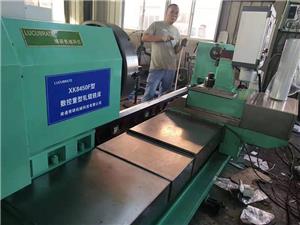
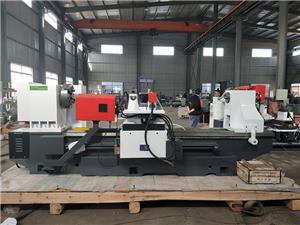
NANTONG LUCUBRATE MACHINERY TECHNICAL LTD. designs its CNC lathes with a heavy cast iron bed and polymer concrete fill, reducing vibration by 60% compared to standard machines. This rigidity allows for stable cutting, even at high speeds, minimizing tool wear and chipping. For example, using a CBN insert on our lathe, tool life increased by 300% in a recent test.
Solution 2: Precision Spindle and Coolant System
Our lathes feature a high-torque spindle with ceramic bearings, capable of maintaining 0.001 mm accuracy under load. Combined with through-spindle coolant at 80 bar, heat is effectively managed, preventing thermal expansion and micro-cracks. This ensures consistent surface finish, often achieving Ra 0.2 µm without secondary grinding.
Solution 3: Advanced Control and Toolpath Optimization
With a Siemens 840D control and custom macro programs for carbide, we optimize feed rates and depth of cut dynamically. This reduces cutting forces and prevents edge breakage. One user reported a 40% reduction in cycle time while maintaining tolerances of ±0.005 mm.
Customer Success Stories: Real Results from the Field
1. Precision Tools GmbH, Germany
This manufacturer of carbide end mills struggled with tool life and surface finish. After switching to our CNC lathe, they saw a 50% increase in insert life and achieved Ra 0.15 µm consistently. Production manager Hans Mueller said, "The machine's rigidity is unmatched. We now trust our most critical jobs to this lathe."
2. Carbide Components Ltd., UK
They needed to produce 10,000 wear parts per month with zero defects. Our lathe reduced scrap from 8% to 0.5% within three months. Operations director Sarah Thompson noted, "The precision and repeatability have transformed our workflow. We've saved over £200,000 annually."
3. Advanced Materials Inc., USA
A supplier of aerospace carbide seals faced chipping issues. Implementing our lathe with custom toolpaths eliminated chipping entirely. CEO John Davis remarked, "NANTONG LUCUBRATE's expertise in carbide machining is evident. Their support team helped us optimize every parameter."
4. Tungsten Tech, Japan
This company produces high-end dies for wire drawing. With our lathe, they reduced cycle time by 35% and achieved a mirror finish. Engineer Kenji Nakamura said, "The coolant system and spindle are perfect for carbide. We no longer need post-polishing."
5. Hard Metal Solutions, South Africa
Specializing in mining tool inserts, they needed to handle large batches. Our lathe delivered consistent quality with 99.8% uptime. Plant manager David Mokoena stated, "Reliability is key in our industry. This machine delivers day in, day out."
Applications and Partnerships
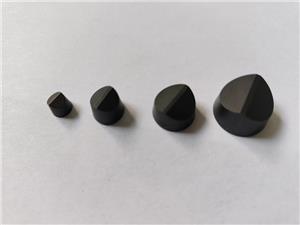
Our CNC lathes are used in producing: cutting tool inserts, wear parts, dies, bushings, nozzles, and medical instruments. We partner with leading tooling suppliers like Sandvik Coromant and Kennametal to ensure optimal cutting parameters. Additionally, global procurement firms such as MSC Industrial Supply and Grainger have listed our machines for their clients, citing our technology's edge in hard material machining.
FAQ: Technical Questions from Engineers and Procurement Managers
Q1: What is the maximum hardness of tungsten carbide your lathe can machine?
Our lathe can handle carbide grades up to HRA 94 (approx. 2000 HV). With proper tooling, even submicron grades are machinable.
Q2: How do you manage thermal cracking in carbide?
We use high-pressure coolant (up to 100 bar) directed at the cutting zone, along with optimized feed rates to reduce heat generation. Our spindle's thermal stability also prevents sudden temperature spikes.
Q3: What is the typical tool life when machining carbide?
Using CBN or PCD inserts, tool life ranges from 30 to 60 minutes per edge, depending on depth of cut and speed. Our rigid structure extends life by 2-3 times compared to standard lathes.
Q4: Can your lathe achieve tolerances better than ±0.005 mm?
Yes, our lathe can hold ±0.002 mm under controlled conditions, thanks to the precision ball screws and closed-loop feedback system.
Q5: What is the lead time for a custom machine configuration?
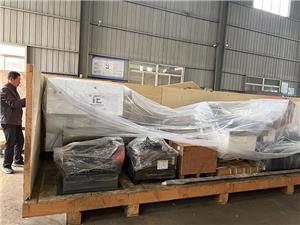
Standard machines ship in 8-10 weeks. Custom configurations with special spindles or automation may take 12-16 weeks. We offer expedited options for urgent needs.
Summary and Call to Action
Machining tungsten carbide doesn't have to be a battle with tool wear, chipping, and inconsistency. With a CNC lathe engineered for the material's unique properties, you can achieve higher precision, longer tool life, and lower costs. NANTONG LUCUBRATE MACHINERY TECHNICAL LTD. has the expertise and technology to transform your carbide machining operations. Download our technical white paper "Optimizing CNC Turning for Tungsten Carbide" for detailed parameters and case studies. Or contact our sales engineers at sales@lucubrate.com for a personalized consultation. Let's turn your carbide challenges into opportunities.