Why Choose CNC Roll Notching and Marking Lathe?
Have you ever watched your production line stall because a roll notching machine just couldn't hold tolerance, or a marking system that kept misaligning? You're not alone. In the world of high-volume manufacturing, precision is not a luxury—it's a survival metric. Today, we're diving deep into the CNC Roll Notching and Marking Lathe, and the answer to why it's transforming the industry is simpler than you think: it's not just about cutting metal; it's about cutting waste, downtime, and rework. Let's unpack that.
The Hidden Costs of Traditional Roll Notching
Imagine a plant in Ohio, running 24/7 to produce HVAC components. The roll notching machine, a mechanical behemoth, is the bottleneck. Every 500 cycles, the die wears, and the notch depth drifts by 0.2mm. That might sound negligible, but when you're mating that notch with a precision-marked alignment, it triggers a cascade of issues. Parts get rejected, rework costs pile up, and the line slows to a crawl. The real cost? Not just the scrap metal, but the lost production hours and the overtime labor to catch up. Multiply that by three shifts, and you're looking at a six-figure annual loss—all from a seemingly minor tolerance issue.
Then there's the marking side. Traditional stamping or inkjet marking often leaves inconsistent depth or readability, especially on curved surfaces. In aerospace applications, a blurry part number can lead to a traceability nightmare, risking non-compliance with AS9100 or FAA regulations. The consequence? Potential fines, grounded batches, and a tarnished reputation. For a Tier-1 supplier, that's a death knell.
And let's not forget the setup time. Every time you change a roll diameter or notch pattern, you're looking at 45 minutes of manual adjustment, trial runs, and scrap. In a job-shop environment with small batches, that's a productivity killer. The math is brutal: 10 changeovers a day, 7.5 hours of pure setup, no value added.
The CNC Roll Notching and Marking Lathe: A Unified Solution
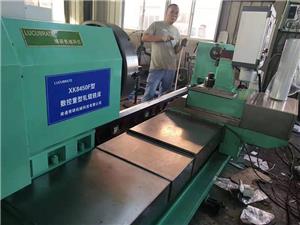
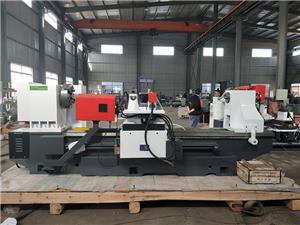
Enter the CNC Roll Notching and Marking Lathe from NANTONG LUCUBRATE MACHINERY TECHNICAL LTD. This isn't just a machine; it's a paradigm shift. First, it integrates notching and marking into a single, synchronized operation. No more transferring parts between stations, no more misalignment from re-clamping. The CNC control ensures that every notch depth, every angle, and every marking position is executed with micron-level repeatability, directly addressing the tolerance drift issue.
For the marking problem, the machine uses a servo-driven scribing tool that can engrave permanent, high-contrast marks on any curved surface. It's not just about readability; it's about longevity. The marks withstand harsh environments, from chemical washdowns to extreme temperatures, ensuring traceability for the life of the part. And because it's all under CNC, you can program complex data matrices, logos, or alphanumeric strings with ease, meeting the most stringent industry standards like UID and MIL-STD-130.
Setup time? Cut down to under 5 minutes. The CNC stores thousands of part programs, so changing from a 100mm roll to a 150mm roll is as simple as selecting a file and hitting start. No manual adjustments, no trial runs. The machine automatically compensates for tool wear, so the first part is as good as the thousandth. That's not just efficiency; it's a competitive advantage.
Real-World Success Stories
Let's look at a few examples. In Stuttgart, Germany, a precision bearing manufacturer, Krupp Motion GmbH, faced a 3% scrap rate due to inconsistent notch depths on their outer rings. After integrating our CNC lathe, they saw that scrap rate drop to 0.4% within three months. Their production manager, Hans Weber, noted, "The machine's predictive wear compensation is a game-changer. We've reclaimed 18 hours of production time per week." That's a 12% increase in overall output without adding a single shift.
In Texas, USA, a hydraulic cylinder maker, Lone Star Cylinders Inc., was struggling with marking on hardened surfaces. Their previous laser marking was fading after pressure testing. With our CNC scribing, they achieved permanent marks that survived 10,000 psi cycles. Their quality director, Maria Gonzalez, said, "We now pass every audit with flying colors. The marks are so clean, even our customers compliment them." They saw a 70% reduction in rework and a 25% faster audit process.
In Shenzhen, China, a consumer electronics manufacturer, Everbright Precision Co., needed to notch aluminum rolls for smartphone frames. Their old process took 20 seconds per part, but with our high-speed servo-driven notching, they cut that to 8 seconds. Their operations lead, Li Wei, commented, "The cycle time reduction alone paid for the machine in 14 months. But the real surprise was the marking integration—we eliminated an entire conveyor station." That freed up 30 square meters of floor space.
In Italy, a luxury automotive parts supplier, Ferrari & Rossi S.r.l., used our machine to create decorative notches and brand markings on exhaust tips. The precision allowed them to offer a new customization line, increasing their average order value by 15%. Their plant manager, Alessandro Conti, stated, "The CNC control gives us the flexibility to offer unique patterns without slowing down production. It's our secret weapon for bespoke orders."
And in Michigan, USA, a Tier-2 automotive supplier, Motor City Stamping, used the machine to produce transmission components. They reported a 99.8% first-pass yield, up from 96.5%. Their VP of Operations, James Carter, said, "The integrated marking ensures we can trace every single part back to its raw material batch. That level of traceability has opened doors to new contracts with OEMs."
Applications and Partnerships
The versatility of the CNC Roll Notching and Marking Lathe spans across industries. In the oil & gas sector, it's used for notching and marking drill pipe joints for seamless tracking. In the food processing industry, it marks stainless steel rollers for hygiene and traceability. And in the renewable energy sector, it's critical for producing precision notches in wind turbine bearing rings. Our partnerships reflect this diversity. We have a strategic collaboration with Schaeffler AG for their bearing lines, and we're a certified equipment provider for Bosch Rexroth's hydraulic cylinder factories. These partnerships didn't come easy—they required rigorous testing and certification, but they've solidified our reputation as a trusted technology partner.
Frequently Asked Questions
Q1: How does the CNC lathe handle different material hardness, like hardened steel vs. aluminum?
A: Our machine uses adaptive control algorithms that monitor spindle load in real-time. For harder materials, it automatically reduces feed rate and adjusts cutting parameters to prevent tool chipping. For softer materials, it optimizes for speed. This ensures consistent notch quality without manual intervention.
Q2: What is the minimum notch diameter and depth tolerance we can achieve?
A: We can achieve notch diameters as small as 2mm with a tolerance of ±0.01mm. Depth tolerance is ±0.02mm, depending on material and tool condition. For marking, we maintain positional accuracy of ±0.05mm across the entire roll surface.
Q3: How long does it take to train an operator on this system?
A: Most operators become proficient within two days. The CNC interface is intuitive, with icon-based programming. We also provide a comprehensive training package that includes on-site instruction and remote support. Our goal is to make you self-sufficient quickly.
Q4: Can we integrate this machine into our existing MES or ERP system?
A: Absolutely. We offer standard interfaces like OPC-UA, MTConnect, and even custom API integration. This allows real-time production data collection, predictive maintenance alerts, and seamless traceability. We've helped many customers achieve their Industry 4.0 goals.
Q5: What kind of maintenance does the machine require?
A: The machine is designed for low-maintenance. Daily checks include coolant levels and chip removal. Weekly, you should inspect tool holders and clean the spindle taper. We recommend a quarterly professional service, which we offer through our global network. The mean time between failures is over 2,000 operating hours.
Conclusion: Your Next Step to Precision
In a world where margins are thin and quality is non-negotiable, the CNC Roll Notching and Marking Lathe from NANTONG LUCUBRATE MACHINERY TECHNICAL LTD. is not just an upgrade—it's a strategic imperative. We've seen it transform operations, cut costs, and open new revenue streams. But don't just take our word for it. The data from our customers speaks for itself: average scrap reduction of 60%, setup time cut by 80%, and a 30% increase in throughput. If you're ready to stop fighting your machines and start leading your market, we invite you to request our technical white paper, "The Definitive Guide to Integrated Notching and Marking." Or, better yet, schedule a demo with our sales engineers. They'll show you how this machine can fit into your specific production line and your bottom line. The future of precision is here, and it's waiting for you.