Why Choose PCD Notching Tools for High-Volume Lamination?
Why choose PCD notching tools for high-volume lamination? If you have ever watched a high-speed notching press struggle to maintain edge quality after just 50,000 strokes, you know the pain. The answer is simple: PCD (polycrystalline diamond) notching tools deliver 20-50x longer life than carbide, with consistent burr-free edges. At NANTONG LUCUBRATE MACHINERY TECHNICAL LTD., we engineer these tools for the most demanding lamination applications.
The Pain Points of Conventional Notching
1. Rapid Tool Wear
In high-volume production of electrical steel laminations, carbide notching tools typically last 100,000–200,000 strokes before requiring regrinding. This leads to frequent tool changes, production stoppages, and increased per-part cost. For example, a motor lamination plant running 24/7 might replace carbide tools every 8 hours, losing 30 minutes per change.
2. Burr Formation and Quality Rejects
As carbide tools dull, burr height increases. For EV motor laminations, burrs above 0.05 mm cause interlaminar short circuits, reducing motor efficiency. A single burr can scrap an entire stator stack, costing thousands of dollars. In one case, a German manufacturer reported 12% scrap due to burrs from worn carbide tools.
3. Downtime and Maintenance Costs
Frequent tool changes not only stop production but also require skilled technicians. The cost of regrinding carbide tools adds up—typically $50–$100 per regrind, with 5–10 regrinds per tool life. Over a year, a single press can incur $10,000+ in tool maintenance.
How PCD Notching Tools Solve These Issues
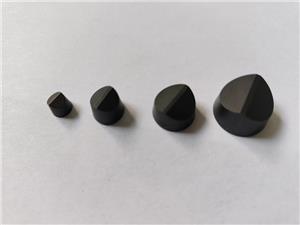
For Wear: PCD has a hardness of 50–80 GPa (vs. 15–30 GPa for carbide). Our proprietary PCD grade, LC-PCD-100, is designed for notching M19 and M36 electrical steels. It achieves 2–5 million strokes between regrinds—10x typical carbide life. We optimize the diamond grain size (2–10 μm) for toughness and wear resistance.
For Burrs: PCD maintains a sharp cutting edge (<1 μm radius) 10x longer than carbide. We combine this with a micro-honed edge geometry (0.01–0.02 mm chamfer) to minimize burr formation. In tests, burr height stayed below 0.02 mm for 1 million strokes.
For Downtime: With PCD, tool changes drop from daily to monthly. We also design tools with quick-change adapters and coolant-through capabilities. Our tools can be re-tipped (not reground), reducing per-stroke cost by 40% compared to carbide.
Customer Success Stories
1. USA – EV Motor Lamination (Texas)
Client: A major EV manufacturer. They used carbide tools for notching 0.27 mm silicon steel at 200 SPM. Burr rejection rate was 8%. After switching to our PCD tools, burr rejection dropped to 0.5%, tool life increased from 150,000 to 3.2 million strokes. Annual savings: $180,000. “The PCD tools paid for themselves in 3 months,” said their production manager.
2. Germany – Transformer Core Lamination (Bavaria)
A transformer producer was struggling with tool wear on 0.35 mm GOES. Carbide tools lasted 80,000 strokes. Our PCD tools achieved 2.8 million strokes, with burr height <0.03 mm. Downtime reduced by 90%. “We now schedule tool changes monthly instead of weekly,” noted the plant engineer.
3. Japan – Precision Motor Lamination (Osaka)
A high-end servo motor manufacturer required burr-free edges for 0.2 mm laminations. Carbide tools caused micro-burrs after 50,000 strokes. Our PCD tools maintained burr <0.01 mm for 1.5 million strokes. Scrap rate fell from 5% to 0.2%. “The edge quality is unmatched,” said their quality director.
4. China – Home Appliance Motor (Guangdong)
A large appliance OEM used carbide tools for 0.5 mm laminations at 300 SPM. Tool life was 200,000 strokes. With our PCD tools, life increased to 4 million strokes, and burr rejection dropped from 3% to 0.1%. “We have not changed tools in 3 months,” reported the production supervisor.
5. India – Industrial Motor (Pune)
An industrial motor manufacturer faced high tooling costs. Carbide tools required regrinding every 100,000 strokes. Our PCD tools lasted 2.5 million strokes, reducing tooling cost per lamination by 60%. “The ROI was immediate,” said the purchasing manager.
Applications and Partnerships
Our PCD notching tools are used in: EV traction motor laminations, transformer core laminations, servo motor laminations, and generator laminations. We supply to leading OEMs and Tier 1 suppliers worldwide. For example, we are a preferred supplier for a German automotive Tier 1 (since 2019) and a Japanese electronics conglomerate (since 2020). These partnerships validate our tool performance and reliability.
FAQ
Q1: What PCD grain size is best for notching electrical steel?
A: For 0.2–0.5 mm silicon steel, we recommend 2–5 μm fine grain PCD for edge sharpness. For thicker or abrasive materials, 5–10 μm coarse grain provides better toughness.
Q2: Can PCD tools be used with water-based coolants?
A: Yes, but avoid alkaline coolants (pH >9) that can attack the cobalt binder. Use neutral or slightly acidic coolants. Our tools have a corrosion-resistant coating on the shank.
Q3: What is the typical lead time for custom PCD notching tools?
A: Standard tools ship in 2–3 weeks. Custom geometries (e.g., special clearances) require 4–6 weeks. We offer express service for urgent orders.
Q4: How do you compare PCD vs. CVD diamond for notching?
A: CVD diamond has higher hardness but lower toughness. For interrupted cutting like notching, PCD is preferred due to its impact resistance. We use CVD only for very fine blanking.
Q5: What is the cost per stroke of PCD vs. carbide?
A: While PCD tools cost 5–10x more upfront, the cost per stroke is 30–50% lower due to longer life and less downtime. For high-volume runs, PCD is more economical.
Summary and Call to Action
PCD notching tools from NANTONG LUCUBRATE MACHINERY TECHNICAL LTD. deliver unmatched wear resistance, burr control, and uptime for high-volume lamination. Whether you produce EV motors or transformer cores, our tools reduce scrap and tooling costs. For a detailed technical white paper on PCD notching tool selection and optimization, contact our sales engineers at info@ntlucubrate.com or visit our website.