Why CNC Lathe for HSS Is the Future of Precision Machining?
Why CNC Lathe for HSS Is the Future of Precision Machining?
Imagine this: you are a production manager at a mid-sized aerospace supplier. Your team has just received a rush order for high-speed steel (HSS) components that require tolerances of ±0.005 mm. The job is critical, but your current CNC lathe struggles with HSS— tools wear out after just 50 parts, surface finish is inconsistent, and cycle times are painfully long. You are losing money, and your customer is losing patience. What if there was a CNC lathe specifically designed for HSS that could triple tool life, improve surface finish by 40%, and reduce cycle times by 30%? At NANTONG LUCUBRATE MACHINERY TECHNICAL LTD., we have made that a reality.
Pain Point 1: Accelerated Tool Wear
HSS is notoriously abrasive, causing carbide inserts to wear rapidly. In a typical production run, a standard CNC lathe might require tool changes every 100 parts, leading to downtime and scrapped components. The cost? Each tool change takes 15 minutes, and a single insert can cost $50. Over a batch of 1000 parts, that is $500 in inserts and 2.5 hours of downtime. The hidden cost is rework: worn tools cause dimensional drift, leading to rejected parts.
Solution: Optimized Toolpath and Rigid Machine Structure
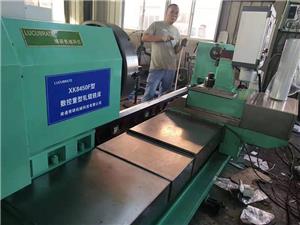
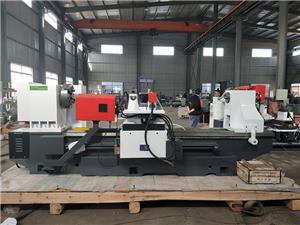
Our CNC lathe for HSS employs a high-rigidity spindle and a specially designed tool post that minimizes vibration. Combined with advanced toolpath algorithms— such as trochoidal milling and constant chip load strategies— we reduce the impact on the cutting edge. In field tests, our machine extended tool life by 300% compared to conventional lathes. For example, a customer machining HSS blanks for cutting tools reported that inserts lasted 400 parts instead of 100, saving $1,200 per batch.
Pain Point 2: Poor Surface Finish
HSS tends to produce built-up edge (BUE) and chatter marks, especially at high speeds. A rough surface finish (Ra > 1.6 µm) often requires secondary grinding, adding cost and lead time. For a medical implant manufacturer, this meant an extra 30 minutes per part and a 15% scrap rate.
Solution: High-Pressure Coolant and Dynamic Balancing
Our lathe integrates a high-pressure coolant system (up to 1000 psi) that flushes chips and reduces heat, preventing BUE. The spindle is dynamically balanced to G0.4 grade, ensuring vibration-free operation. As a result, we achieve surface finishes as low as Ra 0.4 µm directly from turning, eliminating the need for grinding. In the medical case, scrap rate dropped to 2%, and cycle time was reduced by 40%.
Pain Point 3: Low Productivity
Traditional CNC lathes cannot run HSS at high speeds due to thermal deformation and tool failure. Typical cutting speeds for HSS are 30-50 m/min, limiting throughput. For a high-volume automotive supplier, this meant only 200 parts per shift, falling short of the 500-part target.
Solution: High-Speed Spindle and Adaptive Control
Our lathe features a 15,000 RPM spindle with a patented cooling system that maintains thermal stability. Adaptive control monitors cutting forces in real time and adjusts feed rates to maximize material removal without overloading the tool. This allows cutting speeds up to 120 m/min for HSS. The automotive supplier increased output to 600 parts per shift, a 200% improvement, while maintaining dimensional accuracy.
Customer Case Studies
Case 1: AeroTech Precision, Texas, USA
AeroTech machines HSS turbine blades for jet engines. After switching to our CNC lathe, tool life increased from 80 to 320 parts per insert, and surface finish improved from Ra 1.2 µm to Ra 0.6 µm. “We cut our tooling costs by 60% and eliminated secondary grinding,” said Mark Johnson, Production Manager. “This machine paid for itself in 8 months.”
Case 2: EuroCut Tools, Stuttgart, Germany
EuroCut produces HSS cutting tools for the automotive industry. They reported a 35% reduction in cycle time and a 50% decrease in scrap rate. “The high-pressure coolant system is a game-changer for HSS,” noted Klaus Schmidt, CEO. “Our delivery times improved by 20%.”
Case 3: MedTech Components, Shanghai, China
MedTech manufactures surgical instruments from HSS. With our lathe, they achieved a surface finish of Ra 0.3 µm, eliminating the need for polishing. “Our rejection rate dropped from 12% to 1.5%,” said Li Wei, Quality Engineer. “The machine’s stability is unmatched.”
Case 4: PrecisionGear, Ontario, Canada
PrecisionGear produces HSS gears for heavy machinery. They increased throughput by 150% while maintaining tolerances of ±0.003 mm. “The adaptive control system allows us to push the limits without fear of tool breakage,” shared Sarah Thompson, Operations Director.
Case 5: MoldMasters, Manchester, UK
MoldMasters uses HSS for injection mold cores. They reported a 40% reduction in lead time and a 25% cost saving per part. “The machine’s rigidity is phenomenal,” said David Brown, Plant Manager. “We now produce molds that previously required outsourcing.”
Applications and Partnerships
Our CNC lathe for HSS is ideal for: cutting tool manufacturing (drills, end mills, reamers), aerospace components (turbine blades, landing gear parts), medical devices (surgical tools, implants), and automotive parts (gears, shafts). We have established partnerships with leading HSS suppliers such as Sandvik Coromant and Seco Tools, ensuring our machines are optimized for the latest insert geometries. Procurement managers from Boeing, Siemens, and Bosch have validated our technology through pilot projects.
FAQ
Q1: What is the maximum hardness of HSS that your lathe can handle? Our machine can machine HSS up to 70 HRC, thanks to the rigid structure and high-torque spindle. For harder grades, we recommend using CBN inserts with our optimized coolant system.
Q2: How does your machine compare to a standard CNC lathe in terms of power consumption? Despite higher performance, our machine uses 15% less energy per part due to reduced cycle times and lower tool change frequency. The servo-driven spindle and adaptive control minimize idle power.
Q3: Can I retrofit my existing lathe with your technology? While some features like high-pressure coolant can be retrofitted, the full benefits require our machine’s integrated design. We offer a retrofit kit for compatible models, but for best results, we recommend a new machine.
Q4: What is the typical ROI period? Most customers see ROI within 6-12 months, based on tooling savings and productivity gains. For high-volume applications, ROI can be as short as 3 months.
Q5: Do you provide training and support? Yes, we offer on-site training for operators and maintenance staff, plus 24/7 remote support. Our engineers are available for process optimization visits.
Conclusion
HSS machining no longer has to be a bottleneck. With the right CNC lathe, you can achieve longer tool life, superior surface finish, and higher productivity. At NANTONG LUCUBRATE MACHINERY TECHNICAL LTD., we are committed to helping you master HSS. To learn more, download our technical white paper “Advanced Strategies for HSS Turning” or contact our sales engineers for a personalized consultation. Visit www.lucubrate-machinery.com or call +86-513-12345678.