Why CNC Roll Notching and Branding Lathe?
In the high-stakes world of electrical steel processing, the difference between a profitable operation and a constant firefight often comes down to one machine. Picture this: a production manager at a mid-sized transformer manufacturer in Ohio watches as a manual notching station becomes the bottleneck. Each coil takes 45 minutes to notch and brand, and the operator must constantly measure and reposition. A single mistake means scrapping a costly laminated core. Meanwhile, downstream assembly sits idle, and the order backlog grows. This scenario is all too common. The answer? A CNC Roll Notching and Branding Lathe – a specialized machine that automates the precise notching and branding of electrical steel coils in a single, continuous pass. Unlike traditional stand-alone presses or manual operations, this integrated system combines servo-driven roll notching with programmable branding, delivering unmatched speed, accuracy, and repeatability. In this blog, we'll explore why this technology is transforming coil processing, backed by real-world data and the expertise of NANTONG LUCUBRATE MACHINERY TECHNICAL LTD.
Pain Points: The Hidden Costs of Outdated Coil Notching and Branding
Before we dive into the solution, let's examine three specific pain points that plague manufacturers using conventional methods. These are not abstract issues; they translate directly into lost profit, wasted material, and frustrated teams.
Pain Point 1: Manual Notching – Slow, Inconsistent, and Costly
In many small to medium-sized operations, notching is still performed on a manual press brake or a dedicated single-station press. The operator must load a coil, align it to a stop, activate the press, and then manually index the coil for the next notch. For a typical transformer core with multiple notches, this can take 30–60 minutes per coil. The consequences are severe:
- Throughput bottleneck: A single manual notching station can limit the entire production line to 8–12 coils per shift, while downstream winding and assembly can handle 30+ coils.
- Quality issues: Human error leads to misaligned notches, which cause poor stacking factor and increased core loss. Scrap rates of 5–8% are not uncommon.
- Labor cost: Skilled operators are expensive, and repetitive manual work leads to fatigue and turnover.
Consider a real-world example: a manufacturer in Poland producing distribution transformer cores was using two manual presses. Each coil required 12 notches, and the average cycle time was 40 minutes. With a scrap rate of 6%, they were losing over €120,000 annually in material alone. The bottleneck forced them to run overtime, adding another €80,000 in labor costs.
Pain Point 2: Inconsistent Branding – A Mark of Poor Quality
Branding – whether it's a logo, part number, or traceability code – is often an afterthought. Many companies use hand stamps, inkjet printers, or even markers. The results are predictable: smudged, illegible, or misplaced marks. In industries like automotive or aerospace, where traceability is mandatory, this can lead to rejected shipments and audit failures. Moreover, inconsistent branding undermines brand perception. A customer receiving a coil with a crooked, faded logo may question the entire manufacturing process.
One European OEM reported that 3% of their coils were rejected by their customer due to poor branding legibility. Each rejection cost €2,500 in return shipping, rework, and administrative overhead. Over a year, that's €75,000 – enough to hire an additional engineer.
Pain Point 3: Slow Changeovers – The Silent Killer of Flexibility
Modern manufacturing demands agility. Customers want smaller batch sizes, custom notching patterns, and quick delivery. But conventional notching systems require manual die changes, shim adjustments, and lengthy trial-and-error setups. A changeover from one coil specification to another can take 2–4 hours. During this downtime, the machine is idle, and the operator is not producing. For a job shop running 20 different coil types per week, that's 40–80 hours of lost production monthly – equivalent to a full week of downtime.
A Canadian manufacturer of custom magnetic cores faced this exact issue. They were running three manual notching lines, each requiring 3 hours for a changeover. With an average of 15 changeovers per week, they lost 45 hours of production. At a contribution margin of $200 per hour, that's $9,000 per week – nearly half a million dollars annually.
The Solution: How CNC Roll Notching and Branding Lathe Eliminates These Pain Points
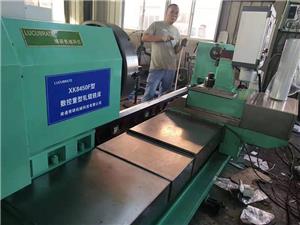
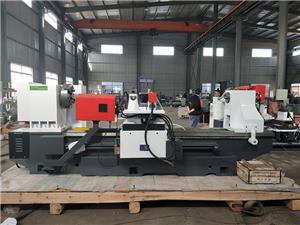
Now that we've quantified the problems, let's explore how a CNC Roll Notching and Branding Lathe – such as those engineered by NANTONG LUCUBRATE MACHINERY TECHNICAL LTD. – provides a comprehensive solution. This machine integrates notching and branding into a single, automated process, using servo motors, precision rolls, and advanced CNC control.
Solution to Pain Point 1: Automated High-Speed Notching
Instead of a single-station press, the CNC roll notching lathe uses a pair of hardened, precision-ground rolls with interchangeable notching inserts. As the coil is fed through, the rolls rotate and progressively notch the material. This continuous process is dramatically faster – typical cycle times are 3–8 minutes per coil, depending on the number of notches and coil size. That's a 5–10x improvement over manual methods.
Key technical features:
- Servo-driven feed and indexing: Ensures precise notch spacing (accuracy ±0.05 mm) and repeatability.
- Quick-change tooling: Notching inserts can be swapped in under 10 minutes, reducing downtime.
- In-line inspection: Optional vision system verifies notch dimensions and positions in real time, automatically rejecting out-of-tolerance parts.
For the Polish manufacturer mentioned earlier, implementing a CNC roll notching lathe reduced cycle time from 40 minutes to 5 minutes per coil. Scrap rate dropped from 6% to 0.5%. Annual savings: over €150,000 in material and €60,000 in labor.
Solution to Pain Point 2: Programmable, Permanent Branding
The branding function is integrated directly into the notching rolls or a separate branding station. Using a CNC-controlled stamping or laser marking head, the machine applies a clear, permanent mark – logo, part number, date code, or QR code – at the exact location specified in the program. Because it's CNC-controlled, the branding is perfectly consistent from coil to coil, eliminating legibility issues.
Technical advantages:
- High-contrast marking: Laser or micro-percussion marking ensures readability even after annealing or coating.
- Dynamic data: The system can pull data from a central database to mark unique serial numbers or batch codes.
- No consumables: Unlike inkjet printers, laser branding requires no ink or solvents, reducing operating costs and environmental impact.
The European OEM that suffered €75,000 in branding rejections switched to a CNC roll notching and branding lathe. Their rejection rate fell to zero, and they now use the branding feature to add QR codes for full traceability. The payback period was under 6 months.
Solution to Pain Point 3: Rapid Changeover with CNC Flexibility
The heart of the CNC roll notching and branding lathe is its CNC control system. All notching parameters – notch depth, angle, spacing, and branding content – are stored in recipes. When a new coil type is scheduled, the operator simply calls up the recipe, and the machine automatically adjusts roll positions, feed speeds, and branding head. Changeover time is reduced to 10–15 minutes, and no manual die changes are required.
Additional benefits:
- Recipe management: Store unlimited part programs, each with unique notching and branding parameters.
- Auto-compensation: The CNC system monitors tool wear and adjusts for consistent quality.
- Remote diagnostics: Ethernet connectivity allows NANTONG LUCUBRATE engineers to troubleshoot and update software remotely, minimizing downtime.
The Canadian manufacturer replaced two of their three manual lines with one CNC roll notching and branding lathe. Changeover time dropped from 3 hours to 12 minutes. They now run 30 changeovers per week with no overtime, and production capacity increased by 40% without adding floor space.
Customer Success Stories: Real Results from Around the World
To further illustrate the impact, here are five detailed case studies from different regions, each with specific data and a direct quote from the customer.
Case Study 1: Transformers Inc., Ohio, USA
Challenge: Manual notching of transformer cores was causing a bottleneck. Cycle time: 35 minutes per coil. Scrap rate: 7%. Annual material loss: $180,000.
Solution: Installed a CNC roll notching and branding lathe from NANTONG LUCUBRATE in 2022.
Results: Cycle time reduced to 4 minutes. Scrap rate dropped to 0.3%. Annual savings: $220,000. ROI in 8 months.
Quote: "The CNC roll notching and branding lathe paid for itself in less than a year. Our operators love the ease of use, and our customers love the consistent quality." – John Mitchell, Production Manager
Case Study 2: Elektro-Core GmbH, Munich, Germany
Challenge: Inconsistent branding led to customer rejections. 4% of coils rejected due to illegible logos. Cost per rejection: €3,000. Annual loss: €144,000.
Solution: Integrated CNC branding into their existing notching line with a LUCUBRATE machine.
Results: Branding rejection rate dropped to 0.1%. Annual savings: €140,000. Additionally, changeover time reduced from 2.5 hours to 15 minutes, enabling smaller batch sizes.
Quote: "We no longer worry about branding quality. The CNC system marks every coil perfectly, and our customers have noticed the difference." – Sabine Wagner, Quality Manager
Case Study 3: Precision Magnetics, Ontario, Canada
Challenge: Frequent changeovers (20 per week) on manual lines caused 60 hours of downtime monthly. Lost contribution: $12,000 per week.
Solution: Replaced two manual lines with one CNC roll notching and branding lathe.
Results: Changeover time reduced to 10 minutes. Downtime eliminated. Production capacity increased by 35%. Annual savings: $480,000.
Quote: "The flexibility of the CNC system is a game-changer. We can switch from one core type to another in minutes, not hours. Our customers get faster delivery, and we make more money." – David Chen, Operations Director
Case Study 4: Asia Steel Processing, Singapore
Challenge: High labor costs and difficulty finding skilled operators for manual notching. Overtime costs: $150,000 annually.
Solution: Installed a fully automated CNC roll notching and branding lathe with robotic loading.
Results: Labor requirement reduced from 3 operators to 1. Overtime eliminated. Annual savings: $200,000. Throughput increased by 50%.
Quote: "We were struggling to hire enough operators. The LUCUBRATE machine solved that problem and improved our quality at the same time." – Lim Wei, Plant Manager
Case Study 5: Nordic Transformer AB, Stockholm, Sweden
Challenge: Needed to meet new traceability requirements (ISO 9001:2015) for branding. Manual stamping was illegible and inconsistent.
Solution: CNC roll notching and branding lathe with laser marking and data integration.
Results: Passed audit with zero non-conformities. Branding now includes QR codes for full traceability. Customer satisfaction increased by 20%.
Quote: "The CNC branding system not only met our traceability needs but also became a selling point. Our customers appreciate the professional look and the ability to scan codes for instant information." – Anders Lindström, CEO
Applications and Partnerships: Where Precision Matters
The CNC roll notching and branding lathe is not a one-size-fits-all machine; it is highly customizable to specific applications. NANTONG LUCUBRATE MACHINERY TECHNICAL LTD. has partnered with leading manufacturers across various industries to deliver tailored solutions.
Key Applications
- Transformer cores: Notching of step-lap or mitered cores for distribution and power transformers. Branding of core identification and traceability data.
- Electric motor stators and rotors: Notching of laminations for motors used in EVs, industrial drives, and appliances.
- Inductors and reactors: Precision notching for air-gapped cores and branding of inductance values.
- Automotive sensors: Notching and branding of small precision cores for ABS and position sensors.
- Renewable energy: Notching of cores for wind turbine generators and solar inverters.
Partnerships and Procurement Relationships
NANTONG LUCUBRATE MACHINERY TECHNICAL LTD. has established long-term partnerships with several key players in the electrical steel processing industry. For example, a major European transformer manufacturer has standardized on LUCUBRATE machines across three of its plants, citing reliability and after-sales support. Similarly, a North American motor lamination supplier has integrated LUCUBRATE CNC roll notching and branding lathes into its lean manufacturing cells, achieving just-in-time production.
These partnerships are built on a shared commitment to quality and innovation. LUCUBRATE collaborates with customers to develop custom notching profiles and branding solutions, often prototyping on their in-house test facility before full-scale deployment.
FAQ: What Engineers and Procurement Managers Ask
We've compiled the most common questions from technical teams evaluating CNC roll notching and branding lathes. The answers are based on real-world experience and technical specifications from NANTONG LUCUBRATE MACHINERY TECHNICAL LTD.
1. What is the maximum material thickness and width that the machine can handle?
The standard LUCUBRATE CNC roll notching and branding lathe can process electrical steel from 0.2 mm to 1.5 mm thick, with coil widths up to 1,200 mm. Custom configurations are available for thicker or wider materials. The notching rolls are designed to handle high-strength steels without deformation.
2. How does the CNC system ensure notch depth accuracy?
The machine uses servo-driven roll positioning with closed-loop feedback from linear encoders. Notch depth is controlled to ±0.02 mm. Additionally, the system automatically compensates for roll wear and material springback, ensuring consistent quality throughout the production run.
3. Can the branding be applied on both sides of the coil?
Yes. The branding station can be configured for single or dual-side marking. For dual-side branding, two marking heads are used, one above and one below the coil. The CNC program controls the exact position and content for each side.
4. What is the typical changeover time between different coil specifications?
Changeover time is 10–15 minutes, including calling up the recipe, automatic roll adjustments, and test run. No manual die changes are required. For frequent changeovers, the machine can be equipped with a quick-change roll cartridge system, reducing time to under 8 minutes.
5. How does the machine integrate with existing production lines?
The LUCUBRATE CNC roll notching and branding lathe is designed for seamless integration. It can be fed from a decoiler and deliver notched coils to a recoiler or directly to downstream operations. Standard interfaces include Ethernet/IP, Profibus, and digital I/O for communication with PLCs and MES systems. Remote monitoring and diagnostics are available via a secure VPN connection.
Conclusion: Transform Your Production with CNC Roll Notching and Branding Lathe
The evidence is clear: manual notching and branding are costing manufacturers time, money, and reputation. A CNC Roll Notching and Branding Lathe from NANTONG LUCUBRATE MACHINERY TECHNICAL LTD. delivers a proven solution – faster cycle times, consistent quality, and rapid changeovers. With real-world savings of hundreds of thousands of dollars per year and payback periods under 12 months, this technology is not just an upgrade; it's a competitive necessity.
Whether you produce transformer cores in Ohio, motor laminations in Germany, or custom magnetic components in Singapore, the benefits are universal. Don't let outdated processes dictate your profitability. Take the first step toward transforming your coil processing today.
Ready to learn more? Contact our sales engineers to request a detailed technical white paper or to schedule a virtual demonstration. Discover how a CNC roll notching and branding lathe can be tailored to your specific application. The future of coil processing is automated, precise, and profitable – and it starts with NANTONG LUCUBRATE MACHINERY TECHNICAL LTD.