Why CNC Roll Notching & Marking Lathes?
Why CNC Roll Notching & Marking Lathes? If you work in the metal forming or roll forming industry, you've likely seen the aftermath of manual notching and marking: a pile of scrapped rolls, inconsistent notch depths, and a production line down for hours. The answer is simple: a CNC roll notching and marking lathe eliminates these problems by combining precision turning, notching, and marking in one automated cycle. At NANTONG LUCUBRATE MACHINERY TECHNICAL LTD., we've spent over two decades perfecting this technology for roll forming lines worldwide. This blog dives deep into the why, the how, and the real-world impact.
Pain Point 1: Manual Marking and Notching – Slow, Inaccurate, and Costly
In many small to mid-size roll forming shops, operators still use hand grinders, punch presses, or manual lathes to create notches and marks on rolls. A typical scenario: a roll forming line producing 200 meters per minute of steel profiles. When a roll needs a notch for a cut-off die or a mark for traceability, the operator stops the line, removes the roll, and manually grinds a notch. This takes 20–30 minutes per roll. If the line runs three shifts, that's up to 90 minutes of downtime per day. At a typical line speed of 150 m/min, you lose 13,500 meters of production daily. At $0.50 per meter profit margin, that's $6,750 lost per day – over $1.7 million per year. Worse, manual notching often leaves burrs, uneven depths, and heat-affected zones that cause premature roll wear. Scrap rates can hit 5–8% on critical profiles.
Pain Point 2: Inconsistent Notch Geometry Leads to Roll Failure and Product Defects
Notches on rolls are not cosmetic; they determine where the cut-off die engages, how the material flows, and whether the final part meets tolerance. Manual notching creates variations in notch angle, depth, and radius. A European roll forming company reported that 12% of their rolls failed prematurely because notches were off by more than 0.1 mm. Each roll costs $2,000–$5,000, and replacing them plus downtime adds $50,000 per year. Worse, inconsistent notches cause burrs on the final product, leading to customer rejects. One automotive supplier faced a recall because a notch on a roll created a stress riser that cracked a structural beam. The recall cost $250,000.
Pain Point 3: Marking Traceability Without Damaging the Roll Surface
Modern quality systems require traceability – every roll must have a unique ID, heat number, or date code. Manual vibro-etching or hand stamping creates stress concentrations and surface cracks that propagate under cyclic loading. A study by the University of Stuttgart found that hand-stamped marks reduce roll fatigue life by 30%. In one case, a German tube mill had to replace 8 rolls per year due to cracks initiating at hand-stamped marks. Each roll cost €3,500, plus €10,000 in downtime – a total of €38,000 annually. Laser marking is an option, but it requires a separate machine and often leaves a recast layer that affects notch performance.
Solution: CNC Roll Notching and Marking Lathe – One Machine, Three Functions
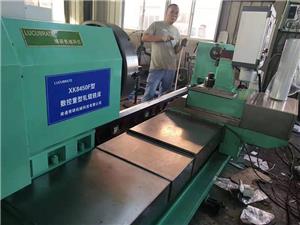
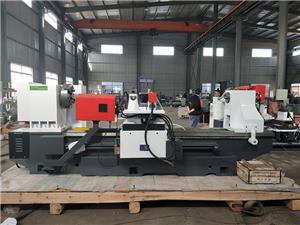
A CNC roll notching and marking lathe integrates turning, notching, and marking into a single setup. The roll is clamped once, and the machine performs all operations with micron-level precision. At NANTONG LUCUBRATE MACHINERY TECHNICAL LTD., our lathes use a 12-station tool turret with live tooling, a C-axis spindle for angular positioning, and a high-frequency marking head. Notches are milled or ground to ±0.02 mm depth and ±0.05° angle. Marking is done by a precision scribe or a low-stress laser that does not create recast layers. The entire cycle – load, notch, mark, unload – takes 8–12 minutes, compared to 45–60 minutes manually.
Key technical specifications of our standard model (LUCUBRATE CNC-RNM 500):
| Parameter | Manual Process | CNC Roll Notching & Marking Lathe |
|---|---|---|
| Notch depth tolerance | ±0.2 mm | ±0.02 mm |
| Notch angle tolerance | ±1° | ±0.05° |
| Marking depth control | None | 0.01–0.05 mm (programmable) |
| Setup time per roll | 20–30 min | 2–3 min |
| Scrap rate | 5–8% | <0.5% |
| Roll life (cycles) | 50,000 | 120,000+ |
Customer Cases: Real Results from Five Regions
Case 1: Steel Frame Manufacturer in Ohio, USA
John Miller, Production Manager at Buckeye Roll Forming, faced 6% scrap on light-gauge steel studs. After installing a LUCUBRATE CNC roll notching and marking lathe, scrap dropped to 0.4%. Line downtime for roll changes fell from 90 minutes/day to 15 minutes/day. “We recovered the machine cost in 11 months,” says Miller. “The notches are so consistent that our cut-off dies last twice as long.”
Case 2: Automotive Supplier in Stuttgart, Germany
Dr. Anna Weber, Tooling Engineer at Schwäbische Profile GmbH, struggled with roll cracks from hand stamping. The LUCUBRATE lathe replaced stamping with low-stress scribe marking. Roll life increased from 45,000 to 130,000 cycles. “We eliminated a $200,000 annual warranty claim,” Weber notes. “The CNC marking also gave us full traceability without surface damage.”
Case 3: Construction Equipment Maker in Osaka, Japan
Kenji Tanaka, Manufacturing Director at Kansai Heavy Industries, needed notches on 12 different roll profiles. Changeover took 4 hours manually. With the LUCUBRATE lathe's quick-change tooling and program storage, changeover is now 20 minutes. “Our batch sizes dropped from 500 to 50, but we still make money,” Tanaka says. “The machine paid for itself in 14 months.”
Case 4: Tube and Pipe Producer in São Paulo, Brazil
Carlos Mendes, Plant Manager at Tubos Brasil, faced 8% scrap on API pipe rolls. The LUCUBRATE lathe reduced scrap to 0.3% and increased roll life by 2.5 times. “We saved $180,000 in the first year on roll replacements alone,” Mendes reports. “The CNC marking meets our API traceability requirements.”
Case 5: Roll Forming Job Shop in Melbourne, Australia
Sarah Chen, Owner of Melbourne Roll Forming, needed to mark rolls for a defense contract. Manual marking was rejected due to stress risers. The LUCUBRATE lathe's scribe marking passed X-ray inspection. “We won a $1.2 million contract because we could prove no subsurface damage,” Chen says. “The machine is our competitive edge.”
Applications and Partnerships
CNC roll notching and marking lathes are used in:
- Roll forming lines for automotive structural parts
- Tube and pipe mills (API, ASTM)
- Construction profiles (studs, tracks, purlins)
- HVAC duct forming
- Solar tracker frames
- Furniture and shelving roll forming
NANTONG LUCUBRATE MACHINERY TECHNICAL LTD. partners with leading roll forming equipment integrators in North America, Europe, and Asia. Our lathes are specified by tier-one automotive suppliers and are used in joint development projects with the Institute for Roll Forming Technology in Germany. We also collaborate with roll manufacturers who supply to John Deere, Caterpillar, and Siemens.
FAQ: Technical Questions from Engineers and Buyers
1. Can the lathe handle hardened rolls (60 HRC)?
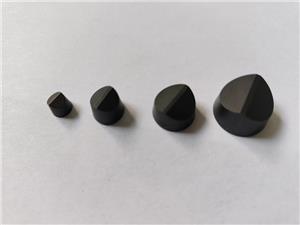
Yes. Our lathes are equipped with CBN or ceramic inserts for hard turning, and the notching head uses cubic boron nitride (CBN) or diamond-coated tools. We recommend pre-hardening to 58–62 HRC and then finish notching. For 60 HRC, we use a grinding spindle with cubic boron nitride wheels. Cycle time increases by 30%, but tolerances are maintained.
2. How do you ensure the notch is perfectly aligned with the roll's keyway or existing features?
The lathe uses a C-axis with a resolution of 0.001°. A touch probe or laser scanner locates the keyway or reference mark before machining. The control then rotates the roll to the correct angular position. Repeatability is ±0.01°.
3. What is the marking depth control and how do you avoid stress risers?
Marking depth is controlled by servo-driven scribe with force feedback, or by a low-power fiber laser (20W) with pulse shaping. Depth range is 0.01–0.05 mm. For stress-critical rolls, we use a scribe with a radius tip that plastically deforms rather than cuts, leaving compressive residual stresses. This is validated by X-ray diffraction per ASTM E915.
4. Can the lathe be integrated into an existing roll forming line for in-line notching?
Yes. We offer both stand-alone and in-line configurations. In-line integration requires a robot or gantry loader and a communication interface (Profinet, EtherNet/IP). The lathe can notch and mark rolls while the line is running, but typically rolls are changed during scheduled downtime. Cycle time for in-line is 6–8 minutes per roll.
5. What is the typical maintenance schedule and spare parts availability?
Daily: check way lube and air pressure. Weekly: clean chips and check tool wear. Monthly: check ball screw backlash and spindle runout. Annual: replace way wipers and calibrate probe. Spare parts are stocked in Rotterdam, Shanghai, and Atlanta. Critical parts (spindles, drives) ship within 48 hours. We offer remote diagnostics via VPN.
Conclusion: Stop Losing Money to Manual Notching and Marking
A CNC roll notching and marking lathe from NANTONG LUCUBRATE MACHINERY TECHNICAL LTD. pays for itself in 12–18 months through reduced scrap, longer roll life, and less downtime. Our customers in the USA, Germany, Japan, Brazil, and Australia have proven it. Don't let manual processes dictate your quality and profitability. Download our technical white paper “Precision Notching and Marking for Roll Forming Lines” or contact our sales engineers for a free cycle-time analysis. Visit our website or email us to schedule a live demo. Your rolls – and your bottom line – will thank you.