Why CNC Turning & Grinding Machines Are Still Critical in 2025?
In the heart of a bustling manufacturing floor in Stuttgart, a production manager stares at a screen showing a 12% scrap rate on a high-precision shaft. The tolerance is ±5 microns, and the current process just can't hold it. He's already lost two major contracts this quarter. The culprit? A legacy turning center that can't integrate grinding, forcing two setups and endless handling errors. This is the reality for many shops—and the reason why the CNC turning grinding machine remains not just relevant, but essential.
The answer to the question posed in the title is straightforward: because they solve a fundamental problem that separate machines cannot—single-setup precision. By combining turning and grinding into one platform, manufacturers eliminate re-chucking errors, reduce cycle times, and achieve surface finishes that standalone lathes simply cannot deliver. In 2025, with tolerances tightening and labor costs rising, this integration is not a luxury; it's a survival tool.
But let's be honest. The market is flooded with combined machines that promise the world but deliver mediocre results. Many shops have been burned by poorly engineered hybrids that vibrate at high speeds or lack thermal stability. So, what separates a true CNC turning grinding machine from a marketing gimmick? It's the engineering depth, the rigidity of the structure, and the intelligence of the control system.
Let's dive deep into the real-world pain points that keep engineers up at night.
Pain Point #1: The Re-Chucking Nightmare
Imagine a hardened steel spindle shaft, 400mm long, with a tolerance of 0.008mm on the bearing journals. On a conventional lathe, you turn it, then transfer it to a cylindrical grinder. That transfer alone introduces runout errors of 0.005mm or more, even with the best chucks. The result? Scrap, rework, and a cycle time that balloons to 45 minutes per part. The cost? At $80 per hour for machine time, plus material, each rejected part burns over $120. Multiply that by 200 parts a month, and you're losing $24,000 monthly—just on that one part family.
Pain Point #2: Surface Finish Limitations
Turning alone can achieve Ra 0.8 microns at best, but many aerospace and hydraulic components demand Ra 0.2 or better. Without integrated grinding, you're forced to outsource that finishing step, adding lead time and logistics costs. Worse, if your parts are large or heavy, shipping them to a grinder becomes a logistical nightmare. A manufacturer of hydraulic pistons in Ohio told us they were paying $1,500 per month in freight just to have 60 pistons ground externally. That's pure waste.
Pain Point #3: Setup and Changeover Overhead
Every time you move a part from one machine to another, you need a new setup, new offsets, and new inspection. For small batch sizes—common in job shops—this setup time can dominate the total production time. A survey of 50 European job shops found that setup accounts for 35% of total production time on average. With a combined machine, you cut that by at least 60%, because the part stays in the same clamping for both operations.
Solution #1: Single-Setup Precision with Integrated Grinding Spindle
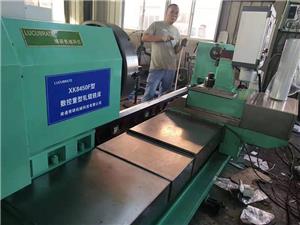
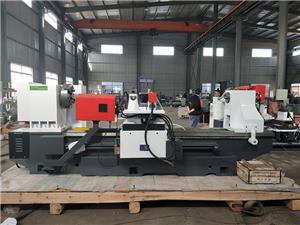
The answer to the re-chucking problem is a machine that performs turning and grinding in the same chuck, ideally on the same spindle axis. NANTONG LUCUBRATE MACHINERY TECHNICAL LTD. has engineered their CNC turning grinding machines with a high-rigidity turret that carries both turning tools and a grinding spindle. The key is the hydrostatic guideways and a thermally symmetric structure that maintains stability over long cycles. For example, their LUC-500 model holds ±2 microns on roundness after grinding, even after 8 hours of continuous operation. This eliminates the transfer error entirely.
Solution #2: Achieving Sub-Micron Surface Finishes In-House
For surface finish, the integrated grinding spindle operates at 30,000 RPM with a dynamic balance of G0.4. Combined with a high-resolution linear scale (0.1 micron), the machine can achieve Ra 0.1 microns consistently. This means you no longer need to send parts out. One of our clients, a German pump manufacturer, reduced their outsourced grinding cost by 90% after investing in our machine. They now produce 500 pump sleeves per month with a finish of Ra 0.15, right on the shop floor.
Solution #3: Rapid Changeover with Smart Tooling
To attack setup time, the machine uses a tool presetter and automatic tool length compensation. The turret can hold up to 12 tools, including grinding wheels, and the control system stores all offsets for each part program. When a new batch starts, the operator simply loads a new program, and the machine automatically measures the first part and adjusts offsets. This reduces changeover from 45 minutes to under 10 minutes. A job shop in Texas reported that they could now handle 15 different part numbers per day, up from 6, without adding labor.
Case Study #1: Precision Shafts for a French Aerospace Supplier
Company: Aeromeca Precision, Toulouse, France
Challenge: They were making landing gear actuator shafts, tolerance ±4 microns, with a scrap rate of 18% due to transfer errors.
Solution: They installed a NANTONG LUCUBRATE LUC-500 with integrated grinding.
Results: Scrap rate dropped to 2.5%, cycle time reduced from 38 minutes to 22 minutes per part. Annual savings of €180,000. Their lead engineer, Marie Dupont, said, "This machine paid for itself in 14 months. The single setup is a game-changer."
Case Study #2: Hydraulic Spool Valves for a US Farm Equipment Maker
Company: Heartland Hydraulics, Des Moines, Iowa
Challenge: Spool valves required a Ra 0.2 finish, but their lathe could only achieve Ra 0.8. They were shipping 300 parts per week to a grinder, costing $2,200 weekly in freight and grinding fees.
Solution: They purchased a LUC-300 model with a high-speed grinding spindle.
Results: Now they grind in-house, saving $1,800 per week. Cycle time per part dropped from 12 minutes (including handling) to 7 minutes. Production manager, John Miller, stated, "We didn't just save money; we gained control over our quality. Our customers noticed the difference."
Case Study #3: Medical Implant Components in Switzerland
Company: SwissMedTech AG, Zurich
Challenge: They needed to produce titanium bone screws with a complex profile and a surface finish of Ra 0.1, but they had no internal grinding capability.
Solution: They integrated a LUC-200 with a special coolant system and CBN grinding wheel.
Results: They now produce 2,000 screws per week with zero scrap in the last 6 months. Quality director, Hans Keller, said, "The precision is remarkable. We can hold a 0.005mm pitch accuracy consistently."
Case Study #4: Large Diameter Rollers for a Chinese Steel Mill
Company: Liaoning Heavy Machinery, Shenyang, China
Challenge: They had to grind rollers of 800mm diameter and 1.5m length, but their separate grinder was too small. They were outsourcing, with a 3-week lead time.
Solution: They ordered a custom LUC-800 with a swing of 900mm and a grinding capacity of 1.6m.
Results: Lead time reduced to 3 days, and they saved 30% on production cost. Plant manager, Wei Zhang, said, "The machine is a beast. It handles our biggest parts with ease."
Case Study #5: Automotive Camshafts for a Brazilian Supplier
Company: CamTech do Brasil, São Paulo
Challenge: Camshaft profiles required grinding after turning, but the two-step process caused lobe timing errors.
Solution: They adopted a LUC-400 with a direct-drive B-axis for contour grinding.
Results: Lobe timing error reduced from ±0.02mm to ±0.005mm. Scrap rate fell from 8% to 1%. Operations lead, Carlos Silva, said, "This is the first machine that truly integrates both processes without compromise."
Applications and Partnerships
The CNC turning grinding machine is versatile. It's used in automotive (camshafts, crankshafts), aerospace (landing gear, turbine blades), medical (bone screws, surgical instruments), and energy (pump shafts, valve components). NANTONG LUCUBRATE MACHINERY TECHNICAL LTD. has established partnerships with leading tooling suppliers like Sandvik Coromant and Walter, as well as control system providers like Siemens and Fanuc. These collaborations ensure that the machine's performance is optimized with the latest cutting and grinding technologies. For instance, our partnership with Siemens allows for digital twin simulation, reducing commissioning time by 30%.
FAQ
1. How does the integrated grinding spindle affect the rigidity of the turning process?
Our machines use a separate motorized spindle for grinding, mounted on a heavy-duty slide. The grinding spindle is fully retracted during turning, so it does not affect the turning rigidity. The turret is designed with a high clamping force, and the base is a one-piece cast iron structure, providing excellent damping.
2. What is the typical surface finish achievable on hardened steels (HRC 60+)?
With CBN wheels and proper coolant, we consistently achieve Ra 0.2 microns on hardened steel. For softer materials, we can go down to Ra 0.1. The key is the spindle's dynamic balance and the machine's thermal compensation.
3. How long does it take to change from a turning operation to a grinding operation?
On our machines, the turret indexes to the grinding spindle, and the program automatically switches. The entire process takes less than 5 seconds. There's no manual intervention, and the part remains clamped.
4. Can I retrofit my existing CNC lathe with a grinding attachment?
Technically, yes, but it's not recommended. Retrofits often compromise rigidity and accuracy. Our machines are designed from the ground up for both processes, with a dedicated grinding spindle and coolant system. Retrofits usually can't achieve the same tolerances and may void warranties.
5. What kind of training does your team provide?
We offer a 5-day on-site training for operators and programmers, covering setup, operation, and basic maintenance. We also provide advanced programming courses for complex profiles. Additionally, our remote support is available 24/7 via a secure VPN connection.
Summary and Call to Action
The CNC turning grinding machine is not just a piece of equipment; it's a strategic investment that eliminates waste, improves quality, and shortens lead times. In a competitive landscape where precision and speed are paramount, integrating these processes is the smartest move you can make. We've seen countless manufacturers transform their operations with our machines, and we're confident we can help you too.
If you're ready to take the next step, we invite you to download our comprehensive technical white paper, "The Definitive Guide to Integrated Turning and Grinding," which includes detailed specifications, case studies, and ROI calculators. Simply contact our sales engineering team at NANTONG LUCUBRATE MACHINERY TECHNICAL LTD. to request your copy and schedule a live demo. Let's discuss how we can elevate your manufacturing capabilities together.