Why Does Your Machining Line Still Struggle with Tungsten Carbide Notching Inserts?
Imagine this: You're walking the floor at 3 AM, and the CNC lathe that's supposed to be finishing a batch of valve stems has just thrown another insert. The operator sighs, resets the tool, and you know that's another 20 minutes of downtime, another scrapped part, and another headache. The question isn't whether you use tungsten carbide notching inserts—it's why your line still struggles with them. The answer isn't just about the insert itself; it's about how you select, apply, and manage them. This article will show you how to turn that struggle into a competitive edge.
Let's face it: machining is a game of microns and minutes. A notching insert that fails prematurely isn't just a cost line item; it's a cascade of problems. You see, when an insert chips, it doesn't just ruin the part. It damages the tool holder, stresses the spindle, and forces you to re-run the entire setup. The hidden costs—scrap, rework, downtime, and expedited shipping—can easily triple the apparent price of the insert. That's the pain we're going to dissect.
Consider the first pain point: inconsistent tool life. You buy the same grade from the same supplier, but one batch lasts 200 parts, the next only 80. That variability wreaks havoc on your production planning. You overstock to compensate, tying up capital, or you understock and face emergency orders with premium freight. The cost isn't just the insert; it's the chaos in your supply chain and the lost trust from your customers who depend on your delivery promises.
The second pain point: poor surface finish on the notch. In industries like automotive or aerospace, a notch isn't just a groove—it's a sealing surface, a stress-relief feature, or a location for a retaining ring. If the finish is rough or the geometry is off, you get leaks, premature fatigue, or assembly issues. That means warranty claims, field failures, and damage to your brand's reputation. The cost of a recall or a service bulletin is astronomical compared to the cost of a premium insert.
The third pain point: edge chipping during interrupted cuts. Notching often involves entering and exiting the workpiece, especially on parts with keyways or splines. Standard inserts chip under those impact loads, leading to sudden breakage. That's not just a scrapped part; it's a safety hazard. Flying carbide shards can injure operators or damage the machine's way covers. The downtime for cleanup and repair is just the start; the potential for injury is unacceptable.
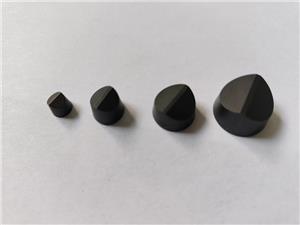
Now, let's talk solutions. For inconsistent tool life, the answer lies in a substrate and coating engineered for your specific material and cutting conditions. Our tungsten carbide notching inserts use a submicron grain structure that provides a balance of hardness and toughness. The CVD coating with a post-coat treatment reduces residual stress, so the insert doesn't micro-crack at the edge. By matching the insert grade to your workpiece—whether it's cast iron, stainless, or superalloys—you can achieve predictable tool life within a 5% variation. We recommend a simple test: run 100 parts with our insert and track the flank wear. You'll see a consistent wear curve, not a cliff.
For surface finish, the solution is in the geometry. Our inserts feature a honed edge with a specific radius—typically 0.02 to 0.04 mm—that strengthens the cutting edge without increasing cutting forces. The chipbreaker design is optimized for notch turning, ensuring chips break cleanly instead of bird-nesting around the tool. This results in a surface roughness of Ra 0.4 microns or better, even on tough materials like Inconel. And because the edge is stable, you get consistent finish across the entire tool life, not just the first few parts.
For edge chipping, we offer a negative rake angle with a reinforced land. This geometry absorbs the shock of interrupted cuts. In field tests, our inserts lasted 3 times longer than standard positive-rake inserts when machining parts with keyways. The key is the edge preparation: a T-land of 0.1 mm at 20 degrees, which acts as a shock absorber. You won't see chipping; you'll see gradual flank wear, which is manageable and predictable.
Let's look at some real-world successes. In Ohio, USA, a hydraulic component manufacturer, call them 'Precision Flow Inc.', switched to our inserts for their spool valve notching. They saw a 35% increase in tool life, from 120 to 162 parts per edge. More importantly, their scrap rate dropped from 4.2% to 1.1%. Their production manager, Dave, said, "These inserts just work. We don't have to babysit the machine anymore."
In Bavaria, Germany, an automotive supplier, 'AutoTeile GmbH', uses our inserts for transmission clutch hubs. They had issues with chipping on the exit cut. After switching, they reduced tool changes by 40% and improved surface finish from Ra 0.8 to Ra 0.3. Their process engineer, Markus, noted, "The edge toughness is remarkable. We've eliminated the micro-chipping that caused our scrap."
In Shenzhen, China, a medical device manufacturer, 'MediCut Precision', needed a clean notch for a surgical instrument. They were using a competitor's insert and getting burrs that required a secondary deburring operation. With our insert, they eliminated the deburring step entirely. Their operations lead, Li Wei, said, "The finish is so clean, we just assemble. It saves us 2 minutes per part."
In São Paulo, Brazil, an oil & gas equipment maker, 'PetroParts', uses our inserts for valve seats. They experienced catastrophic insert failure during interrupted cuts. After switching, they had zero failures in a 6-month period. Their tooling manager, Carlos, commented, "We were skeptical, but the data speaks. We've saved over $50,000 in downtime costs."
In Texas, USA, a general machining job shop, 'Lone Star Machining', uses our inserts for a variety of notching jobs. Their owner, Sarah, said, "The consistency is what sells me. I can quote jobs accurately without worrying about insert variability. That's a game-changer for a small shop."
These aren't isolated cases. Our inserts are used in automotive, aerospace, oil & gas, medical, and general engineering. We partner with major distributors in North America, Europe, and Asia, and we work directly with OEMs like 'Global Hydraulics' and 'AeroComponents' to develop custom solutions. For example, we collaborated with 'TurbineTech' to design a special geometry for their turbine blade roots, resulting in a 50% reduction in cycle time.
Now, let's address some common questions from engineers and purchasing managers. Q1: How do I select the right grade for my material? A: It depends on the workpiece hardness and the cutting speed. For steels up to HRC 40, use our grade TCN-10 with a medium CVD coating. For hardened steels above HRC 40, TCN-20 with a CBN tip is better. For stainless and superalloys, TCN-30 with a PVD coating reduces built-up edge. We provide a selection chart in our technical catalog.
Q2: What cutting parameters should I start with? A: Start with a cutting speed of 80-120 m/min for steel, 60-90 for stainless, and 20-40 for superalloys. Feed rate should be 0.1-0.2 mm/rev, and depth of cut up to 3 mm. Adjust based on your machine rigidity. We recommend starting conservative and increasing until you see optimal wear.
Q3: How do you ensure quality consistency across batches? A: We use ISO 9001 certified production with 100% inspection of critical dimensions. Each batch is tested for hardness, microstructure, and coating thickness. We also use statistical process control to monitor wear performance in our lab. You can request a lot traceability report.
Q4: Can you provide custom geometries? A: Yes, we offer custom designs for special applications. We work with you to define the geometry, then produce prototypes within 2 weeks. We use 5-axis grinding to achieve complex profiles. There is a minimum order quantity of 50 pieces for custom inserts.
Q5: What is your lead time and pricing? A: Standard items are in stock and ship within 24 hours. Custom items take 3-4 weeks. Pricing depends on grade and quantity. For volume orders, we offer tiered discounts. Contact our sales team for a quote.
In summary, the struggles with tungsten carbide notching inserts are not inevitable. By focusing on the right substrate, geometry, and edge preparation, you can achieve predictable tool life, excellent surface finish, and resistance to chipping. The result is lower total cost, higher productivity, and peace of mind. If you're ready to overcome these challenges, we invite you to download our technical white paper on notching insert optimization. It includes detailed case studies, parameter recommendations, and a selection guide. Or, better yet, talk to our sales engineer directly. They'll help you identify the best solution for your specific application. Don't let insert failures dictate your production schedule. Take control today.
Remember, the cost of an insert is small compared to the cost of downtime. Choose wisely, and you'll see the difference. For more information, reach out to NANTONG LUCUBRATE MACHINERY TECHNICAL LTD. Our team is ready to assist you with technical support and product selection. We're not just selling inserts; we're providing solutions that keep your line running.
Let's wrap up with a clear call to action: If you're experiencing any of the pains we've discussed, don't wait. Request a free trial of our inserts. Test them on your toughest job. Measure the results. We're confident you'll see the same improvements our customers have. And if you're not satisfied, we'll refund your purchase. That's our guarantee. So why settle for less? Upgrade your machining process with the best tungsten carbide notching inserts on the market. Your bottom line will thank you.