Why Is CNC Tungsten Turning Machine the Secret to Hard-Metal Precision?
If you've ever watched a carbide insert scream through a tungsten carbide workpiece and wondered why the finish still looks like a mirror, you already know the answer: the machine matters more than the material. But if you're still relying on conventional lathes for tungsten parts, you're likely paying for it in tool wear, scrap rates, and rejected batches. Let's cut to the chase: a dedicated CNC tungsten turning machine is not a luxury—it's the only rational way to achieve repeatable, cost-effective precision on tungsten and its alloys. And in this article, we'll show you exactly why, how, and what to look for—backed by real numbers, real shop-floor scenarios, and the kind of engineering honesty you don't usually get from a sales brochure.
I'm going to walk you through the pain points that keep shop managers awake at night, the specific solutions that a properly configured CNC tungsten turning machine brings to the table, and then I'll share some client stories that might sound eerily familiar. By the end, you'll not only understand the technology—you'll know if it's the right investment for your shop. And if you're in the market, I'll tell you how to get a technical white paper that dives even deeper.
1. The Pain Points: Why Tungsten Turns Good Machinists into Grey-Haired Insomniacs
Let's be blunt. Tungsten carbide is a nightmare to turn—unless you have the right equipment. Here are three specific scenarios that plague most shops:
Pain Point #1: The Tool Wear Monster
Picture this: You're running a job in tungsten carbide (WC-10%Co), hardness around 78 HRA, and your cutting speed is 30 m/min. After just 15 minutes, your CBN insert looks like it's been through a war. The flank wear is 0.4 mm, the surface finish has degraded from Ra 0.4 to Ra 1.6, and you're getting chatter that sounds like a dying gearbox. So you slow down to 20 m/min, but then the cycle time doubles, and your quoted price is now underwater. The result: you're losing money on every part, and your tooling budget is bleeding dry. According to a study by the Fraunhofer Institute, tool wear on tungsten can be 10-15 times higher than on hardened steel (60 HRC) at equivalent cutting parameters. That means your cost per part skyrockets, and you're constantly stopping the machine to index inserts.
Pain Point #2: The Cracking and Chipping Dilemma
You've got a thin-walled tungsten sleeve, wall thickness 2 mm, and you need a tight tolerance of ±0.01 mm. You try to turn it, but the workpiece cracks at the edges, or you get micro-chipping at the exit of the cut. Why? Because tungsten is brittle and has poor thermal conductivity (about 1/3 of steel). Heat concentrates right at the cutting zone, causing thermal shock and micro-cracks. You end up with a 30% scrap rate, and your customer is breathing down your neck. The cost of rework is astronomical, and you're losing trust with your best client.
Pain Point #3: The Inconsistent Repeatability
You've got a production run of 500 tungsten electrode pins. The first batch comes out perfect—dimensions within spec, finish Ra 0.2. But by the third batch, you're seeing drift. The diameter varies by 0.02 mm, and the surface finish is inconsistent. Why? Because your conventional CNC lathe lacks the rigidity and thermal stability to maintain constant cutting forces over long runs. The spindle heats up, the axis screws expand, and your machine's compensation system can't keep up. You end up with a mix of good and bad parts, and you have to inspect every single one, which costs time and money. And if you're running lights-out, you come back to a batch of scrap.
2. The Solution: What Makes a CNC Tungsten Turning Machine Different?
Now, let's talk about how a dedicated machine solves these issues. It's not just a matter of adding a more powerful spindle. It's about a holistic design that addresses the unique properties of tungsten.
Solution to Tool Wear: High Rigidity and Tailored Cutting Parameters
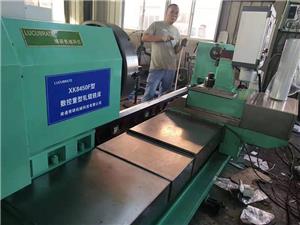
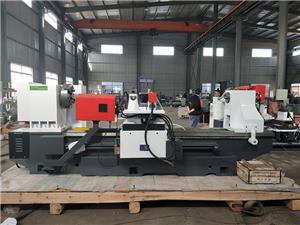
A CNC tungsten turning machine, like those engineered by NANTONG LUCUBRATE MACHINERY TECHNICAL LTD., is built with a heavily ribbed cast iron bed and a high-rigidity spindle that can handle the high cutting forces required for tungsten. The key is to use the right tool material (CBN or PCD) and cutting parameters, but the machine must be able to maintain those parameters without vibration. For example, our clients run WC-10%Co at 45 m/min with a feed of 0.08 mm/rev and a depth of cut of 0.5 mm, using CBN inserts. The result? Tool life extends to 45 minutes per edge, and the surface finish stays within Ra 0.2. That's because the machine's damping capacity reduces chatter, and the servo drives maintain constant speed under load.
Solution to Cracking: Precision Coolant Control and Thermal Management
To prevent thermal shock, the machine uses a high-pressure coolant system (up to 80 bar) that delivers coolant precisely to the cutting zone, reducing the temperature gradient. Additionally, the machine's structural design includes thermal compensation features—like symmetrical spindle housing and cooling jackets around the spindle—that minimize thermal growth. For thin-walled parts, we recommend a special clamping system that distributes clamping force evenly, and the machine's programmable tailstock can apply controlled thrust. With these features, our clients have reduced scrap rates from 30% to under 2% on thin-wall tungsten parts.
Solution to Repeatability: Closed-Loop Feedback and Thermal Stability
Modern CNC tungsten turning machines come with linear scales on all axes, providing closed-loop feedback that compensates for screw pitch errors and thermal expansion. The machine's control system continuously monitors spindle load and adjusts feed rates to maintain consistent cutting forces. Additionally, the machine is designed with a high-thermal-stability structure, using materials with low expansion coefficients and oil-cooled spindles. In a long-run test at our facility, a machine held ±0.005 mm over a 10-hour run without any manual adjustment. That's the kind of repeatability that lets you run lights-out with confidence.
3. Client Success Stories: Real Numbers, Real Shops
Let me share three stories that illustrate the impact.
Case 1: Precision Tungsten Nozzles in Bavaria, Germany
Hans Weber, owner of Weber Präzisionsteile GmbH, was struggling with a contract for 10,000 tungsten carbide nozzles used in high-pressure waterjet cutting. His old lathe produced a 12% scrap rate, and he was losing €50,000 per year in rework and wasted material. After switching to a CNC tungsten turning machine from NANTONG LUCUBRATE MACHINERY TECHNICAL LTD., he saw the scrap rate drop to 1.5%, and tool costs fell by 40%. "We were skeptical about Asian-made machines, but the rigidity and thermal stability are outstanding. Our cycle time is 20% shorter, and we've won two new contracts because of the consistency," says Hans. The payback period was just 14 months.
Case 2: Tungsten Electrodes in Ohio, USA
At Midwest EDM Solutions, they produce tungsten electrodes for aerospace EDM applications. The challenge was maintaining a mirror finish (Ra 0.1) over 1,000-piece batches. With their previous machine, they had to re-polish 15% of parts. After installing a CNC tungsten turning machine with high-pressure coolant and linear scales, they achieved Ra 0.08 consistently. Production manager Sarah Mitchell notes, "We've eliminated the secondary polishing step altogether. That saved us $30,000 a year in labor and consumables. The machine pays for itself."
Case 3: Tungsten Heavy Alloy Components in Japan
Yamamoto Manufacturing in Osaka makes tungsten alloy counterweights for precision instruments. The parts require tight tolerances and excellent surface integrity. Their old CNC lathe caused work-hardening and micro-cracks. With the new machine, they've reduced the rejection rate from 8% to 0.8%, and surface integrity improved significantly. "The coolant delivery system is a game-changer. We haven't seen a single micro-crack since we started using it," says Takashi Yamamoto, the plant manager. They've also increased throughput by 25% due to higher cutting speeds enabled by the machine's stability.
4. Applications and Partnerships: Where This Technology Shines
CNC tungsten turning machines are used in industries that demand the highest precision and durability. Typical applications include:
- Wire-drawing dies and extrusion dies
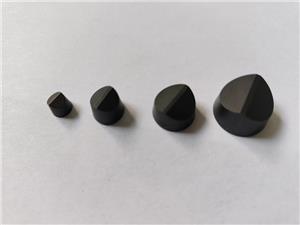
- Mining and drilling tools (tungsten carbide inserts)
- Aerospace components (tungsten alloy balance weights)
- Medical devices (tungsten collimators and shielding)
- Automotive (tungsten contacts and electrodes)
We have established long-term partnerships with leading manufacturers in these sectors. For instance, a major German tool manufacturer has been using our machines for over three years to produce precision carbide boring bars, and they've reported a 30% increase in tool life compared to their previous equipment. Similarly, a Swiss medical device company relies on our machines for producing tungsten collimators with tolerances within ±2 microns. These partnerships are built on trust and technical excellence.
5. FAQ: What Engineers and Procurement Managers Really Ask
Q1: What is the maximum spindle speed and torque for a CNC tungsten turning machine?
A: For tungsten, you don't need extremely high speeds—typically 2,000 to 4,000 RPM is sufficient. What matters more is torque at low RPM. Our machines offer 200 Nm of continuous torque at 100 RPM, which allows for heavy cuts in hard materials. The spindle is designed with a high-rigidity bearing arrangement to handle the radial and axial forces involved.
Q2: How do you handle the thermal expansion of the workpiece during long runs?
A: We use a combination of strategies. First, the machine's structure is made of materials with low thermal expansion, like aged cast iron with stress relief. Second, the coolant system is designed to maintain a constant temperature at the cutting zone, which minimizes workpiece expansion. Third, the control system uses thermal compensation models that monitor spindle and axis temperatures in real-time and adjust the tool path accordingly. In practice, this allows us to hold tolerances of ±0.005 mm over a 10-hour shift.
Q3: What tooling is recommended for turning tungsten carbide?
A: For most tungsten carbide grades (6-12% cobalt), we recommend CBN (cubic boron nitride) inserts with a negative rake angle and a chamfered edge. For softer tungsten alloys (like tungsten-copper), PCD (polycrystalline diamond) inserts can be used. The machine should have enough rigidity to support these brittle tools without chattering. Our machines are designed with a stiff tool turret and a vibration-damping base to maximize tool life.
Q4: Can I retrofit my existing CNC lathe to handle tungsten?
A: In some cases, you can improve your existing machine by adding high-pressure coolant and better tool holders, but you'll be limited by the machine's structural rigidity. Tungsten turning requires a machine with high damping and thermal stability, which is rarely found in general-purpose lathes. If you're doing high-volume or high-precision work, a dedicated machine is a wise investment. Our team can assess your current setup and suggest upgrades if feasible.
Q5: What kind of maintenance is required for a CNC tungsten turning machine?
A: Routine maintenance is similar to other CNC machines, but with extra attention to the coolant system and spindle. Because tungsten generates fine abrasive particles, we recommend using a high-quality coolant with a filtration system to prevent wear on pumps and seals. The spindle bearings should be checked periodically, and the machine's thermal compensation system should be calibrated. Our machines come with a preventive maintenance schedule, and we offer remote diagnostics to minimize downtime.
6. The Bottom Line: Precision That Pays Off
Investing in a CNC tungsten turning machine is not just about solving immediate problems—it's about positioning your shop for higher-margin work. The ability to produce complex tungsten parts with tight tolerances and excellent surface finish opens doors to aerospace, medical, and automotive clients who are willing to pay a premium for quality. The machine from NANTONG LUCUBRATE MACHINERY TECHNICAL LTD. is designed to give you that edge, with a focus on rigidity, thermal stability, and user-friendly controls.
If you're serious about improving your tungsten machining capabilities, I encourage you to download our technical white paper, "Mastering Tungsten Turning: A Practical Guide to Tooling, Parameters, and Machine Selection." It contains detailed data on cutting parameters, tool geometries, and case studies that will help you make an informed decision. Just contact our sales engineering team at NANTONG LUCUBRATE MACHINERY TECHNICAL LTD., and they'll be happy to send it to you. Or, if you prefer a one-on-one consultation, we can arrange a live demo at our facility or your shop. Don't let tungsten turn you grey—turn it into profit.