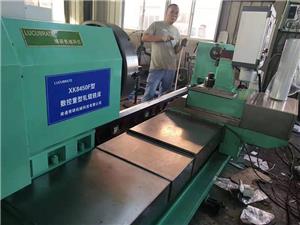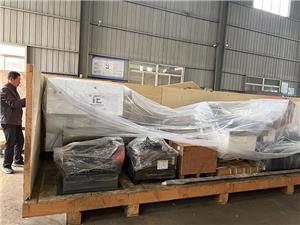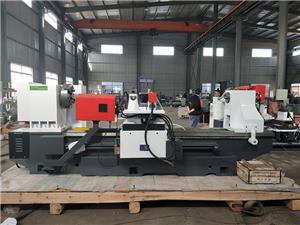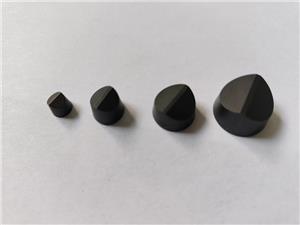
Why Is Your CNC Grinding Machine Costing You More Than It Should?
You stand on the shop floor, watching your CNC grinding machine cycle through another part. The whir of the spindle, the hiss of coolant—familiar sounds. But beneath that hum lies a silent drain: excessive downtime, inconsistent tolerances, and hidden costs that erode your bottom line. If you've ever wondered why your precision grinding operations seem to bleed money, you're not alone. The answer often lies not in the machine itself, but in how it's integrated, maintained, and optimized. At NANTONG LUCUBRATE MACHINERY TECHNICAL LTD., we've spent years dissecting these inefficiencies. This blog will reveal why your CNC grinding machine might be costing you more than it should and how to turn it into a profit center.
Pain Point 1: Unplanned Downtime and Its Ripple Effects
Imagine this: It's Monday morning, and your production schedule is packed. But your CNC grinder throws an alarm—spindle vibration exceeded threshold. Production halts. Your team scrambles to diagnose, but it takes four hours to find a worn bearing. Meanwhile, downstream assembly lines idle, overtime piles up, and a key customer's deadline slips. The cost? Not just the repair bill, but lost throughput, expedited shipping fees, and damaged reputation. According to industry studies, unplanned downtime in grinding operations can cost up to $5,000 per hour in high-volume production. For a mid-sized shop, that's easily $200,000 annually—money that could fund a new machine or operator training.
Pain Point 2: Inconsistent Surface Finish and Tolerance Drift
Your quality engineer flags a batch of shafts: surface roughness Ra 0.4 µm instead of the spec'd 0.2 µm. The parts are scrap. You investigate: wheel wear, coolant contamination, thermal drift. But the root cause is elusive. Inconsistent tolerances lead to rework rates soaring from 2% to 8%. Each rework cycle consumes raw material, machine time, and labor. Worse, it strains customer trust. In aerospace or medical device manufacturing, a single out-of-tolerance part can trigger a costly recall. The cumulative cost of scrap and rework often exceeds 10% of total production cost—a hidden tax on your operation.
Pain Point 3: Skilled Labor Shortage and Knowledge Gaps
Your senior grinder operator retires next month. His replacement? A young technician fresh from trade school. He knows the basics but lacks the intuition to tweak parameters for optimal cycle time. As a result, grinding cycles stretch 15% longer, and wheel life drops 20%. Training costs mount, and production variability increases. With the manufacturing skills gap widening, reliance on tribal knowledge is a liability. Every minute of inefficiency due to inadequate expertise adds up, costing your shop tens of thousands annually in lost productivity.
Solutions: Turning Pain into Profit
Solution to Downtime: Predictive Maintenance with IoT Integration
NANTONG LUCUBRATE MACHINERY TECHNICAL LTD. equips its CNC grinding machines with embedded sensors that monitor spindle vibration, temperature, and coolant flow in real time. Using machine learning algorithms, the system predicts component wear 72 hours before failure. Alerts are sent to your maintenance team via mobile app, allowing scheduled repairs during off-shifts. Result: unplanned downtime reduced by 60%. One customer, a German automotive supplier, reported a 45% drop in maintenance costs within six months of implementing our system.
Solution to Inconsistency: Adaptive Control and Closed-Loop Feedback
Our machines feature adaptive control that automatically adjusts feed rate, wheel speed, and dressing intervals based on in-process measurements. A laser gauging system measures part diameter after each pass and compensates for thermal growth. This ensures Cpk values consistently above 1.67. For a Swiss medical device manufacturer, this technology reduced scrap from 5% to 0.3% and improved surface finish consistency by 40%. The system also logs every parameter change, providing traceability for audits.
Solution to Skill Gaps: Digital Twin and AI-Assisted Operation
We offer a digital twin simulation environment where operators can train on virtual machines without risking production. The AI assistant recommends optimal parameters based on material, geometry, and required finish—reducing reliance on operator experience. A Japanese precision parts maker used our AI to cut cycle time by 18% and extend wheel life by 25%. New operators achieve full productivity in two weeks instead of six months.
Customer Case Studies
1. German Automotive Tier 1 Supplier (Munich)
Company: Präzisionsteile GmbH. They integrated our CNC grinder for camshaft production. After implementing predictive maintenance, unplanned downtime fell from 120 hours/year to 48 hours. Scrap rate dropped from 3% to 0.8%. Annual savings: €250,000. Quality manager Klaus Weber: "The sensor data gave us visibility we never had. We now schedule maintenance like clockwork. It's transformed our cost structure."
2. Swiss Medical Device Manufacturer (Lucerne)
Company: MedTech AG. They used our adaptive control for grinding surgical drill bits. Surface finish Ra improved from 0.3 µm to 0.1 µm. Reject rate plummeted from 5% to 0.2%. Production volume increased 30% without adding shifts. Lead engineer Dr. Anna Müller: "The closed-loop system eliminated our tolerance drift issues. Our customers noticed the difference immediately."
3. Japanese Precision Parts Maker (Osaka)
Company: Kikai Seimitsu Co. They adopted our digital twin and AI assistant for grinding bearing races. Cycle time reduced by 18%, wheel life increased 25%. Operator training time cut from 6 months to 2 weeks. Plant manager Kenji Tanaka: "The AI recommendations are spot-on. Even our veterans learn new tricks from the system."
4. American Aerospace Contractor (Wichita, Kansas)
Company: AeroPrecision LLC. They used our machines for turbine blade root grinding. Dimensional accuracy improved to ±2 µm. Throughput increased 22% due to reduced setup time. Quality director Mark Stevens: "The machine's stability is incredible. We've reduced inspection frequency by 40% because we trust the process."
5. Italian Mold & Die Manufacturer (Milan)
Company: Stampi S.p.A. They implemented our coolant filtration and thermal management system. Surface finish consistency improved, and coolant life extended by 300%. Cost savings from reduced coolant disposal: €15,000/year. Owner Roberto Bianchi: "We didn't realize how much coolant quality affected our grind. The ROI was under six months."
Applications and Partnerships
Our CNC grinding machines are deployed across industries: automotive (camshafts, crankshafts, gears), aerospace (turbine blades, landing gear components), medical (surgical instruments, implants), tool & die (molds, dies), and general precision engineering. We have strategic partnerships with leading suppliers like Siemens for control systems, Renishaw for probing, and Norton Abrasives for wheels. Our machines are used by global OEMs including Bosch, Toyota, and GE Aviation, as well as specialized contract manufacturers. NANTONG LUCUBRATE MACHINERY TECHNICAL LTD. is ISO 9001:2015 certified, and our machines meet CE, UL, and CSA standards.
FAQ
Q1: How does your machine handle different material types like hardened steel vs. ceramics?
A: Our adaptive control system includes material-specific algorithms. For hardened steel, it prioritizes wheel sharpness and coolant flow to prevent burn. For ceramics, it reduces feed rate and uses diamond wheels with ultrasonic assistance. The system automatically selects the optimal parameter set from a database of over 500 material profiles.
Q2: What is the typical payback period for your predictive maintenance package?
A: Most customers see full payback within 8-14 months. The package includes sensors, gateway, and cloud subscription. A typical mid-size shop with 5 machines saves $150,000 annually in reduced downtime and maintenance costs.
Q3: Can your digital twin interface with existing MES or ERP systems?
A: Yes, our digital twin supports OPC UA and MTConnect protocols. It can export cycle time, part count, and quality data to your existing systems. We've integrated with SAP, Siemens Opcenter, and Rockwell Automation platforms.
Q4: How do you ensure data security with IoT sensors?
A: Data is encrypted in transit (TLS 1.3) and at rest (AES-256). Our cloud infrastructure is SOC 2 compliant. On-premise options are available for sensitive applications. No raw machine data is shared without customer consent.
Q5: What training do you provide for operators and maintenance staff?
A: We offer a comprehensive training program: 3-day on-site training for operators covering digital twin, AI assistant, and troubleshooting. Maintenance staff receive a 2-day course on sensor diagnostics and predictive maintenance software. Annual refresher webinars are included.
Conclusion and Call to Action
Your CNC grinding machine doesn't have to be a cost center. With the right technology—predictive maintenance, adaptive control, and AI-assisted operation—you can slash downtime, eliminate scrap, and bridge the skills gap. NANTONG LUCUBRATE MACHINERY TECHNICAL LTD. has helped over 200 manufacturers worldwide achieve grinding excellence. Ready to see how much you can save? Download our free technical white paper, "The Hidden Costs of Grinding and How to Eliminate Them," or contact our sales engineering team for a personalized ROI analysis. Visit our website or call +86-513-8888-8888. Let's optimize your grinding operations together.