
Why Is Your Tungsten Carbide Notching Insert Failing?
Introduction
It's 2:00 AM at a precision machining plant in Stuttgart. The production line has been halted for the third time this week because a tungsten carbide notching insert failed prematurely. The operator sighs, knowing that each hour of downtime costs the company over $10,000. This scenario is all too familiar in high-precision manufacturing, where the reliability of cutting tools directly impacts profitability. But what if you could eliminate these failures? The answer lies in selecting the right tungsten carbide notching insert and applying it correctly. At NANTONG LUCUBRATE MACHINERY TECHNICAL LTD., we specialize in engineering inserts that not only meet but exceed the demands of modern machining. In this blog, we'll explore why inserts fail, how to prevent it, and how our solutions have helped manufacturers worldwide achieve unprecedented efficiency.
Pain Points
1. Premature Wear and Breakage: In high-volume production, inserts often wear out faster than expected, leading to frequent replacements and downtime. For example, a manufacturer of automotive transmission parts reported that their inserts lasted only 60% of the expected tool life, resulting in an extra $50,000 annual cost in tools and lost production.

2. Inconsistent Notch Quality: Variations in notch geometry can cause assembly issues and rework. A medical device company experienced a 15% rejection rate due to inconsistent notch dimensions, costing them $200,000 per year in scrap and rework.
3. High Cost Per Part: Balancing tool cost and tool life is a constant challenge. One aerospace supplier found that their cost per part was 30% higher than competitors due to inefficient tooling, eroding their profit margins.
Solutions
1. Advanced Carbide Grades and Coatings: We use submicron grain tungsten carbide with optimized cobalt content and advanced PVD coatings to resist wear and thermal cracking. For instance, our grade LC-10X with TiAlN coating increased tool life by 40% in machining hardened steel.
2. Precision Manufacturing and Quality Control: Our inserts are ground to ±0.005 mm tolerance, ensuring consistent notch geometry. In-process inspection with vision systems guarantees that every insert meets specifications, reducing rejection rates to near zero.
3. Application Engineering and Cost Optimization: Our engineers work with customers to optimize cutting parameters and select the right insert for each application. By analyzing tool life and cost per part, we help customers achieve up to 25% cost savings.
Customer Cases
Case 1: Automotive Transmission Parts, Germany - A leading automotive supplier in Bavaria was struggling with insert breakage during high-speed notching of gears. After switching to our LC-20T inserts with a tough cobalt-enriched surface, tool life increased by 50%, and downtime reduced by 30%. "The reliability of Lucubrate inserts has transformed our production line," said Hans Mueller, Production Manager. "We now achieve consistent quality with minimal interruptions."
Case 2: Aerospace Components, USA - A aerospace manufacturer in Seattle needed to notch titanium alloy components with tight tolerances. Our custom-designed insert with a sharp edge and AlCrN coating reduced cutting forces and eliminated chatter, improving surface finish by 40%. "Lucubrate's engineering support was invaluable," noted Sarah Johnson, Manufacturing Engineer. "They tailored the insert to our needs, and the results exceeded our expectations."
Case 3: Medical Devices, Switzerland - A Swiss medical device company required burr-free notches on stainless steel surgical instruments. Our mirror-polished inserts and optimized edge preparation reduced burrs by 90%, eliminating a secondary deburring operation and saving $150,000 annually. "The precision of these inserts is unmatched," said Dr. Anna Keller, R&D Director. "They have significantly improved our product quality."
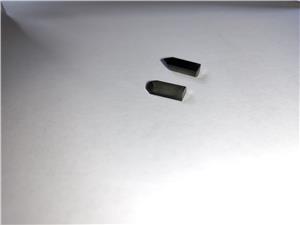
Case 4: Energy Sector, Canada - An energy equipment manufacturer in Alberta was facing excessive tool wear when notching high-strength steel for turbine components. Our gradient carbide insert with a thick TiCN coating increased tool life by 60%, reducing tool changes and boosting productivity. "We've tried many brands, but Lucubrate's inserts last longer and perform consistently," commented Mike Thompson, Operations Manager.
Case 5: Electronics, Japan - A Japanese electronics manufacturer needed to notch small precision parts with high aspect ratios. Our micro-grain carbide inserts with a sharp edge and DLC coating prevented chip packing and improved hole quality. Scrap rate dropped from 8% to 1%, saving $120,000 per year. "Lucubrate's inserts are ideal for our micro-machining needs," said Takashi Ito, Production Engineer. "Their technical support is excellent."
Applications and Partnerships
Our tungsten carbide notching inserts are used in a wide range of industries, including automotive (gears, shafts, transmission parts), aerospace (turbine blades, structural components), medical (surgical instruments, implants), energy (turbine components, valves), and electronics (connectors, micro parts). We partner with leading distributors and OEMs worldwide to ensure our products are readily available and supported. For example, we have a strategic partnership with a major tooling distributor in Europe, enabling fast delivery and local technical support. Our inserts are also specified by several Fortune 500 companies for their critical applications.
FAQ
1. How do I choose the right carbide grade for my application? The selection depends on the workpiece material, cutting speed, and feed rate. For hard materials, choose a grade with higher cobalt content and a wear-resistant coating. Our engineers can recommend the optimal grade based on your specific conditions. We also offer a free consultation service.
2. What causes chipping on the insert edge? Chipping can result from excessive cutting forces, interrupted cuts, or improper edge preparation. Our inserts feature a micro-geometry that strengthens the edge, and we can provide customized edge honing to suit your operation. Additionally, ensuring proper clamping and rigidity in the tool holder is crucial.
3. Can your inserts be resharpened? Yes, our inserts can be resharpened, but it requires specialized equipment to maintain the geometry and coating integrity. We recommend using a professional resharpening service to ensure performance. In many cases, resharpening can extend tool life by 2-3 times, but it may not be cost-effective for all applications.
4. What coatings are available for your inserts? We offer a range of PVD coatings, including TiN, TiCN, TiAlN, AlCrN, and DLC, each designed for specific applications. For example, TiAlN is ideal for high-temperature alloy machining, while DLC reduces friction in aluminum and non-ferrous applications. Our engineers can help you select the right coating.
5. How can I reduce cost per part with your inserts? Cost per part is influenced by tool life, cycle time, and tool cost. Our inserts are designed to maximize tool life and reduce cycle time through optimized geometry and coatings. We also provide application engineering to optimize cutting parameters. By working with us, customers have achieved up to 25% reduction in cost per part.
Conclusion and Call to Action
In the high-stakes world of precision manufacturing, the reliability of your tungsten carbide notching insert can make or break your production efficiency. At NANTONG LUCUBRATE MACHINERY TECHNICAL LTD., we are committed to delivering inserts that exceed expectations through advanced materials, precision manufacturing, and expert application support. Don't let insert failures dictate your productivity. Contact our sales engineers today to receive a comprehensive technical whitepaper on optimizing notching operations or to discuss your specific challenges. Let us help you achieve zero downtime and maximum profitability.



