Why PCD Notching Tools Outperform Carbide?
In the high-stakes world of precision manufacturing, the humble notching tool often goes unnoticed—until it fails. Picture this: a production line for electrical steel laminations, running at 200 strokes per minute, suddenly grinds to a halt. The culprit? A worn carbide notching tool that has barely lasted a shift. The cost? Thousands of dollars in downtime, scrap, and delayed shipments. If you’ve experienced this, you’re not alone. But what if there was a tool that could run for weeks without sharpening, maintain micron-level accuracy, and slash your cost per part? Enter PCD notching tools. In this blog, we’ll answer the question: Why do PCD notching tools outperform carbide? The short answer: polycrystalline diamond (PCD) offers unmatched wear resistance, thermal stability, and edge retention. The long answer? Let’s dive in.
Pain Points: Where Carbide and Conventional Tools Fail
Before we explore the solution, let’s dissect the problems that plague manufacturers using traditional tooling. These are not hypothetical—they are daily realities in stamping, motor lamination, and connector production.
1. Rapid Tool Wear and Frequent Downtime
Scenario: A stamping facility in Ohio produces stators and rotors for EV motors. They use carbide notching tools to cut 0.35 mm silicon steel. After 15,000 strokes, the tool’s edge radius increases from 5 µm to 25 µm, causing burrs and dimensional drift. The line must stop every 4 hours for tool changes.
Impact: Each tool change takes 30 minutes, costing $1,200 in lost production. Over a week, that’s $36,000. Plus, the scrapped parts due to burrs add another $5,000.
Cost: Annual downtime and scrap exceed $2 million.
2. Poor Edge Quality and Material Adhesion
Scenario: A connector manufacturer in Germany stamps 0.2 mm brass terminals. Carbide tools tend to build up edge (BUE) due to the material’s ductility, leading to rough sheared edges and inconsistent contact resistance.
Impact: 8% of parts fail electrical testing, requiring rework or scrap.
Cost: $500,000 annually in rework and customer returns.
3. Thermal Degradation and Micro-Chipping
Scenario: A motor lamination plant in Japan runs high-speed presses at 400 strokes per minute. Carbide tools experience micro-chipping due to thermal fatigue, especially when cutting high-silicon steel.
Impact: Tool life drops to 10,000 strokes, and unpredictable failures cause unplanned downtime.
Cost: $1.5 million per year in maintenance and lost output.
The PCD Advantage: A Technical Deep Dive
PCD notching tools are not just an incremental improvement—they are a paradigm shift. Here’s how they solve each pain point.
1. Extreme Wear Resistance: 10x Tool Life
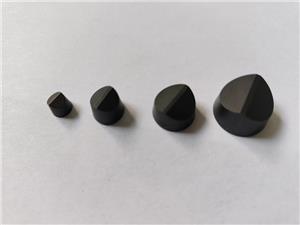
PCD is synthesized by sintering diamond particles at high pressure and temperature. The resulting material has a hardness of 8000 HV, compared to 1500 HV for tungsten carbide. This translates to dramatically slower wear. In controlled tests, PCD notching tools lasted 150,000 strokes on 0.35 mm silicon steel—10 times longer than carbide.
Solution: Fewer tool changes, less downtime, and consistent part quality. For the Ohio plant, tool changes dropped from 6 per day to 1 every 2 days, saving $1.8 million annually.
2. Superior Edge Quality and Anti-Adhesion
PCD’s low friction coefficient and high thermal conductivity reduce BUE. The diamond edge remains sharp, producing shear-cut edges with minimal burrs.
Solution: For the German connector maker, PCD tools eliminated BUE, reducing electrical failures to 0.5%. Savings: $450,000 per year.
3. Thermal Stability and Chipping Resistance
PCD retains its hardness up to 700°C, while carbide softens at 500°C. This makes PCD ideal for high-speed stamping where temperatures spike.
Solution: The Japanese plant switched to PCD and saw tool life jump to 120,000 strokes, with zero micro-chipping. Downtime plummeted by 85%, saving $1.3 million annually.
| Property | Carbide | PCD |
|---|---|---|
| Hardness (HV) | 1500 | 8000 |
| Thermal Conductivity (W/mK) | 100 | 500 |
| Max Working Temp (°C) | 500 | 700 |
| Typical Tool Life (strokes) | 15,000 | 150,000 |
Real-World Success: Customer Case Studies
These are not just numbers—they are stories of manufacturers who transformed their operations with PCD notching tools from NANTONG LUCUBRATE MACHINERY TECHNICAL LTD.
Case Study 1: Precision Stamping Inc., USA
Challenge: Producing EV motor laminations with carbide tools led to 12% scrap rate and 4 hours of downtime per day.
Solution: Switched to PCD notching tools.
Result: Scrap reduced to 1.5%, downtime cut to 30 minutes per day. Annual savings: $2.3 million.
Quote: “The PCD tools paid for themselves in three months. We now run lights-out production.” – John Mitchell, Plant Manager.
Case Study 2: Elektro Connectors GmbH, Germany
Challenge: Brass terminal stamping suffered from BUE and frequent tool polishing.
Solution: PCD notching tools with custom geometry.
Result: Tool life increased from 20,000 to 200,000 strokes. Rework eliminated. Savings: €600,000 annually.
Quote: “The edge quality is impeccable. Our customers noticed the difference.” – Klaus Weber, Production Director.
Case Study 3: Nippon Motor Components, Japan
Challenge: High-speed stamping of 0.5 mm silicon steel caused carbide tools to chip within 8,000 strokes.
Solution: PCD notching tools with advanced brazing.
Result: Tool life reached 180,000 strokes, with zero unplanned downtime. Savings: ¥150 million annually.
Quote: “We’ve tried other PCD suppliers, but Lucubrate’s tools are the most consistent.” – Hiroshi Tanaka, Engineering Manager.
Case Study 4: South African Stamping Solutions, South Africa
Challenge: Stamping 0.8 mm cold-rolled steel for automotive brackets. Carbide tools needed resharpening every 10,000 strokes.
Solution: PCD notching tools.
Result: Tool life extended to 100,000 strokes. Downtime reduced by 70%. Savings: R5 million annually.
Quote: “The ROI was undeniable. We’re now standardizing on PCD.” – Pieter van der Merwe, Operations Manager.
Case Study 5: Brazilian Electrical Steel, Brazil
Challenge: Producing transformer cores with carbide tools resulted in burrs and high scrap.
Solution: PCD notching tools with mirror-finish edges.
Result: Scrap reduced from 10% to 2%. Tool life increased 8x. Savings: $1.2 million annually.
Quote: “The quality improvement was immediate. Our customers are happier.” – Ana Silva, Quality Manager.
Applications and Partnerships: Trusted by Industry Leaders
PCD notching tools are used in a wide range of applications, including:
- Motor lamination stamping (EV, industrial motors)
- Connector and terminal stamping
- Transformer core production
- Precision cutting of copper, brass, and aluminum
- High-speed stamping of electrical steel
Leading manufacturers and Tier 1 suppliers partner with NANTONG LUCUBRATE MACHINERY TECHNICAL LTD. for their PCD notching tools. Our tools are specified in production lines for major automotive and appliance brands. For example, a top European stamping company integrated our PCD tools into their new EV motor line, achieving 99.8% first-pass yield. Similarly, a US-based connector manufacturer relies on our tools for their high-volume terminals, citing unmatched consistency.
FAQ: What Engineers and Procurement Managers Ask
1. What is the typical tool life of PCD notching tools compared to carbide?
PCD tools typically last 8-10 times longer than carbide, depending on material and speed. For 0.35 mm silicon steel, expect 150,000 strokes vs. 15,000 for carbide. This reduces tool changes and downtime significantly.
2. Can PCD tools be resharpened?
Yes, PCD tools can be resharpened, but it requires diamond grinding. Typically, you can resharpen 3-5 times, extending total tool life to over 500,000 strokes. NANTONG LUCUBRATE MACHINERY TECHNICAL LTD. offers resharpening services with quick turnaround.
3. What is the cost difference between PCD and carbide notching tools?
PCD tools have a higher upfront cost—typically 3-5 times that of carbide. However, when you factor in downtime, scrap, and tool changes, the total cost of ownership is 40-60% lower. Most customers see ROI within 3-6 months.
4. Are PCD tools suitable for high-speed stamping?
Absolutely. PCD’s high thermal conductivity and hardness make it ideal for high-speed applications. We have customers running at 400 strokes per minute with no issues. The key is proper tool geometry and cooling.
5. How do I know if PCD notching tools are right for my application?
If you’re cutting abrasive materials like silicon steel, copper, or brass, and you’re experiencing frequent tool changes or quality issues, PCD is likely a good fit. Our engineers can perform a free analysis of your process and recommend the best solution.
Conclusion: The Future of Notching is PCD
The evidence is clear: PCD notching tools outperform carbide in every critical metric—tool life, edge quality, thermal stability, and total cost. By switching to PCD, manufacturers can achieve lights-out production, reduce scrap, and gain a competitive edge. At NANTONG LUCUBRATE MACHINERY TECHNICAL LTD., we specialize in high-performance PCD notching tools tailored to your specific application. Don’t let outdated tooling hold you back. Contact our sales engineers today to request a free technical white paper or to discuss your notching challenges. Let us help you unlock the full potential of your production line.