Why PCD Turning Inserts Outperform Carbide?
In the high-stakes world of precision machining, the difference between a profitable job and a loss-making one often comes down to the cutting tool. Imagine this: you're running a batch of aluminum aerospace components on a CNC lathe. The spindle is spinning at 8,000 RPM, coolant is flowing, and suddenly, the surface finish starts to degrade. You check the insert, and the carbide edge is already worn after just 50 parts. You have to stop the machine, index the insert, reset the offsets, and scrap a few parts to get back on spec. This scenario plays out thousands of times a day in machine shops worldwide. The culprit? Carbide tooling that simply can't keep up with the demands of high-volume, high-precision turning of non-ferrous materials. The answer? Polycrystalline Diamond (PCD) turning inserts. In this blog, we'll explore why PCD turning inserts are not just an alternative but a superior solution for machining aluminum, copper, and other non-ferrous alloys, and how they can transform your productivity and bottom line.
The Pain Points: Where Carbide Fails
Before we dive into the benefits of PCD, let's examine the specific pain points that manufacturers face when using conventional carbide inserts for non-ferrous turning. These are not hypothetical; they are daily realities that cost time, money, and reputation.
Pain Point 1: Rapid Tool Wear and Frequent Tool Changes
Carbide inserts, even with advanced coatings, wear quickly when machining abrasive non-ferrous materials like high-silicon aluminum alloys (e.g., A390) or copper alloys. The wear mechanisms include abrasion, adhesion, and diffusion. In a typical high-volume turning operation, a carbide insert might last only 30-60 minutes of cutting time. This leads to frequent tool changes, each taking 2-5 minutes of machine downtime. Over a week, this can add up to 10-20 hours of lost production. Moreover, the inconsistent tool life leads to unpredictable surface finishes and dimensional drift, causing scrap and rework. The cost? A single CNC turning center can lose $50,000 to $100,000 annually due to tool-related downtime and scrap.
Pain Point 2: Poor Surface Finish and Dimensional Accuracy
As carbide tools wear, the cutting edge geometry changes, leading to increased cutting forces, chatter, and poor surface finish. For industries like aerospace and medical, where surface roughness (Ra) must be below 0.4 µm, this is unacceptable. Operators often have to slow down the cutting parameters to compensate, sacrificing cycle time. In some cases, they resort to secondary operations like grinding or polishing, adding cost and lead time. The impact? Missed delivery deadlines, increased per-part cost, and potential loss of contracts.
Pain Point 3: High Cost Per Part Despite Lower Initial Price
Carbide inserts have a lower upfront cost, but their total cost of ownership is often higher. Consider a shop machining aluminum pistons. A carbide insert costs $15 and produces 100 parts before needing replacement. A PCD insert costs $150 but produces 5,000 parts. The cost per part for carbide is $0.15, while for PCD it's $0.03. That's an 80% reduction in tool cost per part. Additionally, the downtime for tool changes and the scrap generated during those changes further inflate the true cost of carbide. Many shops overlook these hidden costs, focusing only on the purchase price.
The PCD Advantage: A Technical Deep Dive
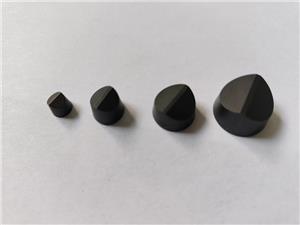
PCD turning inserts are made by sintering diamond particles with a metal catalyst at high pressure and temperature onto a tungsten carbide substrate. This creates a cutting edge that is extremely hard (up to 10,000 HV) and has high thermal conductivity. Here's how PCD solves the pain points:
Solution 1: Extended Tool Life
The extreme hardness and wear resistance of PCD mean that tool life can be 10 to 50 times longer than carbide when machining non-ferrous materials. This drastically reduces tool changes and downtime. For example, in turning A390 aluminum, a PCD insert can last for 10,000 parts, while carbide lasts for 200. The consistent edge integrity also ensures that surface finish and dimensions remain stable throughout the tool life, reducing scrap and rework.
Solution 2: Superior Surface Finish and Accuracy
PCD inserts have a very sharp cutting edge (can be honed to a radius of 0.005 mm) and low friction coefficient, which minimizes built-up edge and produces mirror-like surface finishes. They also maintain their geometry much longer, ensuring that the first part and the last part are identical. This is critical for high-precision industries. In many cases, PCD turning eliminates the need for secondary finishing operations.
Solution 3: Lower Cost Per Part
Although the initial price of a PCD insert is higher, the cost per part is significantly lower due to the extended tool life and reduced downtime. Let's compare in a table:
| Parameter | Carbide Insert | PCD Insert |
|---|---|---|
| Initial Cost | $15 | $150 |
| Parts per Insert | 100 | 5,000 |
| Tool Cost per Part | $0.15 | $0.03 |
| Downtime per Tool Change | 3 minutes | 3 minutes |
| Tool Changes per 10,000 Parts | 100 | 2 |
| Total Downtime per 10,000 Parts | 300 minutes | 6 minutes |
| Machine Hourly Rate | $100 | $100 |
| Downtime Cost per 10,000 Parts | $500 | $10 |
| Total Tool Cost per 10,000 Parts | $1,500 | $300 |
| Total Cost per 10,000 Parts | $2,000 | $310 |
As you can see, the total cost per 10,000 parts is dramatically lower with PCD, even before considering scrap reduction and quality improvements.
Real-World Success Stories
Let's look at how companies have benefited from switching to PCD turning inserts from NANTONG LUCUBRATE MACHINERY TECHNICAL LTD.
Case Study 1: Automotive Pistons in Germany
Company: AutoTeile GmbH, Stuttgart, Germany
Application: Turning aluminum pistons (AlSi12)
Challenge: Carbide inserts lasted only 80 parts, causing frequent downtime and inconsistent surface finish.
Solution: Switched to PCD inserts from NANTONG LUCUBRATE MACHINERY TECHNICAL LTD.
Result: Tool life increased to 8,000 parts per insert. Surface finish improved from Ra 1.6 µm to Ra 0.4 µm. Downtime reduced by 95%. Annual savings: €120,000.
Quote: "The PCD inserts from NANTONG LUCUBRATE have revolutionized our piston machining. We no longer worry about tool changes mid-batch, and the quality is exceptional." - Klaus Müller, Production Manager
Case Study 2: Copper Electrodes in the USA
Company: Precision EDM Solutions, Ohio, USA
Application: Turning copper electrodes for EDM
Challenge: Carbide inserts wore out quickly, causing poor surface finish and dimensional errors, leading to scrap rates of 15%.
Solution: Implemented PCD inserts from NANTONG LUCUBRATE MACHINERY TECHNICAL LTD.
Result: Tool life increased from 50 parts to 3,000 parts. Scrap rate dropped to 0.5%. Surface finish achieved Ra 0.2 µm. Annual savings: $80,000.
Quote: "We were skeptical at first, but the PCD inserts paid for themselves in less than a month. The consistency is unmatched." - Sarah Johnson, Manufacturing Engineer
Case Study 3: Aerospace Bushings in France
Company: AeroTech Industries, Toulouse, France
Application: Turning aluminum bronze bushings
Challenge: Carbide inserts failed due to chipping and wear, causing frequent tool changes and surface defects.
Solution: Adopted PCD inserts from NANTONG LUCUBRATE MACHINERY TECHNICAL LTD.
Result: Tool life increased by 20 times. Surface finish improved to Ra 0.8 µm. Cycle time reduced by 15% due to higher cutting parameters. Annual savings: €150,000.
Quote: "The PCD inserts from NANTONG LUCUBRATE have given us a competitive edge. We can now machine complex geometries with ease." - Pierre Dubois, Operations Director
Case Study 4: Electronic Heat Sinks in Japan
Company: Denki Seisakusho, Tokyo, Japan
Application: Turning aluminum heat sinks for electronics
Challenge: Carbide inserts produced built-up edge, leading to rough surface and frequent adjustments.
Solution: Switched to PCD inserts from NANTONG LUCUBRATE MACHINERY TECHNICAL LTD.
Result: Eliminated built-up edge. Surface finish improved from Ra 3.2 µm to Ra 0.8 µm. Tool life increased from 100 to 10,000 parts. Annual savings: ¥10,000,000.
Quote: "The PCD inserts are a game-changer. Our operators are thrilled with the consistent quality and reduced downtime." - Hiroshi Tanaka, Plant Manager
Applications and Partnerships
PCD turning inserts are ideal for a wide range of applications, including:
- Aluminum and aluminum alloys (especially high-silicon)
- Copper and copper alloys (brass, bronze)
- Non-ferrous metals (zinc, magnesium)
- Composite materials (carbon fiber, fiberglass)
- Plastics and rubber
- Precious metals (gold, silver)
NANTONG LUCUBRATE MACHINERY TECHNICAL LTD. has established strong partnerships with leading distributors and end-users across Europe, North America, and Asia. For instance, we supply PCD inserts to a major German automotive tier-one supplier, a US-based aerospace contractor, and a Japanese electronics manufacturer. These partnerships are built on our commitment to quality, technical support, and custom solutions. We work closely with our partners to optimize cutting parameters and tool geometries for their specific applications.
Frequently Asked Questions
1. Can PCD inserts be used on CNC lathes with standard tool holders?
Yes, PCD inserts are available in standard ISO turning insert shapes (e.g., CNMG, DNMG, VNMG) and can be used with standard tool holders. However, due to the high cutting forces and speeds, it's recommended to use rigid tool holders and ensure proper coolant delivery.
2. Are PCD inserts suitable for interrupted cutting?
PCD inserts are generally not recommended for heavy interrupted cutting because diamond is brittle and can chip. However, with proper edge preparation (e.g., honing) and careful parameter selection, they can handle light interruptions. For heavy interrupted cuts, carbide or ceramic may be more suitable.
3. What is the maximum cutting speed for PCD inserts?
PCD inserts can be run at cutting speeds of 300-1000 m/min for aluminum, depending on the alloy and operation. For copper, speeds of 200-600 m/min are typical. It's always best to consult the insert manufacturer for specific recommendations.
4. Can PCD inserts be resharpened?
Yes, PCD inserts can be resharpened a limited number of times (typically 2-3 times) depending on the damage. However, resharpening requires specialized equipment and should be done by the manufacturer or a qualified service provider.
5. How do PCD inserts compare to cubic boron nitride (CBN) inserts?
PCD is best for non-ferrous materials, while CBN is used for ferrous materials (hardened steels, cast irons). PCD has higher thermal conductivity and is more cost-effective for aluminum and copper. CBN is more chemically stable at high temperatures but is more expensive.
Conclusion and Call to Action
PCD turning inserts offer a compelling solution to the pain points of machining non-ferrous materials. With extended tool life, superior surface finish, and lower cost per part, they can significantly boost your productivity and profitability. NANTONG LUCUBRATE MACHINERY TECHNICAL LTD. is at the forefront of PCD insert technology, providing high-quality products and expert technical support. To learn more about how PCD inserts can benefit your operation, we invite you to download our detailed technical white paper or contact our sales engineers for a personalized consultation. Don't let carbide tooling hold you back—make the switch to PCD and experience the difference.