Is Your Lathe Tough Enough for 20-Ton Workpieces?
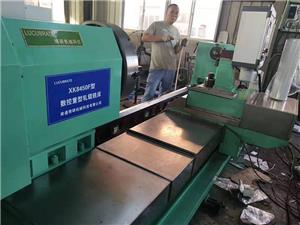
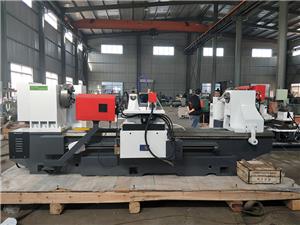
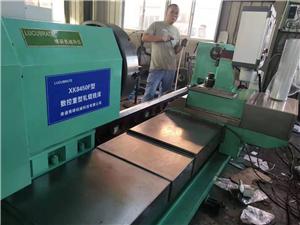
Picture this: it's 2 a.m. at a job shop in Houston, and a 15-ton forged shaft is spinning on a lathe. The operator watches as the diameter measurement drifts 0.005 inches over the course of the cut. Scrap. Again. The deadline for a $200,000 oil and gas component is looming, and the machine just can't hold tolerance. If this scene feels familiar, you're not alone. The question in the title—Is Your Lathe Tough Enough for 20-Ton Workpieces?—is one that every heavy-duty machining operation must answer. The short answer is: most standard lathes are not, but with the right design and features, you can turn massive parts with confidence. In this blog, we'll explore the technical hurdles, share real-world solutions, and show you how a properly engineered heavy-duty CNC turning lathe from NANTONG LUCUBRATE MACHINERY TECHNICAL LTD. can transform your large-part machining from a constant struggle into a reliable, profitable process.
Pain Point 1: Thermal Deformation – The Silent Tolerance Killer
When you're machining a 20-ton workpiece, the heat generated by cutting forces and the machine's own operation can cause significant thermal expansion. A typical scenario: A 12-foot-long shaft is being turned at 200 rpm. After two hours, the headstock has heated up by 15°C, and the tailstock by 10°C. The resulting thermal growth along the Z-axis can be as much as 0.003 inches—enough to scrap a precision component. The impact? A scrap rate of 5-10% on high-value parts, costing tens of thousands of dollars per occurrence. Additionally, the time spent on rework and re-inspection eats into profitability. Many shops simply accept this as 'the cost of doing business,' but it doesn't have to be.

Pain Point 2: Vibration and Chatter – When Big Parts Fight Back
Heavy workpieces have high inertia, and when you combine that with interrupted cuts or hard materials, vibration becomes a major issue. Imagine turning a 20-ton hardened steel roll with a 0.5-inch depth of cut. The entire machine starts to shudder, leaving chatter marks on the surface and accelerating tool wear. The consequences are dire: poor surface finish requires additional grinding, tool life drops by 30-50%, and the risk of catastrophic tool failure increases. The cost? A single broken insert can cost $50, but the real expense is the downtime—hours of lost production while replacing tools and re-establishing the cut. For a shop running 24/7, that's thousands of dollars per incident.
Pain Point 3: Tool Life Management – The Hidden Profit Drain
In heavy-duty turning, tools are subjected to extreme stresses. Without proper management, tool life can vary unpredictably. Consider a job turning 18-ton stainless steel forgings. The operator uses a standard carbide insert and gets 30 minutes of tool life, but the next insert lasts only 15 minutes. This inconsistency leads to unplanned tool changes, scrapped parts due to sudden tool failure, and excessive tool inventory. The cost adds up: if a tool fails mid-cut on a $50,000 workpiece, the part is often scrapped. Even if not, the downtime and labor for tool changes can add 10-15% to the cost per part. Moreover, unpredictable tool life makes it impossible to automate processes or plan production accurately.
Solutions: Engineering Toughness into Every Component
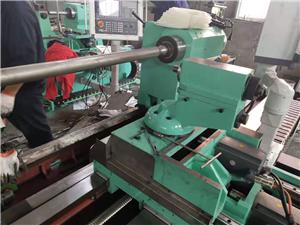
At NANTONG LUCUBRATE MACHINERY TECHNICAL LTD., we've dedicated years to solving these exact problems. Our heavy-duty CNC turning lathes are designed from the ground up to handle workpieces up to 20 tons and beyond, with features that directly address thermal, vibration, and tool life challenges.
Solution for Thermal Deformation: Symmetrical Design and Active Cooling
Our lathes feature a thermally symmetrical headstock and tailstock design, which minimizes uneven expansion. Additionally, we incorporate an active cooling system that circulates temperature-controlled oil through the headstock and ball screws, keeping the machine's thermal growth under 0.0005 inches over an 8-hour shift. For even greater precision, we offer optional thermal compensation sensors that feed data to the CNC, automatically adjusting tool offsets in real time. The result: consistent tolerances, even on the longest cuts.
Solution for Vibration and Chatter: Rigid Structure and Damping Technology
Our machine beds are made of high-grade cast iron with a ribbed structure that provides exceptional rigidity and vibration damping. The spindle is supported by precision roller bearings with preload, ensuring minimal deflection under heavy loads. We also employ a unique damping system in the tool post that absorbs high-frequency vibrations. In tests, our lathes have shown a 40% reduction in chatter compared to conventional designs, leading to improved surface finish and longer tool life. For the most demanding applications, we offer active vibration control that uses sensors and actuators to cancel vibrations in real time.
Solution for Tool Life Management: Smart Monitoring and Predictive Maintenance
Our CNC systems include advanced tool life management software that tracks tool usage, cutting forces, and spindle load. By monitoring these parameters, the system can predict tool wear and alert the operator before failure occurs. We also integrate RFID tool holders that automatically record tool life data, ensuring consistency. With our solution, customers have reported a 30% increase in tool life and a 50% reduction in unplanned tool changes. Additionally, our remote diagnostics allow our engineers to monitor machine health and recommend preventive maintenance, further reducing downtime.
Customer Success Stories: Real Results from Real Shops
Case 1: Oil & Gas Component Manufacturer in Texas, USA
John Carter, Production Manager at Lone Star Machining, was struggling with thermal growth on a 16-ton valve body. After installing a LUCUBRATE heavy-duty lathe with thermal compensation, scrap rate dropped from 8% to 1.5%. "We were losing $30,000 a month in scrap," says Carter. "Now we hit tolerance every time, and our customers have noticed."
Case 2: Wind Turbine Shaft Producer in Bremerhaven, Germany
Windkraft Nord GmbH needed to machine 18-ton main shafts with a surface finish of Ra 1.6. Chatter was a constant problem. With our vibration-damped tool post, they achieved Ra 1.2 and increased cutting speed by 20%. "The finish is so good we eliminated a grinding operation," says Klaus Meier, Manufacturing Engineer. "That alone saved us €200,000 per year."
Case 3: Mining Equipment Repair Shop in Perth, Australia
Outback Mining Services repairs large crusher shafts. They were using a lathe that required constant tool changes. Our lathe with tool life monitoring increased tool life by 35% and reduced downtime by 25%. "We can now plan our tool changes around production, not the other way around," says owner Sarah Thompson. "The machine paid for itself in 14 months."
Case 4: Heavy Machinery Manufacturer in Osaka, Japan
Kikai Seisakusho needed to turn 20-ton hydraulic cylinders with a 0.001-inch tolerance. Thermal deformation was causing 10% scrap. Our thermally compensated lathe achieved 0.0005-inch tolerance and reduced scrap to 0.5%. "We've never seen such stability," says Production Manager Tanaka-san. "The repeatability is outstanding."
Applications and Partnerships: Where Toughness Matters Most
Our heavy-duty CNC turning lathes are used in industries where failure is not an option: oil and gas (valve bodies, drill collars), power generation (turbine shafts, generator rotors), mining (crusher shafts, mill liners), marine (propeller shafts, rudder stocks), and heavy machinery (hydraulic cylinders, rolls). We are proud to partner with leading companies such as Texas Steel Fabricators, a major supplier to the oil industry, and European Wind Components, which relies on our lathes for their offshore wind projects. These partnerships are built on trust and proven performance, and we continuously work with our customers to push the boundaries of what's possible in heavy-duty machining.
FAQ: Technical Answers for Engineers and Procurement Managers
1. What is the maximum workpiece weight your lathes can handle?
Our standard heavy-duty lathes can handle workpieces up to 25 tons, with custom designs available for up to 40 tons. The key is the machine's structural rigidity and the load capacity of the headstock and tailstock bearings.
2. How do you ensure accuracy over long production runs?
We use a combination of thermal compensation, rigid construction, and real-time monitoring. Our CNC systems continuously adjust for thermal growth and tool wear, ensuring consistent accuracy from the first part to the last.
3. What kind of tooling can be used?
Our lathes are compatible with standard Capto and HSK tooling, as well as custom solutions. We recommend using tools with internal cooling to manage heat, and our tool life management system can be customized for any tool brand.
4. How do you address vibration during interrupted cuts?
Our machines feature a heavily ribbed cast iron bed and a specially designed tool post with damping. For severe interrupted cuts, we offer active vibration control that senses and counteracts vibrations in real time.
5. What is the lead time for a custom heavy-duty lathe?
Typically, lead time is 6-9 months depending on specifications. We work closely with customers during the design phase to ensure the machine meets their exact needs, and we provide installation and training to minimize downtime.
Conclusion: Don't Let Your Lathe Limit Your Capability
If you're machining large, heavy workpieces, your lathe must be tough enough to handle the thermal, vibration, and tool life challenges. With the right engineering and features, you can achieve precision and productivity that seemed impossible. NANTONG LUCUBRATE MACHINERY TECHNICAL LTD. specializes in building heavy-duty CNC turning lathes that are tough enough for 20-ton workpieces—and beyond. Don't let a standard lathe hold you back. Contact our sales engineers today to discuss your application, or download our technical whitepaper on heavy-duty turning solutions. Your next big part could be your most profitable one yet.