
Is Your Roll Lathe Tough Enough?
Imagine this: a 40-ton forged steel roll for a rolling mill sits on your shop floor. Your best machinist spends hours setting it up on a standard CNC lathe, only to find that the machine's rigidity can't handle the interrupted cuts required to turn the hardened surface. Chatter marks appear, the tool life plummets, and the deadline looms. You're not alone. This scenario is all too common in heavy industries, and it's precisely why the question "Is your roll lathe tough enough?" is more than rhetorical—it's a make-or-break consideration for productivity and profitability.

In this blog, we'll dive deep into the world of heavy duty CNC roll turning lathes. We'll explore the pain points that plague manufacturers, the engineering solutions that address them, and real-world examples of companies that have overcome these challenges. Whether you're machining rolls for steel mills, paper machines, or any other heavy application, you'll gain insights to help you evaluate whether your current equipment is up to the task—or if it's time to step up to a machine that's truly tough enough.
Pain Points: When Your Lathe Isn't Tough Enough
Heavy duty roll turning is not for the faint of heart. The rolls themselves can weigh tens of tons, and the machining process involves removing significant amounts of material while maintaining tight tolerances. Standard CNC lathes, even those marketed as "heavy-duty," often fall short in three critical areas. Let's examine each pain point in detail.
1. Lack of Rigidity Leads to Chatter and Poor Surface Finish
When machining large rolls, the cutting forces are enormous. If the lathe's structure isn't rigid enough, vibrations (chatter) occur, resulting in poor surface finish, reduced tool life, and potential scrapping of the workpiece. For example, a steel mill in Ohio reported that their standard lathe produced chatter marks on 30% of their rolls, requiring additional grinding and rework. The cost? An extra $50,000 per year in labor and abrasives, not to mention delayed deliveries.
The impact goes beyond immediate rework. Chatter can also lead to micro-cracks in the roll surface, compromising its fatigue life and leading to premature failure in service. For critical applications like rolling mill work rolls, this is unacceptable. The root cause is often insufficient mass and damping in the lathe bed and carriage, as well as inadequate stiffness in the spindle and tailstock.
2. Thermal Distortion and Inconsistent Accuracy
Heavy duty machining generates substantial heat, both from the cutting process and from the machine's own components. If the lathe isn't designed to manage thermal expansion, the workpiece and machine will distort, leading to dimensional inaccuracies. A paper mill in Finland experienced this first-hand: their lathe would drift by 0.05 mm over a 2-meter roll length during a long cut, forcing them to take multiple passes and slow down the process. This increased cycle time by 25% and increased scrap rate to 5%.
Thermal issues are particularly problematic when machining large rolls because the long continuous cuts allow heat to accumulate. Without proper cooling and thermal compensation, achieving consistent tolerances across the entire roll length becomes a guessing game. The cost of scrap and rework can quickly erode margins.
3. Inadequate Tooling and Power for Hard Materials
Modern rolls are often made from hardened steels, including forged or cast alloys with hardness exceeding 300 HB. Machining these materials requires high torque at low speeds, as well as the ability to handle interrupted cuts. Many standard lathes lack the spindle torque and rigidity to take deep cuts in such materials. A manufacturer of forged rolls in Germany found that their lathe's 30 kW spindle stalled during roughing, forcing them to use lighter cuts and extend machining time by 40%.
Furthermore, the tooling system must be robust enough to withstand the forces. Standard tool posts may deflect, leading to poor dimensional control and shortened tool life. The cost of frequent tool changes and the inability to use advanced tooling (such as ceramic or CBN inserts) can significantly impact productivity.
Solutions: Engineering a Truly Heavy Duty CNC Roll Turning Lathe
Addressing these pain points requires a holistic approach to machine design. A true heavy duty CNC roll turning lathe is engineered from the ground up to handle the extreme demands of roll machining. Let's look at how each pain point can be solved with the right technology and design principles.
1. Massive Rigidity for Chatter-Free Machining
Rigidity starts with the machine bed. A heavy duty lathe should have a bed made from high-grade cast iron or fabricated steel with extensive ribbing, providing high static and dynamic stiffness. For example, a bed weighing 15 tons or more is not uncommon for machines capable of handling rolls up to 60 tons. The carriage and tailstock must also be robust, with large guideways and preloaded bearings to eliminate play.
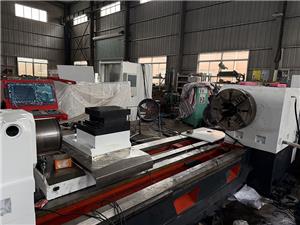
At NANTONG LUCUBRATE MACHINERY TECHNICAL LTD., we design our heavy duty CNC roll turning lathes with a double-wall cast iron bed and a symmetrical headstock to ensure even thermal distribution. The spindle is supported by precision cylindrical roller bearings, and the tailstock is equipped with a hydraulic quill for secure clamping. This results in a machine that can take deep cuts without chatter, achieving surface finishes of Ra 1.6 μm or better directly from turning.
To further enhance rigidity, we offer optional damping systems, such as tuned mass dampers, which can reduce vibrations by up to 70%. This is particularly beneficial when machining long rolls with high length-to-diameter ratios.
2. Thermal Stability for Consistent Accuracy
Managing heat is critical. A heavy duty lathe should have a robust cooling system for both the cutting zone and the machine's critical components. High-pressure coolant through the tool can evacuate chips and cool the cutting edge, while separate cooling circuits for the spindle and ballscrews maintain thermal stability.
Our lathes feature a symmetrical headstock design and a thermally stabilized bed, which minimize thermal growth. Additionally, we incorporate linear scales on the X and Z axes to provide real-time position feedback, compensating for any residual thermal expansion. This ensures that dimensional accuracy is maintained throughout the machining cycle, even on rolls up to 12 meters long.
For the ultimate in thermal control, we offer an optional thermal compensation system that uses sensors to monitor machine temperature and automatically adjusts the CNC offsets. This can reduce thermal drift to less than 0.01 mm over a 24-hour period.
3. High Torque and Advanced Tooling for Hard Materials
To machine hard materials efficiently, the lathe needs a powerful spindle with high torque at low speeds. Our heavy duty lathes are equipped with spindle motors ranging from 60 kW to 200 kW, with two-speed gearboxes that provide high torque even at low RPM. For example, our largest model delivers a maximum torque of 40,000 Nm, allowing for deep cuts in hardened steel.
The tooling system is equally important. We use a heavy-duty turret or a four-way tool post with a large cross-section, capable of holding tools with shanks up to 50 mm x 50 mm. This minimizes deflection and allows the use of advanced tooling, such as ceramic inserts for high-speed machining of hard rolls, or CBN inserts for finishing.
In addition, our lathes can be equipped with driven tools for milling and drilling operations, reducing setup times and increasing versatility. The CNC system is programmed to optimize cutting parameters for different materials, ensuring maximum tool life and productivity.
To summarize the differences between standard and heavy duty lathes, consider the following comparison table:
| Feature | Standard CNC Lathe | Heavy Duty CNC Roll Turning Lathe |
|---|---|---|
| Bed weight | 3-5 tons | 15-30 tons |
| Spindle power | 15-30 kW | 60-200 kW |
| Max torque | 2,000-5,000 Nm | 20,000-40,000 Nm |
| Max roll weight | 5-10 tons | 20-60 tons |
| Thermal compensation | Optional, basic | Standard, advanced |
| Tooling interface | Standard VDI/BMT | Heavy-duty custom |
Customer Cases: Real-World Success Stories
Numbers speak louder than words. Here are a few examples of how companies have benefited from investing in a heavy duty CNC roll turning lathe from NANTONG LUCUBRATE MACHINERY TECHNICAL LTD.
Case 1: Steel Mill in Pittsburgh, USA
A major steel producer was struggling with chatter on their work rolls, leading to excessive rework and scrap. They purchased a LUCUBRATE heavy duty lathe with a 25-ton bed and 150 kW spindle. The result: chatter eliminated, surface finish improved to Ra 1.2 μm, and rework reduced by 90%. The production manager, John Miller, commented: "This lathe has transformed our roll shop. We now machine rolls in a single pass with confidence, and our scrap rate has dropped from 8% to less than 0.5%."
Case 2: Paper Machinery Manufacturer in Gothenburg, Sweden
This company manufactures large granite and steel rolls for paper machines. They needed to machine rolls up to 10 meters long with high precision. Their old lathe suffered from thermal drift, causing dimensional variations. After installing a LUCUBRATE lathe with linear scales and thermal compensation, they achieved consistent tolerance of ±0.02 mm over the entire length. The production engineer, Anna Lindqvist, said: "The thermal stability is remarkable. We no longer have to wait for the machine to warm up or compensate manually. Our cycle times have been cut by 20%."
Case 3: Forging Company in Essen, Germany
A forging company producing hardened steel rolls for rolling mills was limited by their lathe's low torque. They could only take light cuts, extending machining time. With a LUCUBRATE lathe featuring a 200 kW spindle and 40,000 Nm torque, they were able to increase depth of cut by 300%, reducing roughing time from 8 hours to 2.5 hours per roll. The shop foreman, Klaus Weber, remarked: "The power and rigidity of this machine are incredible. We can now use ceramic inserts and really push the tool. It's a game-changer."
Case 4: Roll Manufacturer in Osaka, Japan
This company produces rolls for the printing industry, requiring high surface finish and tight tolerances. They were using a standard lathe but faced frequent tool changes and inconsistent quality. After switching to a LUCUBRATE heavy duty lathe with a 12-station turret and high-pressure coolant, they reduced tool changes by 50% and achieved Ra 0.8 μm consistently. The quality manager, Hiroshi Tanaka, stated: "The repeatability is excellent. We have not had a single rejection since installation. The machine simply delivers."
Case 5: Mining Equipment Supplier in Perth, Australia
This supplier machines large crusher rolls from hard manganese steel. Their existing lathe could not handle the interrupted cuts, leading to tool breakage and downtime. A LUCUBRATE lathe with a reinforced tool post and vibration damping system solved the problem. Tool life increased by 200%, and machine availability improved to 95%. The operations manager, Sarah Thompson, said: "We were skeptical at first, but the results are undeniable. The lathe handles the toughest cuts without flinching. It's built like a tank."
Applications and Partnerships: Where Tough Lathes Excel
Heavy duty CNC roll turning lathes are essential in industries where large, hard rolls are used. Key applications include:
- Steel and Aluminum Rolling Mills: Machining work rolls, backup rolls, and edger rolls.
- Paper Mills: Turning granite, steel, and composite rolls for paper machines.
- Printing Industry: Precision machining of impression cylinders and anilox rolls.
- Mining and Aggregate: Refurbishing crusher rolls and grinding rolls.
- Power Generation: Machining turbine and generator rotors (though these are not rolls per se, the equipment overlaps).
At NANTONG LUCUBRATE MACHINERY TECHNICAL LTD., we have established partnerships with leading companies in these sectors. For example, we supply lathes to a major steel equipment manufacturer in the United States, who integrates our machines into their roll shops. In Europe, we collaborate with a paper machinery builder to provide turnkey roll machining solutions. These partnerships are built on trust and proven performance, and they drive us to continuously improve our designs.
Our customers often involve us early in their procurement process, seeking our expertise in specifying the right machine for their needs. We work closely with their engineers to understand the rolls they machine, the materials, and the production goals, and we tailor our lathes accordingly. This collaborative approach ensures that the machine is not just tough, but also perfectly suited to the task.
FAQ: Technical Answers for Engineers and Buyers
Q1: What is the maximum weight of a roll that your heavy duty lathes can handle?
Our standard heavy duty lathes can handle rolls up to 60 tons. However, we can customize the design for even heavier rolls, up to 100 tons, by increasing the bed size, headstock, and tailstock specifications. The key is to ensure that the machine's structural rigidity and drive power are matched to the workpiece. We conduct a thorough analysis of the customer's requirements to recommend the appropriate model.
Q2: How do you ensure accuracy over long roll lengths, say 12 meters?
Accuracy over long lengths is achieved through a combination of machine design and compensation techniques. First, the bed is machined and aligned to a high degree of straightness. Second, we use linear scales on both axes to provide direct position feedback, eliminating errors from ballscrew thermal growth. Third, our thermal compensation system monitors temperature at critical points and adjusts the CNC offsets in real time. Finally, we recommend that customers use a steady rest to support long rolls and minimize deflection. With these measures, we can achieve a tolerance of ±0.05 mm over 12 meters, and even tighter with special options.
Q3: Can your lathes machine hardened materials like induction-hardened rolls?
Absolutely. Our lathes are designed with high torque and rigidity to machine hardened materials. We offer spindle powers up to 200 kW and torque up to 40,000 Nm, which allows for deep cuts in materials with hardness up to 60 HRC. We also provide recommendations on tooling, such as ceramic or CBN inserts, and cutting parameters to optimize the process. Many of our customers regularly machine induction-hardened rolls with excellent results.
Q4: What CNC control options are available?
We offer a range of CNC controls from leading manufacturers, including Siemens, Fanuc, and Heidenhain. The choice depends on the customer's preference and the complexity of the machining operations. For roll turning, we often recommend Siemens 828D or Fanuc 0i-TF, which provide robust performance and user-friendly programming. We also offer optional features like automatic tool measurement, in-process gauging, and remote diagnostics.
Q5: How do you handle chip evacuation when machining large rolls?
Chip evacuation is critical in heavy duty machining. Our lathes are equipped with a large chip conveyor and a high-pressure coolant system that directs coolant at the cutting zone to flush chips away. We also design the chip pan with sufficient slope and capacity to handle the volume of chips generated. For high-volume operations, we can provide a chip crusher and centrifuge to process chips for recycling. Additionally, the tooling can be selected with internal coolant channels to improve chip evacuation, especially when drilling or boring.
Conclusion and Call to Action
In the world of heavy duty roll turning, the question "Is your roll lathe tough enough?" is not just a catchy phrase—it's a critical assessment of whether your equipment can meet the demands of modern manufacturing. The pain points of chatter, thermal distortion, and inadequate power are real and costly, but they can be overcome with a lathe that is engineered for toughness.
At NANTONG LUCUBRATE MACHINERY TECHNICAL LTD., we specialize in building heavy duty CNC roll turning lathes that deliver rigidity, thermal stability, and power. Our machines are proven in some of the most demanding environments around the world, and our customers' success stories speak to their reliability and performance.
If you're facing challenges with your current lathe, or if you're planning to expand your roll machining capabilities, we invite you to explore our solutions further. Download our technical white paper, "Engineering the Ultimate Heavy Duty Roll Lathe," which delves into the design principles and real-world data. Or, better yet, contact our sales engineers directly to discuss your specific application. We'll work with you to determine the right machine for your needs—one that is truly tough enough.
Don't let a weak lathe hold you back. Take the first step towards unmatched productivity and quality today.



