Is Your Shop Ready for Heavy Duty CNC Turning?
Picture this: It's 3 a.m., and your phone buzzes. The night shift supervisor reports that the heavy duty CNC turning lathe has gone down—again. The spindle is making a grinding noise, and the tolerance on that critical batch of Inconel shafts is drifting. You’re already calculating the overtime, the missed delivery, and the angry call from your biggest customer. If this scene feels familiar, you’re not alone. In fact, it’s the reason we wrote this article.
So, is your shop truly ready for the demands of heavy duty CNC turning? The short answer: only if you’ve matched the machine to the job, and that means more than just horsepower. It means understanding the unique stresses of cutting hard alloys, the thermal dynamics of large parts, and the uptime economics that make or break a production run. At NANTONG LUCUBRATE MACHINERY TECHNICAL LTD., we’ve spent decades helping shops answer that question with confidence. In this blog, we’ll dive into the pain points, the solutions, and the real-world results that separate a struggling shop from a profitable one.

Pain Points: Where Heavy Duty Turning Hurts
Heavy duty turning isn’t just about removing more metal faster. It’s about managing forces that can literally shake a machine apart, and doing it shift after shift. Here are three pain points we hear about constantly from engineers and shop owners.
1. Spindle and Bearing Failures Under High Loads
When you’re turning a 500 kg forged shaft at 200 rpm, the spindle bearing sees loads that would destroy a standard lathe. The scenario: a job shop in the Midwest takes on a contract for wind turbine main shafts. They use a general-purpose CNC lathe with a 15-inch chuck, thinking it’s “heavy enough.” Within three months, the spindle bearings are shot. The cost? Not just the $25,000 bearing replacement, but 120 hours of downtime, missed deadlines, and a customer who’s now looking for a new supplier. The impact cascades: lost revenue, damaged reputation, and a team that’s demoralized.
2. Thermal Growth and Inconsistent Tolerances
Heavy duty cutting generates heat—a lot of it. As the machine and workpiece heat up, they expand. On a large part, a 0.001-inch thermal growth per inch can throw a ±0.0005-inch tolerance out the window. We’ve seen shops scrap entire batches of aerospace components because they didn’t account for thermal drift. The cost isn’t just the material—it’s the machining time, the inspection time, and the potential penalty clauses in the contract. One shop we know lost a $200,000 order because they couldn’t hold a 0.001-inch true position on a 1-meter diameter flange.
3. Chip Control and Tool Life in Hard Materials
Turning hardened steel (HRC 60+) or superalloys like Inconel 718 is a different game. Chips don’t break nicely; they string out, tangle, and cause crashes. Tool life can plummet to minutes, and the cost of carbide inserts adds up fast. A shop in Germany was running a batch of Inconel 625 components and going through 12 inserts per part. At $40 per insert, that’s $480 per part just in tooling—and the cycle time was 40% longer than quoted. The impact: unprofitable jobs, late deliveries, and a team that dreads the work.
Solutions: Engineering the Answer
These pain points aren’t inevitable. They’re the result of mismatched equipment and a lack of application-specific design. Here’s how we address each one with our heavy duty CNC turning lathes.
1. Robust Spindle and Bearing Design
For heavy loads, the spindle must be overbuilt. Our lathes use a rigid, integral spindle motor with large-diameter, preloaded roller bearings that handle radial and axial loads far beyond typical ratings. We also incorporate forced lubrication and cooling to keep temperatures stable. The result: spindles that maintain accuracy under continuous heavy cuts, with bearing life measured in years, not months. For that Midwest job shop, switching to our lathe eliminated spindle failures entirely—they’ve been running three shifts for two years without a single bearing issue.
2. Thermal Stability by Design
Thermal growth is managed through a combination of design and control. Our machines feature a symmetrical headstock design, cooled ball screws, and temperature sensors that feed data to the CNC for real-time compensation. The cast iron bed is heavily ribbed to dissipate heat evenly. For the aerospace shop that lost the order, we provided a lathe with thermal compensation that held ±0.0003 inches on a 1.2-meter part over an 8-hour run. The scrap rate dropped from 15% to near zero.
3. High-Pressure Coolant and Chip Management
Effective chip control in hard materials requires high-pressure coolant (up to 1000 psi) directed precisely at the cutting zone. Our lathes are equipped with through-tool coolant and programmable coolant nozzles that follow the tool path. Combined with optimized insert grades and geometries, this extends tool life dramatically. The German shop switched to our lathe with high-pressure coolant and saw insert life increase from 12 to 45 parts per edge—a 275% improvement—and cycle time dropped by 25%.
To summarize the differences, here’s a comparison table:
| Challenge | Standard Lathe | NANTONG LUCUBRATE Heavy Duty Lathe |
|---|---|---|
| Spindle bearing life under heavy load | 6-12 months | 5+ years |
| Thermal compensation | None or manual | Real-time sensor-based |
| Coolant pressure | Up to 150 psi | Up to 1000 psi |
| Max part weight | 500 kg | 3000 kg |
| Tool life in Inconel | 12 parts/edge | 45 parts/edge |
Customer Success Stories
Don’t just take our word for it. Here are real examples from customers who faced these challenges and found solutions with NANTONG LUCUBRATE MACHINERY TECHNICAL LTD.
Case 1: Precision Shafts Inc., Houston, USA
Precision Shafts Inc. specializes in large shafts for the oil and gas industry. They were using a 20-year-old lathe that required constant maintenance. After installing our heavy duty lathe, they reported a 40% reduction in cycle times and a 90% drop in unplanned downtime. “We used to budget $50,000 a year for spindle repairs alone,” says plant manager Mike Reynolds. “With the Lucubrate lathe, we haven’t touched the spindle in three years. It’s paid for itself.”
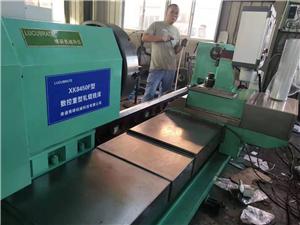
Case 2: AeroComponents GmbH, Munich, Germany
AeroComponents GmbH machines landing gear components from high-strength steel. They struggled with tool life and surface finish. Our solution included a lathe with high-pressure coolant and a custom tooling package. Tool life improved by 300%, and surface finish (Ra) improved from 1.6 µm to 0.8 µm. “The consistency is remarkable,” says production engineer Anna Schmidt. “We now run lights-out on weekends, something we could never do before.”
Case 3: Mining Equipment Ltd., Perth, Australia
This company repairs large mining truck components, including 2-ton wheel hubs. Their existing lathe couldn’t handle the weight, so they outsourced the work at a premium. With our lathe’s 3000 kg capacity and heavy-duty chuck, they brought the work in-house. They now save $120,000 annually in outsourcing costs and have reduced turnaround time from 6 weeks to 10 days. “The machine is a beast,” says workshop supervisor Dave O’Connor. “It just eats through hardened steel.”
Case 4: Energy Solutions Corp., Alberta, Canada
Energy Solutions Corp. produces valve bodies for the oil sands industry. They faced frequent scrapping due to thermal distortion. Our lathe with thermal compensation and a cooled ball screw eliminated the issue. Scrap rate dropped from 12% to 1.5%, saving over $200,000 per year. “We were skeptical about the thermal compensation,” says quality manager Lisa Tremblay. “But it works exactly as promised. Our CMM reports are now boringly consistent.”
Case 5: Marine Propulsion Systems, Rotterdam, Netherlands
This company machines propeller shafts up to 8 meters long. They needed a lathe with a large swing and the ability to maintain tight tolerances over long parts. Our custom-built lathe with a 2-meter swing and a 10-meter bed length delivered. Tolerances held within 0.02 mm over the entire length, and production time was cut by 30%. “The engineering support was outstanding,” says technical director Jan van der Meer. “They didn’t just sell us a machine; they solved our problem.”
Applications and Partnerships
Heavy duty CNC turning lathes from NANTONG LUCUBRATE are used in a wide range of industries where reliability and precision under load are non-negotiable. Key applications include:
- Oil and gas: Drilling collars, tool joints, and valve bodies.
- Aerospace: Landing gear components, engine shafts, and structural parts.
- Power generation: Wind turbine shafts, gas turbine components, and generator rotors.
- Mining: Crusher cones, wheel hubs, and hydraulic cylinders.
- Marine: Propeller shafts, rudder stocks, and deck machinery.
We’re proud to partner with leading distributors and OEMs who demand the highest standards. For example, we supply lathes to Global Machine Tools, a major distributor in North America, and EuroTech Machinery in Europe. These partnerships are built on a shared commitment to quality and after-sales support. When you buy from NANTONG LUCUBRATE, you’re not just getting a machine; you’re getting a network of experts who understand your industry.
FAQ
Here are answers to questions we frequently hear from engineers and procurement managers.
Q: What is the maximum part weight your heavy duty lathes can handle?
A: Our standard heavy duty models can handle parts up to 3000 kg between centers. For heavier or longer parts, we offer custom solutions with capacities up to 10,000 kg. The key is the headstock and tailstock design, as well as the bed rigidity. We’ll work with you to specify the right machine for your heaviest parts.
Q: How do you ensure thermal stability during long machining cycles?
A: We use a combination of design and active control. The headstock is symmetrical to distribute heat evenly, and the ball screws are cooled with oil. Temperature sensors monitor critical points and the CNC adjusts tool offsets in real time. This allows us to hold tolerances of ±0.0005 inches (0.0127 mm) on parts up to 1 meter in diameter over an 8-hour cycle.
Q: What coolant pressure do you recommend for Inconel and other superalloys?
A: For superalloys, we recommend high-pressure coolant (HPCL) in the range of 70-100 bar (1000-1450 psi). This is necessary to break chips and cool the cutting edge effectively. Our lathes can be equipped with HPCL systems up to 150 bar. We also recommend through-tool coolant for deep holes and pockets.
Q: Can your lathes be integrated into an automated production line?
A: Absolutely. Our CNC controls (typically Siemens or Fanuc) support standard automation interfaces, including robot loading and pallet systems. We also offer bar feeders and gantry loaders as options. We can work with your integrator to ensure seamless communication with your existing systems.
Q: What kind of support do you offer for installation and training?
A: We provide on-site installation and commissioning by our factory-trained technicians. Training covers operation, programming, and basic maintenance. We also offer remote diagnostics and a 24/7 hotline for urgent issues. Our goal is to minimize your downtime and maximize your productivity from day one.
Conclusion & Call to Action
Heavy duty CNC turning doesn’t have to be a source of sleepless nights. With the right machine—one designed for the loads, the heat, and the chips—you can achieve consistent quality, maximize uptime, and turn a profit on even the toughest jobs. NANTONG LUCUBRATE MACHINERY TECHNICAL LTD. has the expertise and the engineering to make that happen. We’ve helped shops around the world transform their heavy duty turning operations from a bottleneck to a competitive advantage.
If you’re ready to explore how a heavy duty CNC turning lathe from NANTONG LUCUBRATE can improve your operations, we invite you to download our technical white paper, “Engineering for Heavy Duty Turning: A Guide to Machine Selection and Optimization.” This comprehensive document dives into the metallurgy, the mechanics, and the economics of heavy duty machining. Or, if you prefer a conversation, contact our sales engineers directly. We’ll listen to your challenges and provide honest, technical advice—no sales pitch. Let’s make your shop ready for heavy duty turning.