
What Makes CNC Cylindrical Engraving Machines Essential?
Imagine you're a production manager at a thriving manufacturing plant. You've just received a rush order for 5,000 custom-engraved cylindrical components—think personalized wine bottles, precision rollers for printing presses, or branded aluminum tubes. Your team fires up the old manual engraving lathe, but within hours, you realize you're in trouble. The intricate patterns are inconsistent, the setup for each piece takes forever, and you're already behind schedule. Scrap rates are climbing, and your client is breathing down your neck. This scenario is all too common in industries that rely on cylindrical engraving. But what if there was a way to eliminate these headaches and turn engraving into a seamless, high-precision process? Enter the CNC cylindrical engraving machine—a game-changer that's redefining what's possible in cylindrical engraving. In this blog, we'll explore why these machines are not just tools, but essential assets for modern manufacturing. We'll delve into the pain points they solve, share real-world success stories, and answer your burning questions. Let's dive in.
Pain Point 1: Inconsistent Quality and High Scrap Rates

Manual or semi-automatic engraving on cylindrical surfaces is fraught with variability. Operator skill, machine wear, and environmental factors all contribute to inconsistent depth, alignment, and finish. For a manufacturer of decorative metal tubes, a slight deviation in engraving depth can mean the difference between a premium product and scrap. The cost? A scrap rate of 10-15% is not uncommon, translating to thousands of dollars lost each month. Moreover, rework adds labor hours and delays delivery, eroding customer trust.
Pain Point 2: Long Setup Times and Low Throughput
Traditional engraving methods require extensive setup for each new design or batch. Fixtures must be manually adjusted, and tool paths are often programmed offline, leading to trial-and-error runs. For a job shop that handles diverse orders, this downtime eats into profitability. A typical setup might take 2-3 hours, and with multiple jobs per week, the lost production time adds up to significant revenue loss. Additionally, the actual engraving speed is limited by the machine's capabilities and operator fatigue, capping throughput and making it hard to meet tight deadlines.
Pain Point 3: Limited Design Flexibility and Complexity
As customers demand more intricate and personalized designs, manual engraving struggles to keep up. Complex patterns, variable depths, and fine details are challenging to achieve consistently. For instance, engraving a 3D relief on a curved surface requires precise coordination of rotation and tool movement—something that's nearly impossible to do manually with repeatable accuracy. This limitation restricts businesses from tapping into high-margin markets like luxury packaging or custom automotive parts.
Solution: CNC Cylindrical Engraving Machines
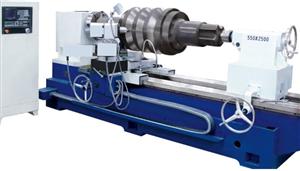
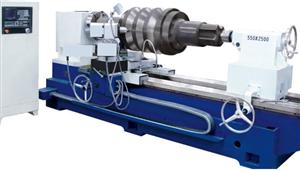
CNC cylindrical engraving machines, like those engineered by NANTONG LUCUBRATE MACHINERY TECHNICAL LTD., are designed to obliterate these pain points. Let's see how.
1. Precision and Consistency
At the heart of these machines is a high-rigidity spindle and precision linear guides, coupled with advanced servo control. This ensures sub-micron repeatability, meaning every engraving is identical—whether it's the first or the thousandth piece. The machine's CNC system interpolates the cylindrical axis with the linear axes, maintaining constant surface speed and depth. For the decorative tube manufacturer, this translates to a scrap rate below 1%, saving tens of thousands annually.
2. Rapid Setup and High Throughput
With a CNC cylindrical engraving machine, setup is drastically reduced. Designs are programmed in CAM software and transferred via USB or network. Quick-change fixtures and automatic tool measurement further cut downtime. Setup times can be as low as 15-30 minutes, and engraving speeds are optimized by the controller, often achieving 2-3 times the throughput of manual methods. This agility allows job shops to take on more orders and increase revenue.
3. Design Flexibility
These machines excel at complex geometries. The simultaneous control of rotary and linear axes enables engraving of intricate patterns, logos, and even 3D textures on cylindrical surfaces. Advanced controllers support high-speed machining and look-ahead algorithms, ensuring smooth motion and fine detail. Whether it's a delicate floral pattern on a perfume bottle or a rugged tread pattern on a metal roller, the CNC machine delivers with repeatable precision.
Comparison: Manual vs. CNC Cylindrical Engraving
| Aspect | Manual Engraving | CNC Cylindrical Engraving |
|---|---|---|
| Scrap Rate | 10-15% | <1% |
| Setup Time | 2-3 hours | 15-30 minutes |
| Throughput | Low (operator-dependent) | High (2-3x faster) |
| Design Complexity | Limited | High (3D, intricate patterns) |
| Labor Cost | High (skilled operator) | Low (automated) |
Customer Success Stories
Let's look at how businesses have benefited from CNC cylindrical engraving machines.
Case 1: Precision Engraving Inc., Germany
This automotive parts supplier struggled with inconsistent engraving on fuel injector bodies. After installing a LUCUBRATE CNC cylindrical engraving machine, they reduced scrap from 12% to 0.5% and increased production by 40%. "The machine's repeatability is incredible—we no longer worry about rejects," says Klaus Müller, Production Manager.
Case 2: Artisan Glassworks, USA
A custom glassware company wanted to offer intricate engraved designs on wine bottles. Manual engraving was too slow and error-prone. With the CNC machine, they cut engraving time per bottle from 30 minutes to 5 minutes and expanded their design catalog. "We've doubled our output and impressed clients with designs we couldn't do before," remarks Sarah Johnson, Owner.
Case 3: MetalCraft Industries, UK
This job shop specializes in engraving rollers for printing presses. Setup time was killing their profitability. The CNC machine reduced setup from 3 hours to 20 minutes, allowing them to take on 50% more jobs. "It paid for itself in six months," says David Thompson, Operations Director.
Case 4: Luxe Packaging, France
A luxury packaging manufacturer needed to engrave complex patterns on aluminum perfume caps. Manual methods couldn't achieve the required detail. The CNC machine delivered, with a 99.8% first-pass yield. "Our clients love the precision—it's a competitive edge," notes Pierre Dubois, CEO.
Case 5: Precision Rollers, Australia
This manufacturer of industrial rollers faced high scrap due to deep engraving variations. The CNC machine's constant surface speed control ensured uniform depth, reducing scrap by 90%. "We've saved over $100,000 annually," says Mark Wilson, Production Engineer.
Applications and Partnerships
CNC cylindrical engraving machines are versatile and find applications in:
- Automotive: engraving VINs, part numbers on cylindrical components.
- Aerospace: marking critical parts for traceability.
- Medical: engraving surgical instruments and implants.
- Packaging: personalizing bottles, caps, and tubes.
- Printing: texturing rollers for flexographic presses.
NANTONG LUCUBRATE MACHINERY TECHNICAL LTD. has established partnerships with leading distributors and OEMs across Europe and North America. For instance, they supply machines to a major German automotive tier-1 supplier and collaborate with a US-based packaging solutions provider to integrate engraving into automated lines. These partnerships underscore the reliability and performance of LUCUBRATE's technology.
FAQ
Q1: What materials can be engraved?
A: Our machines handle metals (steel, aluminum, brass, copper), plastics, glass, and ceramics. The key is selecting the right tool and parameters, which we help you determine.
Q2: How do you ensure cylindrical accuracy?
A: We use a precision rotary axis with a high-resolution encoder and a tailstock for support, ensuring minimal runout. The CNC controller synchronizes the rotary and linear axes for true cylindrical interpolation.
Q3: Can the machine be integrated into an automated line?
A: Yes, we offer I/O interfaces and robotic loading options. Many customers integrate our machines with conveyors and robots for lights-out production.
Q4: What about software compatibility?
A: Our machines support standard G-code and are compatible with popular CAM software like Mastercam, Fusion 360, and ArtCAM. We also provide custom post-processors.
Q5: How is maintenance handled?
A: The machines are designed for low maintenance with linear guides and automatic lubrication. We offer remote diagnostics and a global service network.
Conclusion and Call to Action
CNC cylindrical engraving machines are no longer a luxury—they're a necessity for manufacturers aiming to stay competitive. By eliminating inconsistency, reducing setup times, and unlocking design freedom, these machines deliver tangible ROI. NANTONG LUCUBRATE MACHINERY TECHNICAL LTD. stands at the forefront, offering robust, precision-engineered solutions tailored to your needs. Ready to transform your engraving operations? Contact our sales engineers for a personalized consultation, or download our technical white paper to explore the engineering behind our machines. Don't let outdated methods hold you back—embrace the future of cylindrical engraving today.



