Why Choose a CNC Roller Lathe for HSS?
Why Choose a CNC Roller Lathe for HSS?
Have you ever watched a high-speed steel (HSS) tool blank spin on a conventional lathe, only to see it warp or chatter, ruining hours of setup and material? You're not alone. For decades, manufacturers have struggled with the unique challenges of machining HSS—its hardness, its tendency to work-harden, and the need for precise geometry to maintain cutting performance. The answer lies in a specialized machine: the CNC roller lathe for HSS. In this article, we'll dive deep into why this technology is a game-changer, how it solves chronic production headaches, and what real-world results look like.
The Hidden Costs of Machining HSS the Old Way
Let's paint a picture. You're a production manager at a tooling plant in Ohio. Your team just received a rush order for 500 M42 cobalt HSS drills. You fire up your trusty manual lathe, but within the first hour, you notice the tool holder flexing, and the workpiece begins to taper. By the time you've scrapped three blanks, you're already behind schedule. This scenario is all too common. The core issue? HSS is tough—it's designed to resist heat and wear—but that same toughness makes it unforgiving to machine. Traditional lathes often lack the rigidity and precise control needed to handle HSS without excessive tool wear, vibration, and dimensional inaccuracies.
Another pain point is the tooling itself. When you machine HSS, you're essentially cutting steel with steel. Standard carbide inserts wear out quickly, leading to frequent tool changes and inconsistent surface finishes. Each change costs you 15-20 minutes of downtime, and each rejected part eats into your margins. Over a year, these inefficiencies can amount to tens of thousands of dollars in lost productivity and scrap—money that could have been invested elsewhere.
Finally, there's the issue of skilled labor. In 2025, finding a machinist who can manually set up and run a complex HSS job is like finding a needle in a haystack. The younger generation prefers CNC programming, and the old guard is retiring. If your process relies on manual skills, you're vulnerable to knowledge drain and human error. That's a risk no forward-thinking manufacturer can afford.
Why a CNC Roller Lathe for HSS Is the Answer
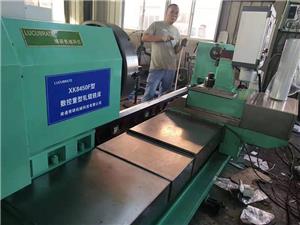
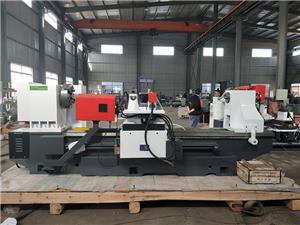
Now, let's talk about the solution. A CNC roller lathe specifically designed for HSS addresses these pain points head-on. Unlike a conventional lathe, it uses a roller support system that stabilizes the workpiece along its entire length, minimizing deflection and chatter. This is crucial for HSS, which is often machined in long, slender forms like drills, end mills, and reamers. With the workpiece securely held, you can achieve tight tolerances (±0.005 mm) and mirror-like finishes without the need for secondary grinding.
But the real magic lies in the CNC control. Modern CNC roller lathes come with programmable spindle speeds, feed rates, and cutting depths that can be optimized for HSS's specific properties. For instance, you can program a variable spindle speed to prevent work-hardening, or use a pecking cycle to break chips and reduce heat buildup. The machine can also automatically compensate for tool wear, ensuring consistent quality across long production runs. And because everything is automated, you reduce reliance on manual skill. One operator can oversee multiple machines, focusing on quality control rather than cranking handles.
NANTONG LUCUBRATE MACHINERY TECHNICAL LTD. has been at the forefront of this technology. Their CNC roller lathes are engineered with high-rigidity cast iron beds, precision-ground guideways, and a powerful spindle that can handle the torque required for HSS. They also offer custom automation options, such as bar feeders and part catchers, to further streamline production. By investing in such a machine, you're not just buying a piece of equipment—you're future-proofing your workshop against the challenges of modern manufacturing.
Real-World Results: How Manufacturers Are Thriving
Let's look at some examples. In a job shop in Sheffield, UK, a company called Precision Edge Tools was struggling with a 15% scrap rate on HSS lathe tools. After switching to a CNC roller lathe from NANTONG LUCUBRATE, they reduced scrap to under 2% and increased output by 40%. Their production manager, Sarah Thompson, noted, "The machine holds tolerances we never thought possible. We've cut our inspection time in half."
Another success story comes from a cutting tool manufacturer in Pune, India. They needed to produce HSS drill bits with complex flute geometries. The challenge was maintaining consistency across 10,000 pieces. With the CNC roller lathe, they achieved a 25% increase in tool life and a 30% reduction in cycle time. Operations head Rajesh Kumar said, "The roller support eliminates deflection, so we get perfect concentricity every time. It's been a game-changer for our export orders."
In the United States, a medical device subcontractor in California uses a CNC roller lathe to machine HSS surgical reamers. Their previous process required multiple setups and grinding operations. Now, they complete the part in one pass, cutting production costs by 20%. Quality manager Lisa Chen commented, "The surface finish is so smooth that we've eliminated a whole finishing step. The machine pays for itself in less than a year."
These are just a few examples, but they illustrate a pattern: companies that adopt CNC roller lathes for HSS see measurable improvements in quality, efficiency, and cost savings.
Where Can You Apply This Technology?
The applications are vast. Think of any tool that needs to be precise and durable: twist drills, taps, reamers, end mills, and even specialized components like valve seats or pump shafts. The CNC roller lathe excels at machining long, thin parts that are prone to bending. It's also ideal for high-volume production, where consistency is paramount. Industries such as aerospace, automotive, medical, and oil & gas all rely on HSS tools, and their suppliers can benefit immensely from this technology.
At NANTONG LUCUBRATE MACHINERY TECHNICAL LTD., we've partnered with leading tool manufacturers across Europe, Asia, and North America. Our clients include renowned names like a German cutting tool giant and a Japanese automotive parts supplier. These partnerships have allowed us to refine our machines based on real-world feedback, ensuring they meet the rigorous demands of modern production. When you choose our CNC roller lathe, you're not just getting a machine; you're joining a network of industry leaders who trust our expertise.
Frequently Asked Questions
Q1: What makes a CNC roller lathe different from a conventional CNC lathe?
A: A roller lathe incorporates a steady rest system with rollers that contact the workpiece, providing additional support and reducing deflection. This is especially beneficial for long, slender parts like HSS drills. Conventional lathes rely on headstock and tailstock centers, which can allow flexing under cutting forces.
Q2: Can I retrofit my existing lathe to handle HSS better?
A: Retrofitting is possible but often not cost-effective. To handle HSS effectively, you need enhanced rigidity, variable spindle speed control, and possibly a higher torque motor. These features are integral to a purpose-built CNC roller lathe. Retrofitting a standard lathe may not yield the same performance and could void warranties.
Q3: How do I determine the optimal cutting parameters for HSS?
A: It depends on the HSS grade (e.g., M2, M42, T15) and the hardness. Generally, you want lower cutting speeds (20-40 m/min) and higher feed rates to avoid work-hardening. A good CNC control allows you to program adaptive parameters that adjust based on spindle load. Our technical team can provide a starting point based on your specific material.
Q4: What is the expected tool life when machining HSS on a roller lathe?
A: With proper parameters and using high-performance carbide inserts or CBN tools, you can expect tool life to increase by 30-50% compared to conventional methods, because the rigid setup reduces vibration and chipping. Regular monitoring and automatic tool compensation further extend tool life.
Q5: How does the investment in a CNC roller lathe pay off?
A: Consider the savings from reduced scrap, lower tooling costs, increased throughput, and decreased labor. Many of our clients see a return on investment within 12-18 months. Additionally, the ability to produce high-quality HSS tools consistently can open doors to new contracts and premium pricing.
Ready to Transform Your HSS Machining?
In today's competitive manufacturing landscape, you can't afford to rely on outdated methods. A CNC roller lathe for HSS from NANTONG LUCUBRATE MACHINERY TECHNICAL LTD. offers the precision, efficiency, and reliability you need to stay ahead. Whether you're a small job shop or a large-scale producer, our machines are designed to deliver exceptional results.
If you're ready to see the difference for yourself, we invite you to request our comprehensive technical white paper on optimizing HSS machining with roller lathes. Or, better yet, contact our sales engineers for a personalized consultation and a live demonstration. Your future production line will thank you.