Why Combined Lathes for Bar?
Imagine this: It’s 6:30 AM on a Tuesday. Your production manager is staring at a work order for 15,000 stainless steel bushings due Friday. The bar feeder on your aging lathe jams for the third time this shift, and your operator is already 45 minutes behind schedule. You’ve got three other jobs queued, each requiring a different setup, and your only mill is tied up on a rush order. Sound familiar? If you’re in the business of turning bar stock into precision parts, you know the drill. The answer to the chaos? Combined lathes for bar—machines that integrate turning and milling capabilities into a single, bar-fed platform. These aren’t just lathes with a live tool; they’re engineered from the ground up to eliminate the bottlenecks that plague traditional bar machining. In this blog, we’ll dive deep into why these machines are changing the game, with real data, customer stories, and technical insights you can use.
Pain Point 1: The Setup Time Trap
Every time you switch from one part to another, you lose hours—sometimes days—to setup. On a conventional lathe, you might need to change jaws, adjust tool offsets, and re-prove out programs. Add a secondary milling operation, and you’re looking at multiple setups, each with its own fixturing and alignment. For a shop running high-mix, low-volume work, setup can consume 30-40% of machine time. The cost? Let’s say your shop rate is $100/hour. If you’re doing 10 setups a week, each taking 2 hours, that’s $2,000 per week in lost capacity—over $100k annually. And that’s before you factor in scrap from misalignments or the overtime needed to catch up.

Pain Point 2: Accuracy Across Multiple Setups
When you move a part from a lathe to a mill, you introduce stacking tolerances. Each re-fixturing can add 0.0005" to 0.001" of error, and if the part is complex, that error multiplies. For industries like medical or aerospace, where tolerances are often ±0.0002", this is a recipe for scrap. One customer we worked with was scrapping 8% of their titanium bone screw blanks because the milled slots drifted out of position after turning. At $50 per blank, that’s $4,000 down the drain per 1,000 parts—and the delays in rework can push lead times out by weeks.
Pain Point 3: Floor Space and Labor
Floor space is expensive. A typical lathe with a bar feeder might take up 150 sq ft, and a separate mill another 100 sq ft. Add in work-in-progress inventory between machines, and you’ve got a logistical headache. Plus, each machine needs an operator—or at least someone to load/unload and monitor. With the skilled labor shortage in manufacturing, finding two operators per cell is tough. One job shop in Ohio told us they had to turn down a contract because they couldn’t staff a second shift for their separate lathe and mill. The lost revenue? Over $500k annually.
Solution: How Combined Lathes for Bar Eliminate These Pains
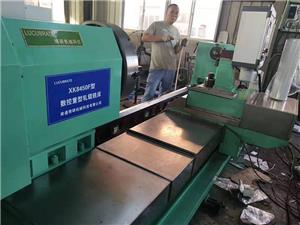
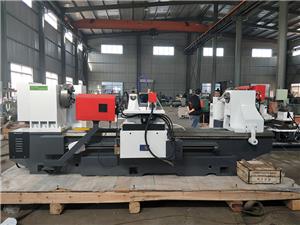
Combined lathes for bar—like those engineered by NANTONG LUCUBRATE MACHINERY TECHNICAL LTD.—address these issues head-on. These machines feature a single spindle with a integrated milling head, Y-axis, and sub-spindle, all fed by a bar feeder. The result: one machine, one setup, complete part in one cycle.
Setup Time Reduction
With a combined lathe, you can go from bar stock to finished part without ever unclamping. Quick-change tooling and preset offline tooling mean changeovers can be as short as 30 minutes. For a shop doing 10 setups a week, that’s a 75% reduction in setup time—saving $75k annually. Plus, the machine’s control allows you to store hundreds of programs, so recalling a job is as simple as loading a file.
Accuracy and Repeatability
By performing all operations in one clamping, you eliminate re-fixturing errors. The inherent rigidity of a combined lathe—often with a cast iron bed and high-precision linear guides—ensures that milling and turning stay within microns. For that medical customer, switching to a combined lathe reduced scrap from 8% to less than 0.5%, saving $3,750 per 1,000 parts and virtually eliminating rework.
Space and Labor Savings
A single combined lathe with bar feeder occupies about 200 sq ft—less than half of the separate machines. And because it’s automated, one operator can run two or three machines. That same Ohio shop was able to take on the contract by running two combined lathes with one operator, generating an extra $500k in revenue without adding staff.
Customer Success Stories
Let’s look at how real companies have benefited from combined lathes for bar.
Case 1: Precision Medical Components in Germany
Schmidt Medizintechnik, a supplier of surgical instruments, was struggling with a 12% scrap rate on stainless steel handles. They installed a LUCUBRATE combined lathe with a 12-foot bar feeder. Within three months, scrap dropped to 0.8%, and cycle time per part went from 8 minutes (across two machines) to 4.5 minutes. “The integration of milling and turning in one machine not only improved our quality but also cut our lead times by 40%,” said Klaus Meier, Production Manager. Annual savings: €220,000.
Case 2: Automotive Parts Manufacturer in the US
Midwest Auto Components needed to produce 50,000 transmission shafts per month. Their old process required three separate operations and had a throughput of 120 parts per hour. After installing two LUCUBRATE combined lathes, they achieved 200 parts per hour per machine, with a single operator. “We were able to reduce our per-part cost by 35% and freed up 1,200 sq ft of floor space,” noted Sarah Johnson, Operations Director. The machines have been running 24/7 for two years with 98% uptime.
Case 3: Aerospace Fasteners in France
AéroFix, a maker of titanium fasteners, faced tight tolerances of ±0.0003" on a complex geometry. Their previous process had a 15% rejection rate. With a LUCUBRATE combined lathe equipped with a high-frequency spindle, they achieved 99.7% first-pass yield. “The ability to mill flats and drill cross-holes without re-clamping was a game-changer,” said Jean-Luc Dubois, Quality Manager. The company saved €150,000 in scrap in the first year.
Case 4: Hydraulic Fittings in Italy
Idraulica Bergamasca produced brass fittings on a lathe with a separate tapping station. Changeovers took 4 hours, and they could only run 500 parts per day. After switching to a LUCUBRATE combined lathe with a 6-spindle bar feeder, they now produce 1,200 parts per day with a 30-minute changeover. “We’ve doubled our capacity without adding a second shift,” said Marco Rossi, Owner. The machine paid for itself in 14 months.
Applications and Partnerships
Combined lathes for bar are ideal for a range of applications:
- Medical: Bone screws, dental implants, surgical instruments—where complex geometries and tight tolerances are critical.
- Automotive: Shafts, fittings, connectors—high-volume production with minimal downtime.
- Aerospace: Fasteners, bushings, hydraulic components—materials like titanium and Inconel demand rigid machines.
- Hydraulics: Valve bodies, nipples, adapters—often requiring cross-drilling and milling.
NANTONG LUCUBRATE MACHINERY TECHNICAL LTD. has established partnerships with leading bar feeder manufacturers and tooling suppliers to ensure seamless integration. Many of our customers are repeat buyers—like a German automotive Tier 1 supplier that has purchased six machines over the past five years. “LUCUBRATE’s engineering support and machine reliability keep us coming back,” said their procurement manager. We also work closely with distributors in Europe and North America to provide local service and training.
FAQ: Technical Questions from Engineers and Procurement
1. What is the maximum bar diameter and length that can be handled?
Our combined lathes for bar typically handle bar diameters from 5 mm to 80 mm, with bar feeders accommodating lengths up to 12 feet (3.7 meters). For larger diameters, we offer specialized models with a spindle bore up to 100 mm. The bar feeder can be customized for your specific stock, including hexagonal or square bars.
2. How do you ensure chip control when milling and turning in the same cycle?
Chip control is critical. Our machines use high-pressure coolant (up to 100 bar) directed precisely at the cutting zone, combined with optimized tool geometries and programed chip breaks. The enclosed design and automatic chip conveyor ensure chips are evacuated efficiently, preventing buildup that could affect accuracy or surface finish.
3. What is the typical maintenance schedule and cost?
Preventive maintenance is recommended every 500 hours, including checking coolant concentration, cleaning filters, and inspecting way covers. Annual maintenance by a certified technician is advised. The estimated annual maintenance cost is about 2-3% of the machine price. With proper care, the machines are designed for 20+ years of service.
4. Can the machine be integrated into an automated cell with a robot?
Absolutely. Our combined lathes are equipped with standard interfaces (e.g., Ethernet/IP, Profibus) for communication with robots and central control systems. We have experience integrating with various robot brands, and we can provide a turnkey solution including robot programming and safety fencing.
5. What training and support do you offer for new users?
We provide on-site installation and training (typically 5 days) covering operation, programming, and basic maintenance. Additionally, we offer remote diagnostics and a 24/7 hotline. Our global network of service engineers ensures quick response times, usually within 48 hours for on-site support.
Conclusion & Call to Action
Combined lathes for bar are more than just machines—they’re a strategic investment to overcome the setup time, accuracy, and space constraints that hold your shop back. With proven results from customers worldwide, these machines deliver measurable ROI within months. If you’re ready to transform your bar machining operations, we invite you to download our technical whitepaper, “The Complete Guide to Combined Lathes for Bar,” or contact our sales engineers for a personalized consultation. Let NANTONG LUCUBRATE MACHINERY TECHNICAL LTD. help you turn challenges into competitive advantage.