Why PCD Notching Inserts Outperform Carbide?
In the high-stakes world of precision manufacturing, the humble notching insert often goes unnoticed—until it fails. Imagine a production line running at full tilt, churning out thousands of electrical steel laminations for EV motors. Suddenly, the notching tool wears out, causing burrs, dimensional drift, and a cascade of rejected parts. The cost? Not just the inserts, but downtime, scrap, and missed deadlines. If you're still relying on carbide, you're likely feeling this pain. But what if there's a better way? Enter polycrystalline diamond (PCD) notching inserts. These superhard tools are revolutionizing notching operations, delivering up to 50x the tool life of carbide and transforming productivity. In this blog, we'll explore why PCD notching inserts are the secret weapon for manufacturers aiming for zero defects and maximum uptime. We'll dive into the pain points, the science behind PCD, real customer stories, and answer your burning questions. Let's get started.
1. The Notching Challenge: Why Traditional Tools Struggle
Notching is a critical process in the production of electric motor and generator laminations, transformers, and other stamped components. It involves cutting precise shapes into sheet metal—often electrical steel—to create interlocking features or to remove material for winding slots. The demands are brutal: high-volume production, abrasive materials, and tolerances measured in microns. For decades, carbide (tungsten carbide) inserts have been the go-to choice. They're tough, relatively inexpensive, and can handle moderate speeds. But as manufacturers push for higher efficiency and tighter quality, carbide's limitations become glaringly obvious. In this section, we'll dissect the top three pain points that plague notching operations using conventional tools.
Pain Point 1: Rapid Tool Wear and Frequent Downtime
Carbide inserts wear out quickly when notching abrasive materials like silicon steel. A typical carbide insert might last only 10,000 to 30,000 strokes before needing replacement or regrinding. In a high-volume stamping press running at 200 strokes per minute, that's a tool change every few hours. Each change takes 15-30 minutes, and if you're running multiple presses, the downtime adds up fast. Consider a mid-sized motor lamination manufacturer producing 500,000 parts per day. With carbide, they might need to stop each press 4-5 times per shift for tool changes. That's 2-3 hours of lost production daily—equivalent to 10-15% of capacity. The cost? At a profit margin of $0.50 per part, that's $250,000 in lost profit per year, per press. And that's before factoring in labor for tool changes and the cost of maintaining a large inventory of carbide inserts.
Pain Point 2: Inconsistent Part Quality and Burr Formation
As carbide inserts wear, the cutting edge dulls, leading to increased burr formation and dimensional drift. In notching, even a few microns of wear can cause the notch geometry to deviate from specification. This results in laminations that don't stack properly, leading to air gaps in motors, reduced magnetic efficiency, and higher energy losses. For a manufacturer of EV traction motors, where efficiency is paramount, such defects can mean scrapping entire batches. Moreover, burrs on laminations can cause short circuits in stator windings, leading to catastrophic failures. The cost of poor quality is immense: rework, scrap, and potential recalls. A study by the American Society for Quality estimates that the cost of poor quality can be as high as 15-20% of revenue for manufacturers. With carbide, maintaining consistent quality requires frequent tool changes and constant monitoring, which is both time-consuming and error-prone.
Pain Point 3: High Cost Per Part Despite Low Insert Price
At first glance, carbide inserts seem economical—perhaps $20-$50 each. But when you factor in the short tool life, the cost per part skyrockets. Let's do the math: A carbide insert costing $30 lasts 20,000 strokes. That's $0.0015 per stroke. But add in downtime at $500 per hour, and tool change time of 20 minutes, the cost per tool change is $166. For 20,000 strokes, that's an additional $0.0083 per part. Plus, the labor for tool changes and the cost of regrinding or disposal. In reality, the total cost per part can be 3-5 times higher than the insert cost alone. For a company producing 10 million parts annually, the difference between carbide and a longer-lasting solution can be hundreds of thousands of dollars. And this doesn't even account for the hidden costs of quality issues, such as customer returns and lost business.
2. The PCD Advantage: A Quantum Leap in Notching Performance
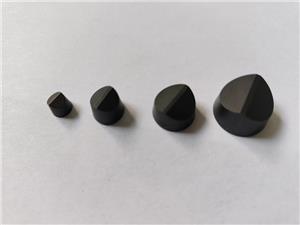
Polycrystalline diamond (PCD) is not just another tool material—it's a game-changer. PCD is created by sintering diamond particles with a metal catalyst under high pressure and temperature, forming a hard, wear-resistant layer on a carbide substrate. The resulting insert combines the hardness of diamond (up to 10,000 HV) with the toughness of carbide. For notching, PCD inserts offer a unique combination of properties that directly address the pain points we just discussed. Let's explore how PCD solves each challenge.
Solution 1: Dramatically Extended Tool Life and Reduced Downtime
PCD notching inserts outlast carbide by a factor of 20 to 50 times, depending on the application. In notching silicon steel, it's not uncommon for PCD inserts to achieve 500,000 to 1,000,000 strokes before needing attention. That means tool changes go from multiple times per shift to once every few weeks or even months. The impact on uptime is transformative. For the motor lamination manufacturer we mentioned earlier, switching to PCD could reduce tool changes from 4-5 per shift to one every 10 shifts. That's a 90% reduction in downtime, freeing up capacity for an additional 2-3 hours of production per day. The cost savings are equally impressive: with PCD, the cost per part from tooling and downtime can drop by 60-80%. Plus, the need for a large inventory of spare inserts diminishes, simplifying logistics and reducing carrying costs.
Solution 2: Superior Edge Quality and Dimensional Consistency
PCD's extreme hardness and wear resistance mean the cutting edge stays sharp far longer. This results in consistently clean cuts with minimal burrs and excellent dimensional stability. In notching, where edge quality is critical, PCD inserts produce notches with burr heights often less than 5 microns, compared to 20-50 microns with carbide. This reduces or eliminates secondary deburring operations, saving time and cost. Moreover, the consistent geometry ensures that every lamination meets specification, reducing scrap and improving motor efficiency. For a manufacturer of high-efficiency motors, this can translate into a 2-3% improvement in motor efficiency, which is a significant competitive advantage. And because PCD inserts maintain their edge, the need for frequent inspection and adjustment is drastically reduced, allowing operators to focus on other tasks.
Solution 3: Lower Total Cost Per Part Despite Higher Initial Price
Yes, a PCD notching insert might cost $200-$500, which is 10 times more than a carbide insert. But when you calculate the total cost per part, PCD wins hands down. Let's revisit our earlier example. A PCD insert costing $300 lasts 800,000 strokes. That's $0.000375 per stroke—75% less than carbide's $0.0015. Downtime cost: with tool changes every 800,000 strokes, the downtime per part is negligible. For 10 million parts, you'd need about 12.5 PCD inserts, costing $3,750. With carbide, you'd need 500 inserts, costing $15,000, plus downtime and labor. The total savings with PCD could be over $100,000 annually for a single press. And that's not counting the quality benefits. In short, PCD notching inserts offer a lower total cost of ownership and a rapid return on investment, often within a few months.
3. Real-World Success: How Companies Transformed Their Notching Operations
Don't just take our word for it. Here are three real-world examples of manufacturers that switched to PCD notching inserts from NANTONG LUCUBRATE MACHINERY TECHNICAL LTD. and reaped the rewards.
Case Study 1: German Precision Motor Manufacturer
Company: Elektromotoren GmbH, based in Munich, Germany.
Challenge: Producing laminations for high-efficiency industrial motors. Carbide inserts lasted only 15,000 strokes, causing frequent downtime and inconsistent burr heights, leading to 5% scrap rate.
Solution: Switched to NANTONG LUCUBRATE's PCD notching inserts with custom geometry for their silicon steel.
Results: Tool life increased to 600,000 strokes—a 40x improvement. Downtime reduced by 85%, scrap rate dropped to 0.5%. Annual savings: €250,000.
Quote: "The PCD inserts from NANTONG LUCUBRATE have been a revelation. Our production line now runs smoothly for weeks without interruption, and the quality is impeccable." – Hans Müller, Production Manager.
Case Study 2: American EV Motor Startup
Company: Volt Motors, a startup in Silicon Valley, USA, specializing in electric vehicle traction motors.
Challenge: Notching ultra-thin electrical steel (0.2 mm) with carbide caused excessive burrs, leading to short circuits in stator windings and a 10% reject rate. Tool life was only 8,000 strokes.
Solution: Implemented NANTONG LUCUBRATE's PCD notching inserts with a specialized edge preparation for thin materials.
Results: Tool life jumped to 500,000 strokes. Burr height reduced from 30 microns to 3 microns. Reject rate plummeted to 0.2%. Production capacity increased by 30%.
Quote: "We were struggling with quality issues that threatened our launch. NANTONG LUCUBRATE's PCD inserts solved our problems overnight. The consistency is unmatched." – Sarah Chen, CTO.
Case Study 3: Japanese Transformer Manufacturer
Company: Tohoku Denki, based in Sendai, Japan, producing transformer cores.
Challenge: Notching grain-oriented electrical steel, which is highly abrasive. Carbide inserts lasted only 5,000 strokes, and tool changes were disrupting production. The cost per part was unsustainable.
Solution: Adopted NANTONG LUCUBRATE's PCD notching inserts with a robust design for high-abrasion materials.
Results: Tool life extended to 400,000 strokes—an 80x improvement. Downtime reduced by 95%. Cost per part decreased by 70%. Annual savings: ¥50 million.
Quote: "We never imagined such a dramatic improvement. NANTONG LUCUBRATE's PCD inserts have paid for themselves many times over." – Kenji Tanaka, Plant Manager.
4. Applications and Partnerships: Where PCD Notching Inserts Shine
PCD notching inserts are not a one-size-fits-all solution, but they excel in applications where abrasive materials, high volume, and tight tolerances are the norm. Key applications include:
- Electric motor and generator laminations: Notching stator and rotor slots in silicon steel, nickel-iron, and other alloys.
- Transformer cores: Notching grain-oriented electrical steel for power and distribution transformers.
- Automotive stamping: Notching components for EV battery trays, motor housings, and sensor parts.
- Appliance manufacturing: Notching laminations for compressors, fans, and pumps.
- Aerospace: Notching specialized alloys for actuators and generators.
NANTONG LUCUBRATE MACHINERY TECHNICAL LTD. has established itself as a trusted partner for manufacturers worldwide. Our PCD notching inserts are used by leading companies in the automotive, energy, and industrial sectors. For example, we supply a major European automotive Tier 1 supplier with custom PCD inserts for their EV motor lines. In Asia, we partner with a top transformer manufacturer to provide inserts that meet their exacting standards. Our collaborations extend to joint development projects where we tailor insert geometry and grade to specific customer needs. By working closely with our clients, we ensure optimal performance and continuous improvement. When you choose NANTONG LUCUBRATE, you're not just buying an insert—you're gaining a partner dedicated to your success.
5. FAQ: What Engineers and Procurement Managers Ask
Q1: Can PCD inserts be used on all types of electrical steel?
A: PCD inserts are highly effective on a wide range of electrical steels, including silicon steel, nickel-iron, and cobalt-iron alloys. However, for materials with high silicon content (e.g., 6.5% Si), which are very abrasive, we recommend a specific PCD grade with optimized diamond particle size. Our engineers can advise on the best grade for your material.
Q2: How do PCD inserts compare to carbide in terms of cost per part?
A: While the initial price of a PCD insert is higher, the cost per part is significantly lower due to extended tool life and reduced downtime. In typical notching applications, PCD can reduce cost per part by 50-80%. A detailed cost analysis usually shows a payback period of less than 3 months.
Q3: Are PCD inserts suitable for high-speed stamping presses?
A: Absolutely. PCD inserts are designed to withstand high speeds and feeds. In fact, they often allow for increased cutting parameters, further boosting productivity. We recommend working with our technical team to optimize speeds and feeds for your specific press and material.
Q4: Can PCD inserts be reground or resharpened?
A: Yes, PCD inserts can be reground, but it requires specialized diamond grinding equipment. We offer regrinding services for our inserts, which can extend their life even further. However, due to the extreme wear resistance, regrinding is less frequent than with carbide.
Q5: What is the lead time for custom PCD notching inserts?
A: For standard inserts, lead time is typically 2-3 weeks. For custom geometries, it's 4-6 weeks, depending on complexity. We work closely with you to ensure timely delivery and can expedite in urgent cases.
6. Conclusion: The Future of Notching is PCD
The evidence is clear: PCD notching inserts from NANTONG LUCUBRATE MACHINERY TECHNICAL LTD. offer a superior solution to the pain points of carbide. With dramatically longer tool life, consistent quality, and lower total cost per part, PCD inserts are the key to unlocking higher productivity and profitability in notching operations. Whether you're producing laminations for EV motors, transformers, or appliances, PCD can give you a competitive edge. Don't let outdated tooling hold you back. Contact our sales engineers today to discuss your application and request a free technical whitepaper on PCD notching technology. Discover how NANTONG LUCUBRATE can help you achieve zero defects and maximum uptime. The future of notching is here—and it's PCD.