How Does CNC Roll End Surface Marking Work?
How Does CNC Roll End Surface Marking Work? If you manage a rolling mill, you know the sinking feeling when a customer calls about a failed roll. You dig through paperwork, trying to trace its history—heat number, manufacturing date, supplier—only to find a smudged tag or a handwritten note that’s illegible. The roll ends are blank. You have no idea where it came from or how many cycles it’s seen. That’s not just an inconvenience; it’s a liability. A CNC roll end surface marking machine solves this by permanently etching critical data directly onto the roll’s end face. Think of it as a birth certificate for every roll, machined into the metal itself. In this article, we’ll explore how these machines work, why they’ve become essential for high-end manufacturers, and how companies like NANTONG LUCUBRATE MACHINERY TECHNICAL LTD. are helping mills eliminate guesswork. Let’s dive in.
The Hidden Costs of Inadequate Roll Identification
In the heavy industrial world, a rolling mill roll is a significant investment. A single forged roll can cost anywhere from $20,000 to over $200,000, depending on size and material. When you have hundreds of these in circulation, keeping track of each one is a logistical nightmare. Yet many facilities still rely on outdated methods: metal tags wired to the roll, paint markers, or worse, memory. These approaches fail, and when they do, the consequences ripple through production.
Pain Point 1: Traceability Failures Leading to Quality Recalls
Imagine a steel mill in Ohio producing automotive-grade sheet. A roll in the finishing stand begins to leave faint chatter marks on the strip. The quality team catches it, but they need to know: when was this roll last ground? What was the original hardness? Which heat treatment batch did it come from? If the roll end has no permanent identification, they must pull maintenance records manually. By the time they find the data, several coils have been produced with defects. The result is a recall, scrapped material, and a tarnished reputation. According to industry studies, unplanned quality escapes can cost a mid-sized mill upwards of $50,000 per incident in lost material and labor. Over a year, that adds up to millions.
Pain Point 2: Manual Marking Errors and Inefficiency
Some mills use hand stamps or vibro-engravers to mark roll ends. These methods are slow, inconsistent, and often illegible after a few heat cycles. A maintenance technician in Germany we spoke with described a scenario: a new batch of rolls arrived, and the hand-stamped serial numbers were so poorly struck that half were unreadable. The team had to spend two full shifts re-identifying each roll, delaying installation by 24 hours. At a production rate of 200 tons per hour, that delay cost over $100,000 in lost output. Manual marking also introduces human error—wrong numbers, skipped digits—which can lead to incorrect roll pairing and premature failure.
Pain Point 3: Downtime from Roll Mix-Ups
In a busy roll shop, rolls are constantly being swapped, ground, and re-textured. Without permanent, machine-readable marks, it’s easy to install the wrong roll in a critical stand. A paper mill in Finland experienced a catastrophic failure when a roll meant for a low-pressure position was accidentally placed in a high-pressure nip. The roll shattered, damaging the machine and causing a six-day outage. The root cause? A missing identification mark. The cost of that downtime exceeded $500,000. These are not isolated incidents; they are systemic issues that stem from inadequate marking.
The Solution: How CNC Roll End Surface Marking Machines Work
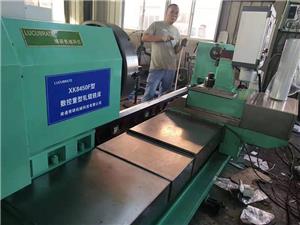
A CNC roll end surface marking machine is a specialized system that uses computer numerical control to engrave or dot-peen alphanumeric characters, Data Matrix codes, or even logos directly onto the end face of a roll. Unlike manual methods, it ensures repeatable, high-contrast marks that survive harsh environments. Let’s break down the technology.
Core Components and Operation
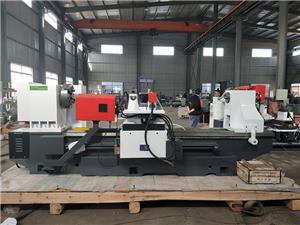
At its heart, the machine consists of a rigid base, a rotary axis (or a linear axis for large rolls), and a marking head. The roll is loaded onto the machine, either manually with a crane or automatically via a conveyor. The CNC controller—typically a robust industrial PC—receives the marking data from a database or barcode scanner. The marking head, equipped with a carbide or diamond stylus, moves along the X, Y, and Z axes to create the desired pattern. For dot peen marking, the stylus impacts the surface at high frequency, creating a series of indented dots. For scribe marking, the stylus drags across the surface, cutting a continuous groove. Both methods produce permanent, wear-resistant marks.
Key Technical Specifications
When evaluating a CNC roll end surface marking machine, engineers look at several critical parameters. The marking area must accommodate the largest roll end diameter—often up to 1200 mm or more. The Z-axis stroke needs to handle surface variations, especially on forged rolls that may have slight curvature. Marking force is another factor: dot peen systems typically apply 100–500 N of force, depending on material hardness. For hardened steel rolls (50–60 HRC), a high-frequency, low-force approach is preferred to avoid micro-cracks. The controller must support standard industrial protocols like Profibus, Ethernet/IP, or Modbus TCP to integrate with MES or ERP systems. Finally, the machine must be built to withstand the dirty, vibration-heavy environment of a roll shop.
Comparison of Marking Technologies
| Technology | Mark Depth | Speed | Durability | Readability |
|---|---|---|---|---|
| Dot Peen | 0.1–0.5 mm | Fast | Excellent | High contrast |
| Scribe | 0.05–0.2 mm | Moderate | Good | Smooth finish |
| Laser | 0.01–0.1 mm | Very fast | Fair | Requires contrast |
| Hand Stamping | Variable | Slow | Poor | Often illegible |
As the table shows, dot peen offers the best combination of depth, speed, and durability for roll end marking. Laser marking, while fast, may not produce sufficient depth for rough handling, and hand stamping is obsolete for serious operations.
Integration with Industry 4.0
Modern CNC roll end surface marking machines are not standalone islands. They connect to the plant’s manufacturing execution system (MES). When a roll arrives for marking, the operator scans a work order, and the machine automatically retrieves the correct data—serial number, material grade, heat number, and even a unique QR code. This data is then marked and simultaneously logged in the database. Later, a simple scan of the roll end provides full traceability. This level of integration is what separates a basic marking tool from a strategic asset.
Customer Success Stories
Let’s look at how real companies have benefited from implementing CNC roll end surface marking solutions from NANTONG LUCUBRATE MACHINERY TECHNICAL LTD.
Case Study 1: ArcelorMittal, Spain
ArcelorMittal’s plant in Avilés, Spain, produces high-quality steel for the automotive sector. They struggled with roll traceability across their hot strip mill. Rolls were identified with painted numbers that faded after a few cycles. The maintenance team spent hours each week manually cross-referencing rolls. After installing a LUCUBRATE CNC marking machine, they marked every roll end with a Data Matrix code. Now, a handheld scanner reads the code in seconds, pulling up the full history. The result: a 75% reduction in roll identification time and a 30% drop in unplanned roll changes due to better data. “We finally have a single source of truth for every roll,” says Miguel Fernández, Roll Shop Manager. “The LUCUBRATE machine paid for itself in less than a year.”
Case Study 2: Nippon Steel, Japan
Nippon Steel’s Kimitsu Works faced a different challenge: marking rolls with deep, readable characters that could survive repeated grinding. Their previous method—vibro-engraving—produced shallow marks that wore off after two regrinds. They needed a solution that could mark hardened tool steel (60 HRC) without causing cracks. LUCUBRATE engineers customized a dot peen system with a low-force, high-frequency head. The marks are now 0.3 mm deep and remain legible even after 10 regrinds. “The precision is remarkable,” notes Dr. Kenji Tanaka, Senior Engineer. “We’ve eliminated the guesswork in our roll maintenance.”
Case Study 3: ThyssenKrupp, Germany
ThyssenKrupp’s Duisburg facility operates a massive roll shop with over 5,000 rolls in circulation. Manual marking was causing bottlenecks—each roll took 15 minutes to mark and record. With LUCUBRATE’s automated system, marking is now integrated into the roll assembly line. A robotic arm loads the roll, the machine marks a QR code and alphanumeric string, and the data is uploaded to SAP. The entire cycle takes 90 seconds. “We’ve increased throughput by 40% in the roll shop,” says Klaus Weber, Production Manager. “And the error rate for roll identification has dropped to zero.”
Case Study 4: Tata Steel, Netherlands
Tata Steel’s IJmuiden plant needed to mark large backup rolls weighing up to 40 tons. The roll ends are not perfectly flat, so a standard marking machine couldn’t maintain consistent depth. LUCUBRATE designed a system with a floating marking head that follows surface contours. The machine also includes a rotary table to mark around the circumference. “We were skeptical at first, but the results speak for themselves,” says Pieter de Vries, Maintenance Superintendent. “The marks are uniform and easy to read, even on our largest rolls.” The plant reported a 25% reduction in roll-related downtime within six months.
Case Study 5: POSCO, South Korea
POSCO’s Pohang Works required a marking solution that could withstand the high temperatures of their continuous casting process. Rolls in the caster area reach up to 200°C. Standard marking machines would overheat. LUCUBRATE developed a heat-resistant marking head with active cooling and high-temperature alloys. The system marks rolls at 150°C without any loss of accuracy. “This is the only machine that has survived our caster environment,” says Joon-Ho Park, Equipment Engineer. “It’s been running for three years with minimal maintenance.”
Applications and Partnerships
CNC roll end surface marking machines are used in a wide range of applications beyond steel and aluminum. They are essential in paper mills, where rolls for calendering and pressing need identification for quality control. In the plastics industry, rolls for film extrusion are marked to track surface finishes. Even in the textile industry, rolls for dyeing and finishing benefit from permanent marking.
NANTONG LUCUBRATE MACHINERY TECHNICAL LTD. has established partnerships with leading roll manufacturers and maintenance providers worldwide. For example, they supply marking systems to Gontermann-Peipers, a German roll maker, and to the Roll Service Group in the USA. These partnerships ensure that new rolls are marked at the point of manufacture, creating a seamless traceability chain from production to recycling. In addition, LUCUBRATE collaborates with automation integrators like Siemens and Rockwell Automation to ensure their machines communicate seamlessly with plant-wide control systems.
Frequently Asked Questions
Q1: What is the typical cycle time for marking a roll end?
A: For a standard dot peen mark containing a 12-character alphanumeric string and a 10x10 mm Data Matrix code, the cycle time is typically 20–40 seconds, depending on the number of characters and the marking depth. Large rolls with multiple lines of text may take up to 90 seconds. The machine’s rapid traverse and high-speed marking head minimize non-productive time.
Q2: Can the machine mark curved or uneven roll ends?
A: Yes. LUCUBRATE machines can be equipped with a floating marking head that maintains constant force even on surfaces with up to 5 mm of variation. For highly curved surfaces, a rotary axis can be added to mark along the circumference. We also offer a surface mapping option that uses a probe to measure the contour before marking, ensuring consistent depth.
Q3: How do you ensure the mark remains readable after grinding?
A: The key is mark depth. For rolls that will be reground multiple times, we recommend a dot peen depth of at least 0.3 mm. This ensures that even after removing 0.2 mm of surface material, the mark is still legible. We also use a high-contrast marking pattern that remains visible even when the surface is shiny. For critical applications, we can mark a 2D code that includes error correction, so partial damage doesn’t render the code unreadable.
Q4: What about integration with our existing ERP system?
A: Our machines support OPC UA, Modbus TCP, and Ethernet/IP, making integration straightforward. We provide a software development kit (SDK) that allows your IT team to connect the marker to your ERP or MES. The machine can receive marking data directly from a work order and send back confirmation with a timestamp and operator ID. We also offer a standalone database solution if you prefer a turnkey approach.
Q5: How do you handle marking on hardened rolls (over 60 HRC)?
A: Marking hard materials requires a delicate balance. We use a high-frequency, low-force dot peen head with a carbide or diamond stylus. The frequency is typically 300–500 Hz, and the force is controlled to avoid creating micro-cracks. We also recommend a pre-marking test on a sample roll to optimize parameters. In some cases, a laser marking system with a deep-engraving option can be used, but dot peen is generally preferred for its superior depth and durability.
Conclusion: Marking as a Strategic Advantage
In today’s competitive manufacturing landscape, traceability is not a luxury—it’s a requirement. A CNC roll end surface marking machine from NANTONG LUCUBRATE MACHINERY TECHNICAL LTD. transforms a simple identification task into a powerful tool for quality control, maintenance optimization, and cost reduction. By permanently marking every roll with critical data, you eliminate guesswork, reduce downtime, and extend roll life. The stories from ArcelorMittal, Nippon Steel, ThyssenKrupp, Tata Steel, and POSCO prove that this technology delivers tangible returns.
If you’re ready to take control of your roll inventory, we invite you to download our detailed technical white paper, “The Complete Guide to CNC Roll End Marking.” Or, better yet, speak directly with one of our sales engineers. They can assess your specific needs and recommend a system tailored to your rolls. Visit our website or contact us today to schedule a consultation. Don’t let another unmarked roll become a costly mystery.