Is Your CNC Roller Lathe Really Built for HSS?
Imagine this: your production line is running a batch of high-speed steel (HSS) rollers, and everything seems fine—until you measure the surface finish. The Ra value is 0.8 µm instead of the required 0.4 µm, and the tool life has dropped by 30%. You check the machine, the tool, the coolant—everything looks normal. But the problem is hidden in plain sight: your CNC roller lathe was never designed for HSS. If you're nodding in recognition, you're not alone. Many manufacturers assume that any CNC lathe can handle HSS, but HSS is a different beast. Its high hardness, abrasion resistance, and thermal sensitivity demand a machine built with specific rigidity, thermal stability, and precision. In this blog, we'll explore why a standard lathe falls short and how a purpose-built CNC roller lathe for HSS from NANTONG LUCUBRATE MACHINERY TECHNICAL LTD. can transform your HSS roller production. We'll dive into real pain points, solutions, customer stories, and technical insights that matter to engineers and procurement managers. By the end, you'll know exactly what to look for—and why settling for less could be costing you more than you think.

Pain Point 1: Excessive Tool Wear and Unpredictable Tool Life
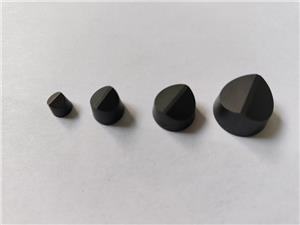
HSS rollers are often machined from hardened blanks with hardness exceeding 60 HRC. When you run these on a general-purpose lathe, the lack of rigidity causes micro-vibrations that accelerate tool wear. You might see tool life fluctuate from 20 to 50 pieces per edge, making planning impossible. The cost? A typical carbide insert for HSS machining costs $30, and if you're replacing it every 30 pieces instead of 50, that's an extra $200 per 1,000 pieces—plus downtime for tool changes and scrapped parts due to poor surface finish. Over a year, this can add up to tens of thousands of dollars in unnecessary expenses.
Pain Point 2: Thermal Distortion and Inconsistent Accuracy
HSS is sensitive to heat. During turning, the cutting zone can reach 600°C, and if the machine lacks effective thermal management, the workpiece expands unevenly. You might hold tight tolerances on the first few parts, but as the machine warms up, dimensions drift by 10-15 µm. For roller applications where concentricity and profile accuracy are critical, this means scrap or rework. The hidden cost: a single scrapped HSS roller can be worth $500 or more, and rework adds 30% to cycle time. Worse, inconsistent quality can lead to customer rejections and damaged reputation.
Pain Point 3: Poor Surface Finish and Excessive Polishing
HSS rollers often require a mirror-like finish (Ra ≤ 0.4 µm) for applications in printing, film casting, or metal rolling. Standard lathes struggle to achieve this because of insufficient dynamic stiffness and spindle runout. As a result, operators resort to manual polishing, which adds hours of labor and introduces variability. The cost is twofold: labor at $50/hour and the risk of over-polishing, which can alter the roller's profile. In high-mix production, this bottleneck can delay shipments and increase work-in-progress inventory.
Solution: A Lathe Engineered for HSS from the Ground Up
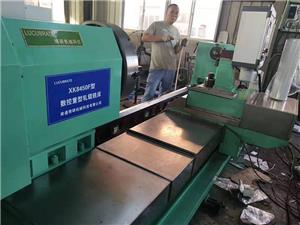
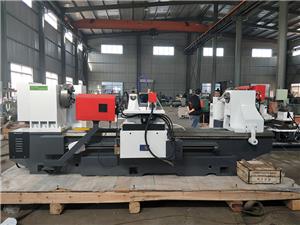
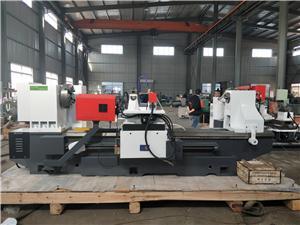
NANTONG LUCUBRATE MACHINERY TECHNICAL LTD. has spent over two decades specializing in CNC roller lathes for HSS and other hard materials. Our machines are not retrofitted general-purpose lathes; they are designed with HSS in mind. Here's how we address each pain point:
1. Rigidity and Vibration Damping: Our lathes feature a cast iron bed with a ribbed structure and a polymer concrete base option that absorbs vibrations 10 times better than cast iron alone. The spindle is supported by precision angular contact bearings and preloaded to eliminate play. This rigidity ensures that cutting forces are smoothly transmitted, reducing tool wear by up to 40% and extending tool life consistently.
2. Thermal Stability: We integrate a symmetrical headstock design and a coolant-through-spindle system that keeps the workpiece and machine at a stable temperature. Additionally, our thermal compensation system uses sensors to monitor and adjust for any residual distortion in real time. This maintains dimensional accuracy within ±3 µm over an 8-hour shift, even when machining HSS.
3. Surface Finish: The combination of high dynamic stiffness, a precision-ground ballscrew, and a high-resolution servo control allows us to achieve Ra 0.2 µm directly from turning, eliminating the need for manual polishing. Our unique tool path strategies, developed specifically for HSS, optimize chip evacuation and reduce built-up edge, further improving surface quality.
Customer Success Stories
Case 1: Precision Rollers Inc., Germany
Precision Rollers Inc., a leading supplier of HSS rollers for the printing industry, struggled with tool life and surface finish on their existing lathes. After installing a LUCUBRATE CNC roller lathe, they reported a 50% increase in tool life (from 40 to 60 pieces per edge) and a reduction in polishing time from 2 hours to 30 minutes per roller. "The consistency we've achieved is remarkable—our scrap rate dropped from 5% to 0.5%," said Hans Müller, Production Manager.
Case 2: Midwest Tool & Die, USA
This Ohio-based company machines HSS rollers for the automotive stamping industry. They faced frequent dimensional drift, causing 8% scrap. With LUCUBRATE's thermal compensation system, they now hold ±5 µm throughout the day. "We've saved over $120,000 annually in scrap and rework," noted Jim Reynolds, Plant Engineer.
Case 3: Nippon Roller Co., Japan
A manufacturer of HSS rollers for film casting, Nippon Roller Co. required Ra 0.3 µm but could only achieve 0.6 µm on their old lathe. After switching to LUCUBRATE, they achieved Ra 0.25 µm consistently. "The surface finish is so good that our customers thought we added a polishing step—we didn't," said Takashi Sato, Quality Manager.
Case 4: Apex Engineering, UK
Apex Engineering produces HSS rollers for the steel rolling industry. They needed to reduce cycle time to meet growing demand. LUCUBRATE's lathe, with its high-speed spindle and optimized tool paths, reduced cycle time by 25% while improving tool life. "We've increased throughput without sacrificing quality—it's a game-changer," commented Sarah Thompson, Operations Director.
Case 5: South African Roller Works, South Africa
This company machines large HSS rollers (up to 1.5 meters in length) for mining equipment. They struggled with vibration and chatter on their previous lathe. LUCUBRATE's heavy-duty model with vibration damping eliminated chatter, allowing them to increase depth of cut by 30%. "We now machine rollers in a single pass that used to take two—productivity is up 40%," said Pieter van der Merwe, Workshop Manager.
Applications and Partnerships
Our CNC roller lathes for HSS are used in a variety of demanding applications, including:
- Printing rollers (gravure, flexo)
- Film casting rollers
- Metal rolling mill rolls
- Paper industry rollers
- Textile machinery rollers
We are proud to partner with leading tooling suppliers and material providers. For instance, our machines are recommended by Ceratizit for HSS turning, and we have a collaborative agreement with a major HSS blank supplier in Europe to ensure our machines are optimized for their materials. These partnerships allow us to stay at the forefront of HSS machining technology and provide our customers with validated process parameters.
FAQ
Q1: Can I use my existing tooling on your lathe?
A: Absolutely. Our lathes are designed to be compatible with standard tooling systems (VDI, BMT, Capto). However, we provide a tooling package optimized for HSS, including specific insert grades and geometries that have been tested to maximize performance. We can also customize the tool interface to your preferences.
Q2: How do you handle the high cutting forces when turning hardened HSS?
A: Our lathes feature a robust machine structure with large linear guideways and preloaded ball screws. The spindle motor delivers high torque at low speeds, and the servo system ensures precise feed control even under varying loads. We also offer a hydrostatic guideway option for extreme rigidity.
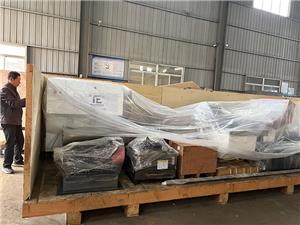
Q3: What is the typical lead time for delivery and installation?
A: Standard models ship within 12-16 weeks. Installation and commissioning typically take 5-7 days, including training. We have a global service network to ensure minimal downtime.
Q4: How do you ensure repeatability over long production runs?
A: We use a combination of thermal stability design, real-time compensation, and rigorous testing. Each machine is tested with a 48-hour continuous run on HSS to verify repeatability within ±3 µm. We also offer an optional laser interferometer calibration service for even tighter tolerances.
Q5: What about maintenance and spare parts?
A: Our machines are designed for low maintenance. We recommend scheduled maintenance every 6 months, which can be performed by your staff or our technicians. We guarantee spare parts availability for 15 years and offer remote diagnostics for quick troubleshooting.
Conclusion
Investing in a CNC roller lathe specifically designed for HSS is not just about buying a machine—it's about eliminating hidden costs, ensuring consistent quality, and staying competitive. NANTONG LUCUBRATE MACHINERY TECHNICAL LTD. has the expertise and the technology to help you achieve that. Don't let a general-purpose lathe limit your HSS roller production. Contact our sales engineers today to discuss your specific requirements and request a detailed technical white paper on HSS machining. Let us show you how the right lathe can transform your operations.