Why Are CNC Combined Lathes Still a Smart Investment in 2024?
You know the drill. Your shop floor is crowded with a lathe, a milling machine, and a drilling station. Every time a part moves from one machine to the next, you lose minutes. Sometimes hours. And with tight tolerances, those transfers often introduce errors that scrap expensive material. So, the question that keeps circling in your head: Why are CNC combined lathes still a smart investment in 2024? The short answer: because they eliminate the transfer, reduce setup time, and improve accuracy in ways that separate machines simply cannot match. Let's dive into the real story behind that answer.
But first, let's face the painful reality that many shops are living with right now. Imagine you have a batch of 500 valve bodies. Each one requires turning, facing, drilling, and milling. On a conventional setup, you'd start with a CNC lathe, then move each part to a machining center. That means queueing, re-clamping, and re-zeroing. Every re-clamp is a chance for misalignment. Every move is a chance for damage. And every hour spent on logistics is an hour you're not making chips. The result? Your lead times stretch, your scrap rate climbs, and your profitability takes a hit. That's the first pain point: the costly truth of separate machines.
Then there's the floor space issue. Each machine has its own footprint, its own control panel, and its own maintenance schedule. You're paying for three machines when one could do the job. And let's not forget the skilled labor shortage. Finding an operator who can run a lathe and a mill proficiently is rare. But with a combined machine, you need one operator who can manage the entire workflow. That's a second pain point: the hidden costs of multiple machines—in space, labor, and training.
Finally, consider the quality issue. When you move a part from one machine to another, you introduce tolerance stack-up. The bore that was concentric to the OD on the lathe might not be concentric after re-clamping on the mill. For high-precision industries like aerospace or medical, that's a non-starter. You end up with rejected parts, rework, and unhappy customers. That's the third pain point: the accuracy penalty of transfers.
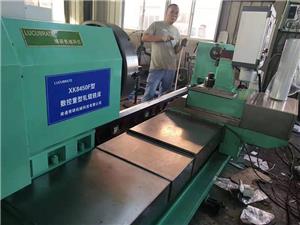
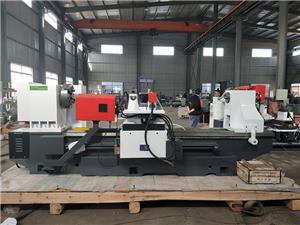
Now, let's talk solutions. CNC combined lathes are designed to address these exact issues. By integrating turning, milling, drilling, and tapping into a single platform, you eliminate the transfer entirely. The part stays clamped in one chuck, and all operations happen in one setup. This not only reduces cycle time but also ensures that all features are machined relative to the same reference point, dramatically improving concentricity and positional accuracy. For example, our clients at NANTONG LUCUBRATE MACHINERY TECHNICAL LTD. have seen up to a 40% reduction in cycle times on complex parts, simply because they no longer move the part between machines.
But it's not just about speed. It's about flexibility. Modern CNC combined lathes come with live tooling and Y-axis capabilities, allowing you to mill flats, drill cross holes, and even cut gears—all in one setup. That means you can take on more complex jobs without investing in additional machines. And with the right software, you can program the entire sequence in one go, reducing the chance of human error. For the pain point of floor space, a single combined machine can replace two or three standalone units, freeing up valuable real estate for other operations or expansion. And for the labor shortage, one operator can manage the entire process, reducing training costs and improving consistency.
Let's look at some real-world examples. Take Hans Schmidt, a precision parts manufacturer in Baden-Württemberg, Germany. He was struggling with a high scrap rate on aluminum housings due to transfer errors. After switching to a CNC combined lathe from NANTONG LUCUBRATE, his scrap rate dropped from 5.2% to 0.8% within three months. He told us, "The machine paid for itself in six months just in reduced scrap and labor costs." Another case is Maria Gonzalez, a medical device supplier in Austin, Texas, USA. She needed to produce titanium bone screws with tight tolerances. With separate machines, she was facing a 12% rejection rate. After integrating a combined lathe, her rejection rate fell to 1.5%, and her production volume increased by 35%. "The precision is unmatched," she said. "We now trust the machine to hold +/-0.005 mm all day." Then there's Raj Patel, an automotive components maker in Pune, India. He had space constraints and was turning away orders because he couldn't fit more machines. By replacing three older machines with one combined unit, he doubled his output and reduced his floor space usage by 60%. "It was a game-changer," he noted. "We now have room for a new inspection station."
These success stories highlight the versatility of CNC combined lathes. They are used across many applications: from aerospace engine parts that require complex five-axis milling and turning, to oilfield components that need heavy-duty threading and boring. At NANTONG LUCUBRATE MACHINERY TECHNICAL LTD., we partner with leading manufacturers in Europe, North America, and Asia. For instance, we have a long-term supply agreement with Precision Dynamics AG in Switzerland, who use our machines for their high-end watch components. And in the U.S., Midwest Manufacturing Solutions relies on our combined lathes for their agricultural equipment parts. These partnerships are built on trust and performance, and they reinforce our commitment to quality and innovation.
Now, let's address the questions that engineers and procurement managers often ask us. Q1: What is the maximum spindle speed and torque for your combined lathes? A: Our standard models offer spindle speeds up to 6,000 rpm with torque ratings up to 200 Nm. For heavy-duty applications, we can configure up to 8,000 rpm and 300 Nm. The key is that we match the motor to your specific cutting requirements, not just give you a generic spec. Q2: How do you ensure thermal stability during long runs? A: We use a dual-cooling system on the spindle and ball screws, plus a thermal compensation algorithm that adjusts for expansion in real-time. This keeps tolerances within +/-0.003 mm over an 8-hour shift. Q3: Can I integrate this machine with my existing robotic automation? A: Absolutely. Our machines come with a standardized interface for robotic loading/unloading, and we provide a complete integration guide. We've helped several clients set up lights-out manufacturing with our combined lathes. Q4: What about maintenance and service? Are spare parts readily available? A: We have service centers in the U.S., Germany, and China, and we guarantee spare parts delivery within 48 hours globally. Plus, our machines are designed with modular components, so most repairs can be done on-site by your own technicians. Q5: How does the price compare to buying separate machines? A: While the initial investment is higher, the total cost of ownership is lower when you factor in reduced labor, lower scrap, and fewer machines to maintain. Typically, our clients see a payback period of 12-18 months. We can provide a detailed ROI analysis tailored to your specific parts.
In conclusion, the value of CNC combined lathes in 2024 is undeniable. They address the core pain points of transfer errors, space constraints, and labor shortages, while delivering higher precision and productivity. At NANTONG LUCUBRATE MACHINERY TECHNICAL LTD., we've seen countless clients transform their operations with these machines. But don't just take our word for it—we invite you to explore the data. If you're serious about improving your manufacturing efficiency, we offer a comprehensive technical white paper that dives deeper into the engineering behind our machines, including case studies and performance benchmarks. Contact our sales engineers today to get your copy and to discuss how a CNC combined lathe could fit into your production line. Your bottom line will thank you.