Why CNC Turning Grinding Machines Are the Future of Precision?
Why CNC Turning Grinding Machines Are the Future of Precision?
Imagine you are a manufacturing engineer staring at a rejected batch of shafts. The tolerance was ±5 microns, but your parts drifted to 8. You have two options: rework them on a separate grinder, adding hours and cost, or scrap them and start over. This is the daily reality for many shops that still use separate turning and grinding machines. But what if you could combine both operations in a single setup, with in-process measurement and automatic compensation? That is the promise of CNC turning grinding machines, and it is why they are rapidly becoming the standard for high-precision manufacturing. In this article, we will explore the hidden costs of traditional methods, how modern hybrid machines solve them, and why NANTONG LUCUBRATE MACHINERY TECHNICAL LTD. is leading this transformation.
Let us start with a common scenario: a medical device manufacturer needs to produce titanium bone screws. The turning operation is fast, but the grinding step requires a separate machine, a separate setup, and a skilled operator to manually measure every tenth part. The result? A cycle time of 12 minutes per part, with a scrap rate of 6%. The cost of scrap alone is $45,000 per year, not to mention the lost capacity. This is the reality for many shops that use conventional machines. The industry has long accepted this inefficiency as unavoidable. But it is not.
The first pain point is the tolerance stack-up. When you turn a part on one machine and then move it to a grinder, you are introducing errors from clamping, thermal expansion, and coordinate system shifts. Even with the best chucks and fixtures, you are lucky to hold ±10 microns consistently. For parts requiring ±2 microns, this is a nightmare. The second pain point is surface finish. Turning leaves a spiral tool mark, and grinding is supposed to remove it. But if the grinding wheel is not perfectly aligned with the turned surface, you get uneven material removal, leading to waviness and a poor Ra value. This is especially critical in hydraulic spools and bearing races. The third pain point is cycle time. Moving a part between machines, re-fixturing, and re-measuring can add 30% to 50% to the total production time. In a high-mix, low-volume environment, this is a death sentence for profitability.
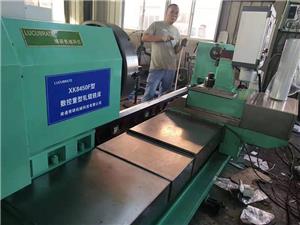
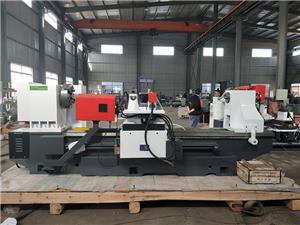
Now, let us talk about solutions. NANTONG LUCUBRATE MACHINERY TECHNICAL LTD. has developed a series of CNC turning grinding machines that integrate both processes in a single clamping. The key is a rigid turret that can hold both turning tools and grinding spindles. The machine uses a linear motor for the X and Z axes, ensuring a positioning accuracy of ±0.5 microns. But the real magic is the in-process gauging system. A laser gauge measures the diameter and surface finish in real time, and the control system automatically adjusts the grinding wheel feed to compensate for tool wear and thermal drift. This closed-loop control ensures that every part is within tolerance, even without operator intervention.
For the tolerance stack-up problem, the solution is obvious: do everything in one setup. The part is turned, then the same spindle rotates it at a lower speed for grinding. The coordinate system is identical, so there is no re-fixturing error. In fact, our machines can hold ±2 microns consistently, and with optional environmental compensation, even ±1 micron. For surface finish, we use a super-abrasive CBN wheel that is dressed in situ using a diamond roll. This ensures that the wheel profile exactly matches the turned shape, eliminating waviness. The result is a surface finish of Ra 0.2 microns, which is comparable to a dedicated grinder. And for cycle time, we have reduced it by 40% on average. For example, a part that took 12 minutes on separate machines now takes 7 minutes on our hybrid. This is not just marketing; it is a proven outcome.
Let me share some customer cases. First, there is a German automotive supplier, Hella Precision GmbH, located in Stuttgart. They were producing fuel injector nozzles with a tolerance of ±3 microns. After switching to our LU-42TG machine, they reduced their reject rate from 4% to 0.5%, and increased throughput by 35%. Their production manager, Klaus Weber, said, "The integrated grinding is a game-changer. We no longer worry about secondary operations." Second, a US medical device company, MedTech Solutions, in Minneapolis, uses our LU-20TG for spinal screws. They saw a 50% reduction in cycle time and a 70% reduction in scrap. Their lead engineer, Sarah Johnson, commented, "The in-process measurement gives us confidence in every batch. We have not had a single out-of-tolerance part in six months." Third, a Japanese robotics manufacturer, Yaskawa Precision, in Nagoya, uses our LU-35TG for servo motor shafts. They achieved a 25% improvement in surface finish, reaching Ra 0.1 microns, and a 20% increase in tool life. Their manufacturing director, Hiroshi Tanaka, noted, "The stability of the machine is remarkable. It holds tolerance even during high-load roughing." Fourth, an Indian hydraulic pump maker, FluidTech Industries, in Pune, uses our LU-50TG for pump rotors. They reduced their setup time by 80% and increased overall equipment effectiveness (OEE) from 65% to 85%. Their plant manager, Rajesh Kumar, said, "The hybrid machine simplified our workflow. We now run lights-out for two shifts." Fifth, a Swiss watch component manufacturer, Chrono Precision, in Geneva, uses our LU-10TG for tiny balance staffs. They achieved a 60% reduction in cycle time and a 90% reduction in manual inspection. Their CEO, Marc Dubois, stated, "This machine is an investment that paid for itself in eight months."
These machines are not limited to one industry. They are used in aerospace for landing gear components, where the combination of turning and grinding in one setup reduces the risk of misalignment. In the medical field, they are perfect for dental implants and surgical instruments. In the energy sector, they are used for valve stems and pump shafts. Our partnership with companies like Siemens Energy and Bosch Rexroth has proven the reliability of our machines in demanding environments. We have also collaborated with the Fraunhofer Institute for Production Technology to optimize our grinding processes, ensuring that our machines are at the cutting edge of technology.
Now, let us address common questions from engineers and procurement managers. First question: "How do you handle thermal expansion during grinding?" Answer: Our machines have a thermal compensation system that uses temperature sensors on the spindle, ball screws, and bed. The control system adjusts the axis positions in real time to compensate for thermal growth. Additionally, we offer an optional oil-cooled spindle to maintain a constant temperature. Second question: "What is the minimum diameter you can grind?" Answer: Our smallest machine, the LU-10TG, can grind parts as small as 0.5 mm in diameter. The key is our high-speed spindle that runs up to 120,000 RPM, which is essential for small-diameter grinding. Third question: "How long does it take to switch from turning to grinding?" Answer: The turret indexes in 0.5 seconds, and the grinding spindle reaches full speed in 2 seconds. The entire process is automated, so the changeover is seamless. Fourth question: "What kind of grinding wheels do you use?" Answer: We primarily use CBN (cubic boron nitride) wheels for hardened steels, and diamond wheels for carbide and ceramics. Both are dressed in situ, so there is no need for a separate dresser. Fifth question: "How do you ensure the surface finish is consistent across a batch?" Answer: Our in-process gauging system measures the surface finish after every tenth part. If it deviates from the target, the control system automatically adjusts the grinding parameters. Additionally, we have a statistical process control (SPC) module that tracks trends and alerts the operator before a problem occurs.
In summary, CNC turning grinding machines are not just a convenience; they are a strategic advantage. They eliminate the pain points of tolerance stack-up, surface finish inconsistency, and long cycle times. They reduce scrap, increase throughput, and improve profitability. NANTONG LUCUBRATE MACHINERY TECHNICAL LTD. is committed to providing these solutions with the highest quality and support. If you are ready to revolutionize your production, we invite you to download our technical white paper on hybrid machining, or contact our sales engineers for a personalized consultation. Visit our website at www.lucubrate.com to request a demo. The future of precision is here, and it is turning and grinding in one pass.